Grisons launches its third wolf cull, even though the number of livestock killed is falling
The FOEN has authorised kills in twelve packs and the complete removal of the Calderas pack, while three days earlier the canton was celebrating offspring that merely fill up territories shot empty.
The FOEN has approved the applications submitted by the canton of Grisons. From 1 September 2026, up to two thirds of the young animals may be killed in twelve packs, and the Calderas pack may even be wiped out entirely. This is happening at a time when livestock killings have more than halved. The figures expose proactive regulation for what it is: killing in advance, just in case.
The state of the rulings
On 26 August 2026, the Federal Office for the Environment approved the applications submitted by the canton of Grisons for the proactive regulation of wolves in the coming period. This was announced on 28 August by the Grisons Office for Hunting and Fishing (AJF). Twelve packs are affected. In all packs with confirmed offspring, up to two thirds of the confirmed young animals may be shot. In four further packs, regulation will likewise be possible as soon as this year's offspring have been documented.
In addition, the canton has applied for the complete removal of the Calderas pack in central Grisons. The AJF justifies this on the grounds that this pack has killed livestock in «herds protected in a professionally appropriate manner». The proactive killing period runs from 1 September 2026 to 31 January 2027. Grisons' recreational hunters will be involved during the high hunt and the special hunt. Grisons is thus continuing the practice it has followed since 2023.
The contradiction that nobody explains
The decisive point lies in a single figure that the AJF itself cites. Livestock killings have more than halved in 2026. By the end of July, wolves had killed 30 head of livestock in the canton, compared with 68 in the same period the previous year. The decline follows the nationwide trend.
Fewer losses, the same kill logic. When the number of kills by wolves falls but the quota is still exhausted to the maximum, then shooting is no longer the answer to a problem. It has become routine. This is precisely the core of proactive regulation: animals are not killed because damage has occurred, but before any could occur. A measure whose justification weakens while its scope remains the same has lost its steering function.
Three days earlier: celebrated offspring that merely fill the gaps
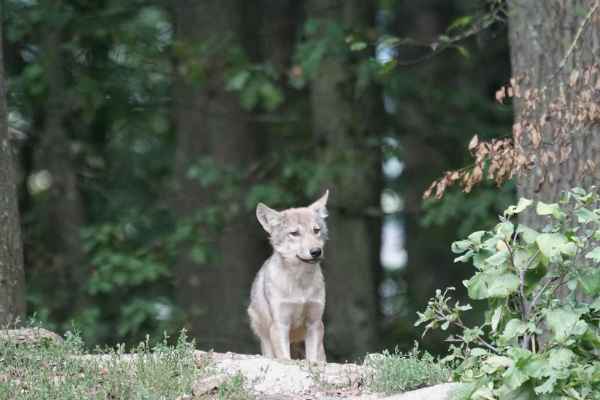
The cynicism of this authorisation only becomes clear in connection with an announcement made a few days earlier. On 25 August the canton celebrated the confirmation of three «new» packs, Heinzenberg, Giarsinom and Madlain, with at least ten cubs. Arithmetically, 13 packs are therefore considered confirmed. What sounds like growth is in truth mere replacement: the three packs occupy exactly the territories of those packs that the kills had previously wiped out. Heinzenberg takes over the area of the former Beverin pack, Giarsinom that of the extinguished Fuorn pack, and Madlain the territory of the Sinestra pack, which was removed in its entirety in November 2025.
This closes a cycle that lays bare the whole absurdity of the practice. First pack structures are destroyed, then immigrating wolves reliably recolonise the shot-out territories, and finally the office treats precisely this recolonisation as a fresh starting point for the next round of killing. The wolves' capacity to compensate, actually proof that nature repairs what recreational hunting destroys, is thus reinterpreted as legitimation for further killing. The offspring of 25 August and the kill authorisation of 28 August are two sides of the same coin.
Calderas: the same family, second round
The Calderas pack is particularly revealing. It was already subject to regulation in the 2025/26 period, when two thirds of its young were released for shooting. Now the very same wolf family is to be wiped out completely. A pack that is decimated over two consecutive periods and finally removed altogether illustrates what the Verein Wolfshirten calls the collective punishment of entire wolf families. It is not the behaviour of an individual animal that is penalised, but the continued existence of a social group that is prevented.
The bigger picture refutes the success story
The authorities sell the proactive massacre as an instrument that slows the wolf's spread. The federal figures paint a different picture. Across three regulation periods, 226 wolves were killed Switzerland-wide, spread over 57, 92 and 77 animals. Nevertheless, the number of packs continued to rise: from 35 after 2023/24 to 36 after 2024/25 and finally 40 after 2025/26.
More kills, more packs. Anyone who calls a measure a success when its stated goal is demonstrably missed is not pursuing wildlife policy but symbolic politics. Grisons was consistently at the forefront. In the past period, the Grisons authorities killed 35 wolves, more than any other canton.
The pattern behind the regulation
The case fits a familiar pattern. As soon as animals are killed, the authorities' actions are deemed a success. Whether an ecological benefit has been demonstrated, whether damage actually declines or whether the animals killed even belonged to the targeted packs recedes into the background. The kill itself becomes the metric.
Yet the most effective preventive measure remains the same as ever: herd protection. Instead of expanding it consistently, politicians shift the focus to kills, because these provide a simple narrative. Capacity to act, control, decisive intervention. Prevention and coexistence are laborious and politically harder to exploit. How deeply this logic runs through state-organised recreational hunting is documented in our dossier An introduction to hunting criticism.
What would be needed
As long as killing counts as success and natural order is confused with human control, wolf regulation remains a political project without any expert foundation. A factual debate would require a moratorium on proactive kills until robust long-term data are available. Without a clear definition of objectives, transparent monitoring of effectiveness and priority for non-lethal measures, the start of the third regulation period is what the previous ones already were: permanent intervention instead of nature conservation. Those who suffer are not only the predators, but also the credibility of state wildlife policy.
All the background in the dossier «The wolf in Switzerland: facts, politics and the limits of hunting».

All articles are written by IG Wild beim Wild as well as by external co-authors. Research, structuring and editorial processes may be supported by AI-assisted tools.
Support our work
With your donation you help to protect animals and to make their voices heard.
Donate now →