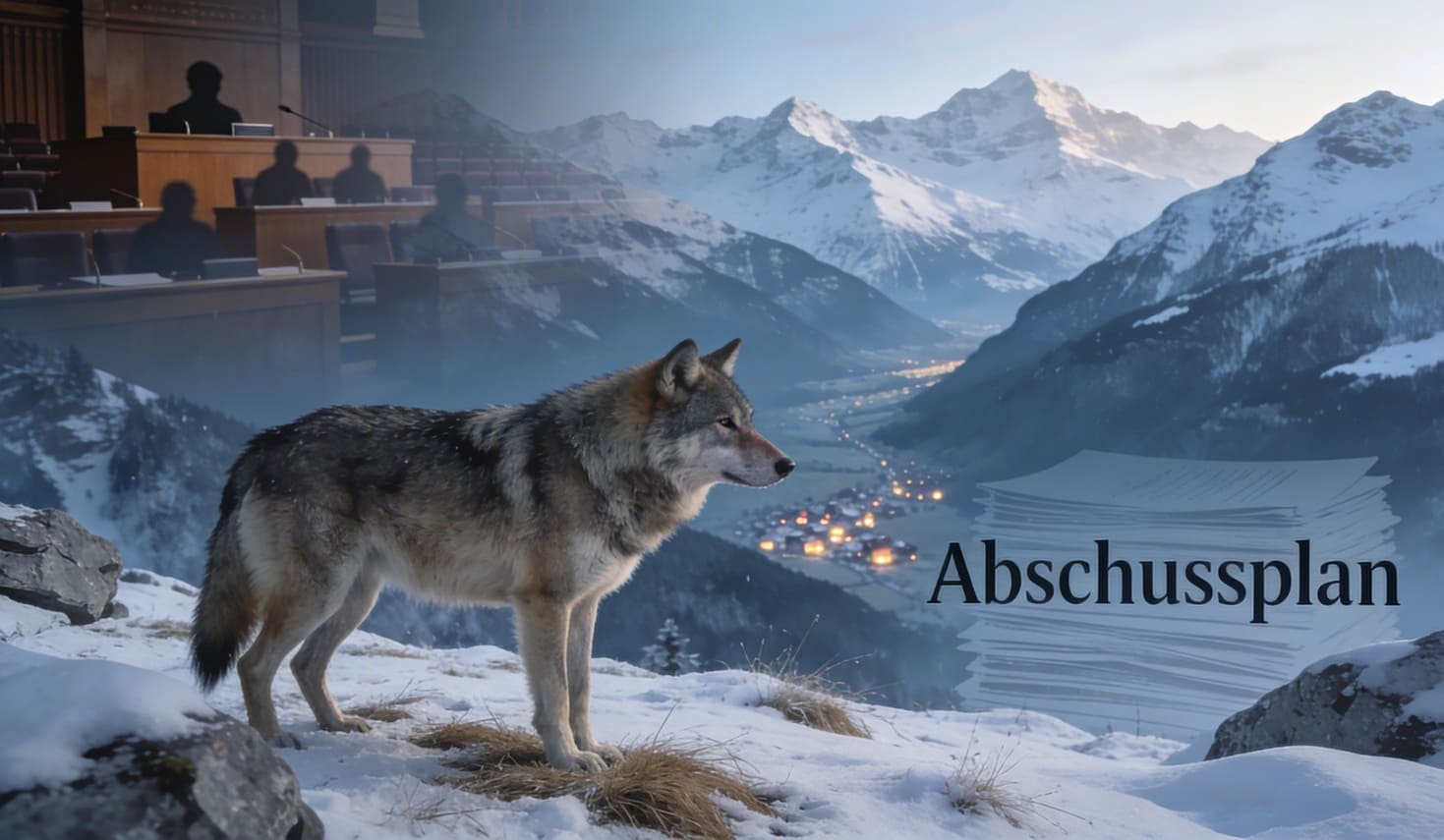
Wolf mismanagement rages in Graubünden
No other canton in Switzerland shoots as many wolves as Graubünden. Yet livestock depredation is suddenly on the rise again following the proactive wolf massacre. Exactly what serious experts predicted based on studies is now coming to pass.


«In Reserve»
Following a peak in 2022 with 1,789 wolf kills (GR 517), wolf depredation incidents had already decreased by 40% (1,051) across Switzerland as a whole in 2023, and in Graubünden by nearly 50% (267) — and this before preventive regulation began on 1 December 2023.
Preventive regulation therefore cannot be credited with the reduction in depredation incidents. This is solely attributable to improved herd protection measures.
Proactive culling of entirely unremarkable wolves and their pups is fundamentally not legal under the Berne Convention.
Between 2022 and 2024, a marked decline in confirmed livestock depredation incidents in Graubünden can be observed (from 517 in 2022 → 267 in 2023 → 213 in 2024). Specialist agencies and NGOs attribute this to enhanced herd protection measures.
Graubünden is at the centre of Swiss wolf mismanagement. During the most recent regulation period from September 2024 to January 2025, 48 wolves were killed in the canton — more than anywhere else in Switzerland. Yet by the end of August 2025, authorities had already recorded 167 livestock depredation incidents, 25 more than the previous year. An unusually high number of applications have once again been submitted to the federal authorities for the new regulation period: young animals in 17 packs are to be shot, with one pack to be wiped out entirely. The wolf population in Graubünden has grown in 2025 compared to the previous year, while the number of livestock depredation incidents is rising again.
Christina Steiner, president of the association CHWolf, assesses the situation: She criticizes Graubünden for exploiting the new hunting ordinance “to the utmost” and shooting into inconspicuous packs as well. This could destroy the pack structure and create space for lone wolves, which are particularly prone to preying on unprotected sheep. A Latvian study demonstrates that indiscriminate culling is no long-term solution. Her organization therefore focuses on livestock protection and supports alpine farms with fencing, livestock guardian dogs, and advisory services.
National Park Director Ruedi Haller also sees culling alone as no solution. He refers to the case of the Fuorn pack in the Lower Engadine: after the authorities wiped it out despite protests, a sudden surge of sheep kills occurred.
Experts and studies have warned that culling, particularly of young animals or entire packs, could disrupt pack structure, leading to unexpected behavior (e.g. lone wolves more likely to attack livestock). This could not improve the situation but worsen it.
The fronts remain hardened. Graubünden Farmers’ Association President Thomas Roffler (SVP) plans to submit two motions in October together with the SVP parliamentary group in the Graubünden Grand Council: wolf hunting is to be extended in terms of time and more recreational hunters are to be involved. Steiner, by contrast, calls for targeted culling only where livestock are killed despite consistent herd protection measures.
Instead of enforcing consistent livestock protection, the SVP declares the rifle the “solution.” This is not protection but capitulation. It is submission to the farming lobby, which exploits the fairy tale of the “big bad wolf” to make politics at the expense of the most vulnerable — thereby squandering the credibility of the rule of law and of science. Wolf culls are not a reliable means of protecting livestock. The risk of counterproductive effects is scientifically proven.
The hunting on wolf cubs is fundamentally prohibited under the Bern Convention. Switzerland has no official authorization to hunt wolf cubs. Also under discussion is whether Switzerland's gradual relaxation of protections is compatible with the Convention's objectives. Under the Bern Convention, proactive culling of wolves is likewise illegal. The Standing Committee of the Bern Convention regards the Swiss regulation with minimum numbers and preventive culls as concerning and potentially non-compliant with the Convention.
Hunting wolves is fundamentally prohibited — except in cases of explicitly authorized exceptions.Wolves may only be culled if certain conditions are met, such as repeated attacks on livestock or when an animal becomes dangerous to humans, which certainly does not apply to wolf cubs. Switzerland may only hunt wolves with federal authorization and in compliance with hunting legislation, ordinances, international law, and livestock protection requirements.
Canton → Application to the federal government (FOEN) → Review under the Hunting Ordinance + Bern Convention → Federal authorization → Notification to the Council of Europe → Execution by game wardens → Oversight by courts/associations.
A cull carried out purely “on reserve” — without a concrete damage situation and without having first tried all other measures — is not permissible under the Bern Convention. Juvenile animals are afforded special protection under the Bern Convention; proactive culls without concrete harm are considered inadmissible.
Wolf populations (as well as fox populations) self-regulate beyond a certain number within a given area and cease to grow further, instead expanding across national borders. Regulatory mechanisms include increased territorial conflicts, higher juvenile mortality, and limited food availability.
On 16 November 2024, a game warden from the Office for Hunting and Nonsense in Graubünden additionally killed three equally protected lynxes during the wolf massacre hunt.
Dossier: Wolf Switzerland: Facts, Politics, and the Limits of Hunting
Further Articles
- Swiss Meadows Losing Biodiversity at an Alarming Rate
- When Sheep, Cattle and Co. Occupy Wildlife Habitat
- Swiss Animal Protection Criticizes Planned Wolf Culls as a Threat to Pack Structures and Livestock Protection
- Wolf Incompetence Rages in Graubünden
- Val Fex: When the Livestock Protection Concept Has More Holes Than the Fence
- Culling Instead of Protection — Switzerland on the Path to Silent Wolf Extermination
- Communication failure at the Office for Hunting and Fishing of Graubünden
- Illegal wolf hunting in Switzerland
- Wolf cubs in Switzerland under fire
- Switzerland sells wolf massacre as success
- Sloppiness in the office of Katrin Schneeberger
- Livestock grazing alters soil, plant and insect populations
- The insane hunt for wolves in Switzerland
- The truth about sheep mortality in Switzerland: causes and statistics
- Wolf culls in Switzerland: concerns about party politician Albert Rösti
- Let us stop the SVP's destructive rage
- Participatory campaign: An appeal for change in Switzerland
- 200 environmental organizations from 6 continents call on the Swiss government: Stop the wolf cull
- Federal Council faces harsh criticism from wolf experts
- The consequences of controversial wolf management in Switzerland
- Wolf: Federal Councillor Rösti (SVP) bypasses law and order
- Es Burebüebli mahn i nit
- Are FOEN and hunting administrations still working diligently?
- Federal Councillor Albert Rösti tramples the will of the people
- The consequences of controversial wolf management in Switzerland
- Too many sheep are harming biodiversity
- Agricultural use destroys alpine meadows
- Livestock losses despite herd protection — how is that possible?
- The rotten apple in the St. Gallen hunting administration
- Pro Natura demands a comprehensive strategy for alpine sheep farming
- According to Agridea study, herd protection with dogs works well
- Thanks to herd protection, wolves in Switzerland kill fewer livestock
- Farmers treat fields as disposal sites
- Biomass of wildlife
- On sheep farmers and vague authorities
- The double standards of wolf opponents
More on the subject of recreational hunting: In our dossiers on recreational hunting gather fact-checks, analyses and background reports. The scientific evidence is presented in the overview Studies on the Effects of Recreational Hunting.
The position of IG Wild beim Wild: IG Wild beim Wild rejects recreational hunting. Our model is the canton of Geneva, which has managed without recreational hunting since 1974: without hunting seasons, without hunting dogs, without driven hunts, without high seats, without the animal cruelty and crime that go hand in hand with hunting season elsewhere. What has worked there for over fifty years disproves every position paper by JagdSchweiz. An association that bases its policy on claims it refutes in its own documents is not a professional organisation, but a factory for misinformation.