Wolf Pups in Switzerland Under Fire
The proactive wolf regulation is based neither on scientific facts nor on knowledge about wolves, but on loud propaganda.

Federal Councillor Albert Rösti and his environmental department were warned on multiple occasions — not only by the Department of Justice — that the culling policy under the new hunting ordinance is incompatible with the Bern Convention. To no avail.
Using flimsy political arguments, without prior consultation and “against the will of the people,” a massive relaxation of wolf protection was enacted in Switzerland.
The wolf is still a protected species. This means that wolves may not be killed, captured, kept or disturbed without good reason, especially not during the rearing period; and their breeding sites may not be damaged or destroyed.
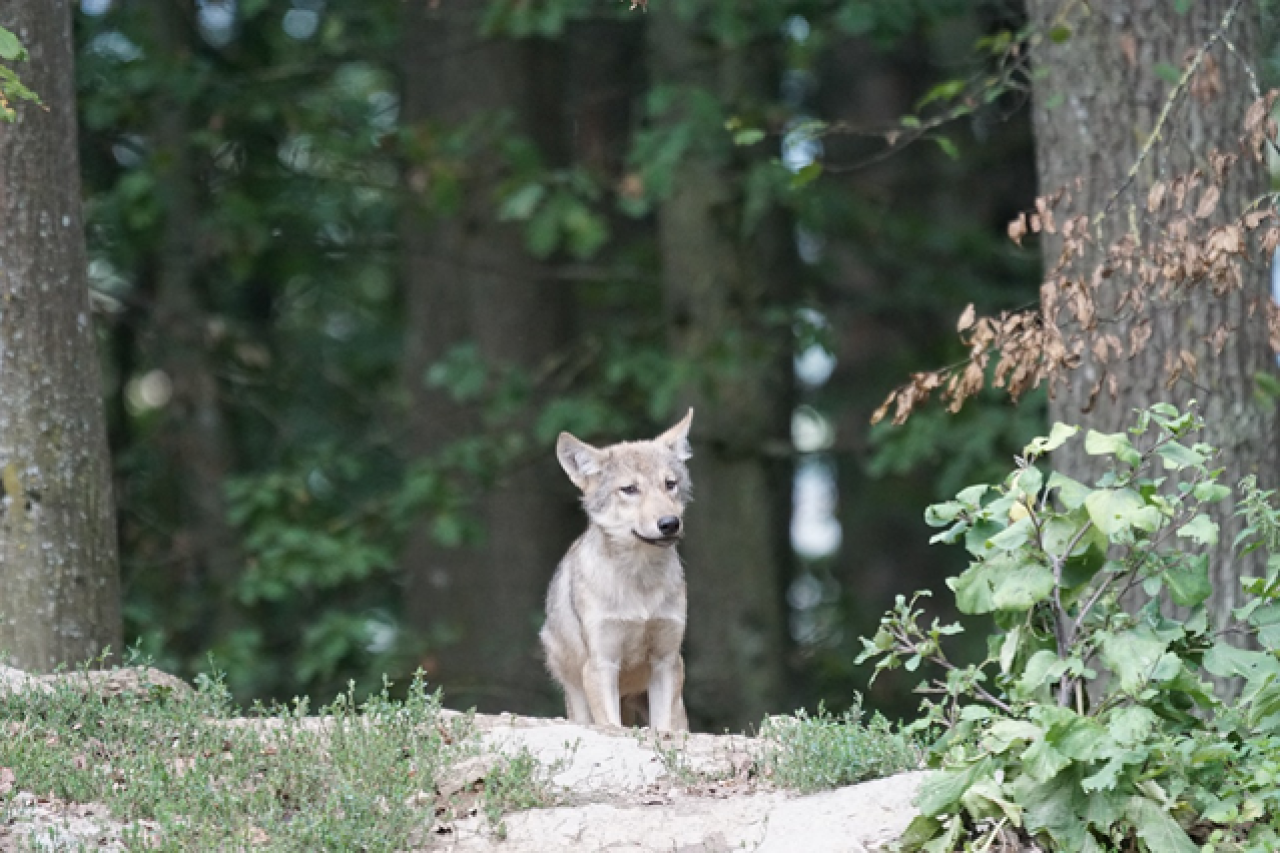
In 2025, there is an intention, in the canton of Graubünden to cross an additional red line in the “regulation” of innocent wolves. The Office for Hunting and Nonsense, led by Adrian Arquint, Marcel Michel and Arno Puorger, plans from 1 September onwards, within the framework of the so-called ‘basic regulation’, with the support of hobby hunters, to kill two thirds of this year’s wolf pups, who bear no guilt whatsoever — their only offence consists of having been born and being classified as a “two-thirds quota” — In the worst case, this could result in the deaths of dozens of wolf pups during the massacre!
The canton's stated intention and reasoning make clear that the proactive wolf regulation has the sole objective of reducing the wolf population across the canton in order to minimize conflict potential. The canton is therefore not responding situationally or selectively to problems or damages that could qualify as justified exceptions within the meaning of the Bern Convention, but rather seeks to decimate the population broadly and on a large scale, whatever the cost. What is being sold as regulation is an ideologically motivated elimination project designed to displace wolves, which are so vital to the ecosystem. This serves the interests of a livestock farming industry that has long since spiraled out of balance and proportion, with its harmful consequences for flora and fauna in the alpine region.
It is internationally condemned and ethically indefensible to kill wolf cubs. Switzerland is also repeatedly criticized by the Bern Convention for its wolf policy. Furthermore, the newly introduced term ‘basic regulation’ is neither defined nor mentioned in the hunting act or the hunting ordinance.
The deplorable hunting misconduct in the canton of Graubünden is well known far beyond the cantonal borders and into other countries. Hunting in Graubünden is quite simply highly criminal, characterized by violence, a lack of scientific grounding, and animal cruelty. Our legal system has simply not yet advanced to the point of addressing this in criminal law. Every year, more than 1’000 administrative fines are issued against Graubünden's hobby hunters and dozens of complaints are filed. Furthermore, according to studies on wounded-game tracking and comparisons with wildlife wardens, these perpetrators of violence are the most incompetent marksmen in the country. The canton of Graubünden is regarded as a showcase model of ignorance, manipulation, and incompetence — and not only in wolf management.
Hobby hunters embody speciesism. Speciesism is comparable to racism and sexism, and it is not a culture or tradition.
Natural regulation by predators such as the wolf, lynx, or fox occurs selectively, dynamically, and in a behaviorally and ecologically adapted manner — a complex interplay that sadistic culling plans drawn up by an office in Bern or Graubünden contaminated with perpetrators of violence can never replicate. Recreational hunting does not replace ecological balance. The practice of decimation hunting is a prime example of the devaluation of nature under the guise of sustainable management.
It must be taken into account that the wolf today, in parts of the cantons Valais and Graubünden, as well as the western Vaud Jura, are extensively populated. Wolf populations in this situation regulate themselves through their territoriality — where one pack lives, no new one settles. In the view of science, a flattening of population growth can be expected there even without regulation.
Thanks to the improved herd protection the number of kills has also declined massively by the end of September 2024. In the canton of Graubünden by 35% and in the canton of Valais by 15%. In 2023, the number of kills across Switzerland had already fallen by 40% compared to 2022. In 2024 as well, most kills occurred in unprotected or insufficiently protected herds. The decline in livestock losses had already begun in 2023, before wolves were first shot preventively. Ultimately, the decline in predation is above all the result of increased herd protection from 2022 onwards, when a significant increase in funding for protective measures was decided for the first time.
A similar situation can be observed in Brandenburg, Germany. 58 wolf packs live in Brandenburg — more than in any other state. In Brandenburg, the increasing number of wolves has led to a decline in deer populations, particularly red deer and fallow deer, which benefits the forest and ecosystem. Hobby hunters in Oder-Spree shot only 128 red deer in 2024/25; previously the number was 800.
Petition: Stop the decimation of wolf pups
Further articles
- Swiss meadows are losing biodiversity at a massive rate
- When sheep, cattle and others occupy wildlife habitat
- Swiss animal protection agency criticizes planned wolf culls as a threat to pack structures and herd protection
- In Graubünden, wolf incompetence rages
- Val Fex: When the herd protection concept has more holes than the fence
- Shooting instead of protection — Switzerland on the path to silent wolf extermination
- Communication failure at the Office for Hunting and Fishing Graubünden
- Illegal wolf hunting in Switzerland
- Wolf pups in Switzerland under crossfire
- Switzerland sells massacre of wolves as a success
- Sloppiness in the office of Katrin Schneeberger
- Livestock grazing alters the soil, plants and insect populations
- The insane hunt for wolves in Switzerland
- The truth about sheep mortality in Switzerland: causes and statistics
- Wolf culls in Switzerland: concern over party politician Albert Rösti
- Let us stop the destructive rage of the SVP
- Participation Campaign: An Appeal for Change in Switzerland
- 200 environmental organizations from 6 continents call on the Swiss government: Stop the wolf culling
- Federal Council faces sharp criticism from wolf experts
- The consequences of controversial wolf management in Switzerland
- Wolf: Federal Councillor Rösti (SVP) circumvents law and order
- Es Burebüebli mahn i nit
- Are FOEN and the cantonal hunting administrations still working rigorously?
- Federal Councillor Albert Rösti tramples the will of the people
- The consequences of controversial wolf management in Switzerland
- Too many sheep harm biodiversity
- Agricultural use destroys alpine meadows
- Livestock kills despite herd protection — how is that possible?
- The rotten apple in the St. Gallen hunting administration
- Pro Natura calls for a comprehensive strategy for summer sheep grazing
- According to Agridea study, herd protection with dogs works well
- Thanks to herd protection, wolves kill fewer livestock in Switzerland
- Farmers treat fields as waste disposal sites
- Biomass of wildlife
- On sheep farmers and vague authorities
- The double standards of wolf opponents