Wildlife Crossings: Caution at the Change of Clocks
The risk of wildlife accidents increases significantly in autumn and spring.

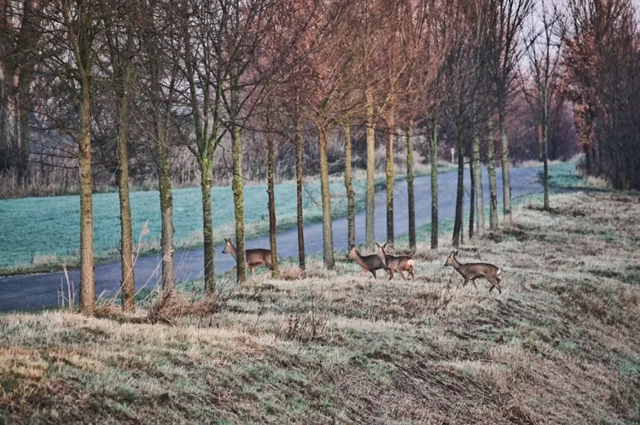
After the switch from summer to winter time and vice versa, rush hour traffic once again largely falls during twilight hours. The danger of failing to spot animals crossing the road in time is particularly elevated on rural roads.
In 2022 alone, approximately 8’898 roe deer, 348 red deer, 22 chamois and 677 wild boar lost their lives in road traffic in Switzerland, as shown by the Federal Hunting Statistics . Those living in the cantons of Appenzell Innerrhoden, Jura, Fribourg or Graubünden in particular should be especially alert to animals crossing the road. The probability of colliding with an animal is considerably higher in these regions than in other Swiss cantons. However, many other animals — such as free-roaming cats, hedgehogs, martens, and songbirds and birds of prey — are also at risk. To prevent harm to both people and animals, cautious driving and appropriate speed are above all essential.

Drivers know the situation: darkness falling early, poor weather conditions — and suddenly a roe deer is standing in the road, caught in the headlights at a wildlife crossing. Before the driver can react, the accident has already happened. A roe deer weighing 20 kilograms has an impact weight of almost half a tonne in a collision at 100 km/h. At that point, a roe deer becomes a rhinoceros and a wild boar becomes an elephant. The animal is injured or dead, the vehicle is damaged, and in the worst case there are casualties. Millions of wild animals die every year in road traffic. The number of hedgehogs run over alone is likely to run into the hundreds of thousands.
Roe deer and red deer are at risk because they consistently travel from their resting places to forage on grassland, rapeseed and grain fields after gathering in groups during winter. Residues of road salt along roadside strips can also lure them to roads, as it represents a high-value dietary supplement for wildlife.
Motorists have the power to counteract this animal welfare problem and reduce the alarmingly high number of animal casualties through defensive and cautious driving. Motorists should reduce their speed, especially in forested areas and on rural roads, to 60 and at most 80 km/h, particularly at night, dusk and in fog. This gives the attentive, slow-driving motorist the opportunity to brake in time, sound the horn and dim the headlights when wildlife crosses, so that the animal can find an escape route. In full beam, wildlife freezes physically due to the cone of light and cannot flee. Always keep an eye on the edges of forests and roads and be ready to brake — that is the guiding principle. An animal rarely comes alone. Wild boar are often travelling with their entire families. If a wild animal appears in the headlights, immediately dip the beams, brake and sound the horn. If a collision is unavoidable, the driver should hold the steering wheel firmly and drive straight ahead. Evasive manoeuvres can have even worse consequences — including for other road users.
Until the end of the 19th century, people in Europe still lived in accordance with the solar day, with the local church clock providing orientation. With the advent of the railway, a uniform time zone of Central European Time was introduced in 1893. The practice of adjusting clocks during the summer months, which existed in the German Empire and Austria-Hungary from 1916 onwards with interruptions, was adopted by the EC countries following the oil crisis from 1977 onwards, and by Switzerland in 1981. Today, clocks are adjusted twice a year not only in the EU but also in 38 other countries.
It would be better to retain winter time throughout the entire year.
Calls for the abolition of summer time are, however, growing. The intended energy-saving effect does not exist at all, as the German Federal Environment Agency recently demonstrated. In Russia and Turkey, clocks have no longer been changed since 2012. In the EU, however, the debate has subsided again since a discussion in 2007.
Early risers, so-called larks, have an easier time adjusting to daylight saving time than night owls, while the opposite is true when switching back to standard time. Owls have a particularly difficult time. This sleep type goes to bed late and sleeps correspondingly longer. The internal clock, however, continues to run on standard time (winter time) — so they feel as though they are an hour behind. Whether owl or lark (early riser) — researchers assume that the internal clock does not fully adjust to daylight saving time.

Increased wildlife movement occurs whenever wild animals must seek new feeding grounds during the autumn months due to overgrazed areas. Particular vigilance is required during this period, as statistically far more wildlife accidents occur than during the rest of the year. If a wildlife accident has occurred, the driver is both ethically and legally obligated to provide assistance.
A collision with a wild animal during a wildlife crossing can generate considerable force even at moderate speeds. Bettina Zahnd, Head of Accident Research at AXA Winterthur, explains how the risk of a wildlife accident can be minimised. “At dusk and at night, speed should be reduced particularly near woodland stretches, and one should always be prepared to brake,” she says. The risk of a wildlife accident exists in principle at any time of day or year. “Particular caution is advised in autumn, however, as it is dark during morning and evening traffic in October, November and December, and wild animals on the road are often spotted only at the last moment,” says Bettina Zahnd.
In the event of collision risk during wildlife crossings: full braking
If a wild animal does unexpectedly leap in front of a vehicle, immediate braking is called for, as the accident researcher explains. “Since ABS became standard, full braking is the best solution. This allows energy to be dissipated, so that any subsequent collision is less severe.” Bettina Zahnd recommends not making excessively sharp steering movements in such situations. “Thanks to ABS, however, it is possible to make controlled steering movements even during full braking,” she says.
First Aid in Accidents – What Should You Do?
It repeatedly happens that an animal, obviously left to fend for itself, wanders along the roadside. Many animals are injured in road traffic. While small wild animals (e.g. hedgehogs, toads) are usually found dead, larger animals (cats, deer, foxes) are often found injured by the roadside.
As a driver, it is my ethical and legal obligation to attend to an animal that has been hit. This is also required by the Animal Welfare Act. A common reason for not helping an animal is one's own helplessness. The driver who finds an animal or has hit one themselves does not know what to do.
A domestic animal has been hit
The general rule is: stay calm! Panic will not help the animal now. You should proceed as follows:
- Secure the accident site so that no other vehicle drives into it
- Spread out a blanket
- Carefully place the animal on the blanket
- If the animal is conscious: Hold the animal with one hand by the scruff of the neck; place the other hand under the animal. The scruff grip prevents defensive reactions from the animal.
- If the animal is unconscious: Place both hands under the animal; support the head, carefully lay it on the blanket; extend the tongue, perform cardiac massage (by applying brief pressure to the chest several times)
- Call the police (Tel. 117): The police should immediately look up the address of the nearest on-call veterinarian or animal clinic.
- Animal clinics must ensure that they are reachable 24 hours a day (if this is not the case, they are not permitted to call themselves an animal clinic).
- Call the veterinarian or animal clinic yourself, or have the police do so immediately. Bring the animal there yourself, or have the police do so if necessary. Professional ethics oblige the veterinarian to initiate life-sustaining measures.
A wild animal has been hit
A wild animal, such as a fox, or a deer that has been hit must under no circumstances be left unattended by the roadside. In the vast majority of cases, however, wild animals are so severely injured that they die from their injuries or must be put down.
There is a legal obligation to inform the police at the scene in the event of wildlife damage. But even a person who did not cause the accident themselves should not look away, but act.
- Take road signs indicating wildlife crossings seriously and thereby protect both wild animals and yourself from accidents.
- Drive with particular care on rural roads and in forest areas. Reduce your speed, increase your following distance, and keep an eye on the forest and field edges.
- Switch on your headlights whenever possible so that you can spot wildlife as early as possible.
- As soon as a wild animal appears at the roadside: brake immediately, dip your headlights, and, if the animal does not move away, sound your horn. Pay attention to the traffic behind you.
- Be prepared for further wildlife at the same location. Animals are often on the move in herds or packs. This means: where there is one, there are others — as soon as the lead animal flees, the rest of the group usually follows.
- Stay calm! Panic does not help the animal.
- Secure the accident scene to prevent other vehicles from driving into it (warning triangle, hazard lights, high-visibility vest).
- Call the police (Tel. 117) or fire brigade: provide details of the accident location. Important: Do not leave the accident scene until emergency services have actually arrived, and inform them of this when you make your first call. This ensures that the animal is not left lying at the scene for hours. If no one has arrived after half an hour, call the emergency services again. Make sure that someone genuinely arrives at the accident scene within a reasonable time.
- In the case of injured foxes or deer: keep your distance from the animals until professional help arrives. Injured foxes or deer can be highly defensive and unpredictable, and may endanger the person who finds them.
Flyer: