Vets save poisoned red kite
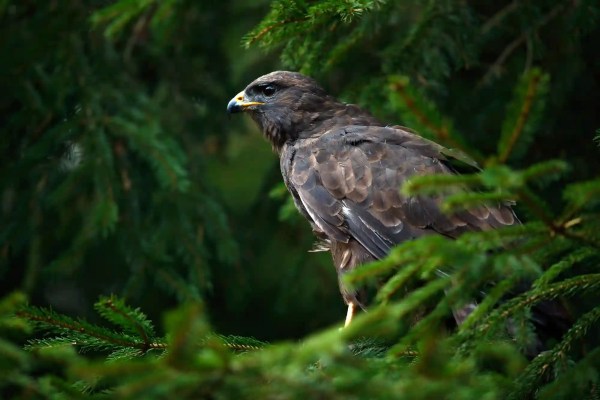
In the canton of Vaud, a red kite was found close to death.

Vets are convinced that it was poisoned by illegal chemical agents.
Over the past few days, the staff of the Centre ornithologique de réadaption (COR) in Genthod GE have literally fought a battle of life and death. A resident of a campsite in La Rippe VD had spotted a red kite. It lay on the ground and had already caught the interest of the cats on the campsite, as «Le Matin» reports. «When I saw this beautiful bird, which could no longer fly, I spoke to it kindly and stroked it,» the finder recounts. She then carefully placed it in a sack.
Eventually she was able to hand the comatose, seizure-plagued bird over to the specialists at the COR. There, in 40 years of operation, they had never before seen a red kite, says Patrick Jacot, who is in charge at the COR, speaking to the newspaper. At first they thought it had collided with a vehicle or a window pane. Only later did they conclude that the animal was suffering from poisoning caused by illegal pesticides.
The red kite has been protected for decades
The red kite was placed under protection in Switzerland as early as 1925. However, since it continued to be shot until the 1950s, it took a long time before the population began to recover. In the meantime it has spread somewhat again, as the Sempach Bird Observatory reports. The roughly 90 breeding pairs recorded in the first census in 1969 have by now multiplied to around 1,500 pairs. Yet in other parts of Europe the population is still in decline.
«I gave it less than a 50 per cent chance of survival»
At the bird station, as a first emergency measure, the red kite's crop was pumped out — a kind of pouch in the oesophagus in which food is collected. «The crop was full, it had the diameter of a tennis ball,» says Emilie Bréthaut, veterinarian at the COR. Finally, an enema was performed using a probe — a procedure that requires great sensitivity. Bréthaut brought dirt and greenery to light, which smelled strongly of chemical substances. «When you see something like that, you do start thinking about the fruit and vegetables we consume,» the vet says.
After the emergency procedure, the red kite was put on a drip. «The situation remained very critical. I gave it less than a 50 percent chance of survival,» says Bréthaut. But the very next day the bird of prey already seemed somewhat fitter. It also began to eat on its own, but later suddenly refused. «The red kite is a species that is very sensitive to stress,» the expert says. That is why they began feeding the starved bird of prey with tweezers.
Rehabilitation in the aviary
As soon as the red kite is fit enough again, it will be able to fully recover from its poisoning in an aviary. Afterwards it is to be released again — presumably ringed and fitted with a transmitter. The finder is pleased: «Luckily it could be saved. We owed it that much, when you see all the things humans do to nature.»
Related dossiers and articles:
- Dossier: Hunting and biodiversity
- Dossier: Hunting and animal welfare
- Dossier: Lead ammunition and environmental toxins
- Dossier: Red Lists Switzerland
- All articles: Wild animals
Fitting to this case: the song «Lead in the Wind» from our song collection.
It is about the traces that lead-containing ammunition leaves behind in animals and the environment.
More on the subject of recreational hunting: In our dossiers on recreational hunting gather fact-checks, analyses and background reports. What the research says about this is shown by Hunting fact-checked: the state of research.
The position of IG Wild beim Wild: IG Wild beim Wild rejects recreational hunting. Our model is the canton of Geneva, which has managed without recreational hunting since 1974: without hunting seasons, without hunting dogs, without driven hunts, without high seats, without the animal cruelty and crime that go hand in hand with hunting season elsewhere. What has worked there for over fifty years disproves every position paper by JagdSchweiz. An association that bases its policy on claims it refutes in its own documents is not a professional organisation, but a factory for misinformation.
Support our work
With your donation you help to protect animals and give their voice a hearing.
Donate now →