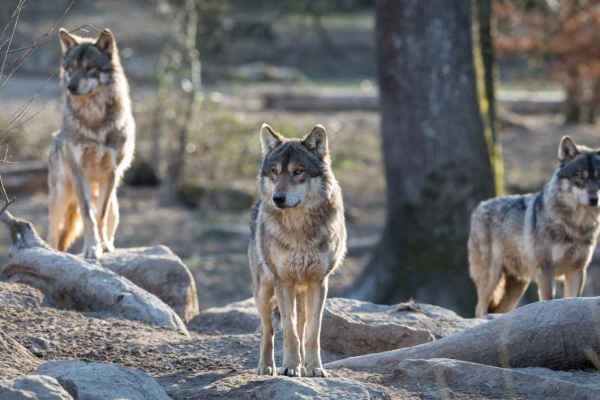
New study: wolf kills do not reliably prevent livestock losses
An evaluation of five field studies shows that killing wolves does little to protect livestock; in individual cases it even increases losses.

A new comparative evaluation in the journal Conservation Science and Practice calls into question the assumption that removing wolves reliably protects livestock.
The team of authors led by Adrian Treves compared five field studies from Slovenia, Michigan, Slovakia, Latvia and the Golan Heights. Each of them pursued the same question: does killing wolves reduce subsequent losses of livestock?
The overall picture is clear, even though the individual findings varied: removing wolves did not reliably prevent subsequent livestock damage. In many cases no discernible effect was found at all. Where losses did change, the effects were not consistent: in some cases they declined, in others they rose.
As a possible explanation, the authors discuss the way such interventions are carried out in practice. Authorities often only react after a depredation event, and wolves are not always removed at the original site of conflict or promptly. Under such conditions, a targeted preventive effect is structurally hard to expect.
There are also possible spatial displacement effects. A study from Michigan found no robust reduction in future damage as a result of lethal interventions. Beyond the immediate site of the intervention there was instead an indication of an increased risk of recurrence, though without statistically clear confirmation.
The team of authors therefore recommends that lethal interventions should not be treated as a precautionary protective measure as long as their effectiveness in preventing future livestock damage has not been robustly demonstrated.
The study thus joins a growing body of work reaching the same conclusion. From Switzerland, too, data now exist showing that livestock losses decline above all where herd protection is applied consistently, irrespective of the number of kills. Just how firmly the kill logic is nevertheless being clung to is shown exemplarily by the Grisons case, where regulation continues despite falling numbers of livestock killed. IG Wild beim Wild has already documented these contradictions between damage logic and political control logic on several occasions, for instance in the analysis of Swiss wolf policy.
The study therefore does not answer the political question of why kills are being adhered to. From the perspective of Wild beim Wild, however, it shows how little a wolf policy fixated on kills can be reconciled with the claim of effective, verifiable herd protection. As long as predators are perceived primarily as competition for leisure hunting interests and not as part of a functioning ecosystem, little is likely to change.
Study: Adrian Treves et al. (2026), «Removing wolves did not reliably prevent domestic animal losses», Conservation Science and Practice, doi.org/10.1111/csp2.70388
LET'S STAY IN TOUCH!
We would like to send you the latest news and offers in our newsletter.

All articles are written by IG Wild beim Wild as well as by external co-authors. Research, structuring and editorial processes may be supported by AI-assisted tools.
Support our work
With your donation you help to protect animals and give their voice a hearing.
Donate now →