
Hunters: Role, Power, Training and Criticism
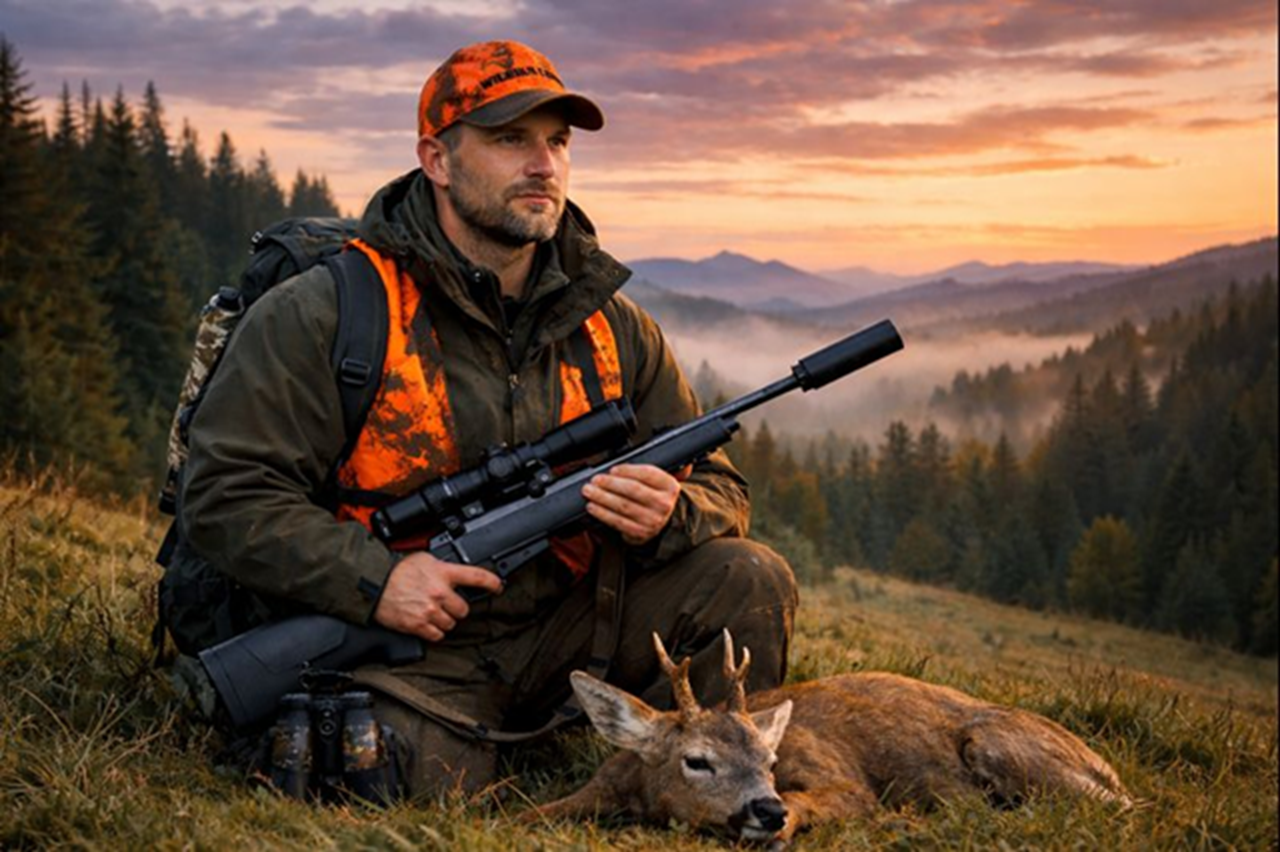
Around 30,000 people hunt in Switzerland. That is 0.3 percent of the population. They have legal access to firearms, kill around 120,000 wild animals annually, sit on cantonal expert commissions, shape hunting legislation and public debates, and consistently present themselves as selfless guardians of nature.
The Swiss Hunting Barometer 2025 paints a clear demographic picture: recreational hunters are predominantly male, above-average age and above-average income. Access to recreational hunting is cost-intensive: hunting education, examination fees, equipment, license or hunting lease, hunting dog and ongoing material costs add up to several thousand francs per year. This is not a recreational activity for everyone, it is one for a specific segment of society.
This dossier analyzes who recreational hunters in Switzerland actually are: their demographics, their training, their gun ownership, their political power and the contradictions between self-image and reality. The focus is not on whether individual recreational hunters are good people – but on what structures, incentives and power mechanisms maintain the recreational hunting system that a majority of society increasingly rejects.
What awaits you here
- Who are recreational hunters? Demographics, income, age, gender: What the Swiss Hunting Barometer 2025 shows, why recreational hunting is a socially selective leisure activity and what this says about representativeness and political claims.
- Hunting education: What is learned – and what is not: How the hunting exam varies by canton, why animal welfare and ethics play a subordinate role in training, and what an education that primarily tests weapon handling and species identification reveals about the system's self-image.
- Weapon ownership: Hunting as a gun law loophole: What proportion hobby hunters represent among private gun owners, why hunting licenses in Switzerland are one of the easiest access routes to legal firearms, and what this means for security policy.
- Sociology of recreational hunters: Networks, loyalty, isolation: How hunting functions as a social network with strong internal loyalties and a culture of mutual protection, why external criticism is systematically deflected, and what this means for the system's self-regulation.
- Hunting lobby: Power without mandate: How hunting associations exert political influence at federal and cantonal levels, where they sit in legislative processes, and why their power stands in glaring disproportion to the size of their social base.
- Hobby hunters and animal welfare: Rhetoric vs. practice: Why animal welfare is emphasized in hunting's self-presentation but structurally treated as secondary in practice, and what the absence of independent oversight over hunting activities means.
- Public perception: Why media perpetuate the hunting myth: How media coverage of hunting is structurally biased in favor of recreational hunting and why critical perspectives are rarely given space.
- International comparisons: What hunting-free or low-hunting countries demonstrate: Why countries or regions with lower hunting intensity show no ecological disadvantages, and what Geneva, major protected areas, and hunting-free regions of Europe empirically prove.
- What would need to change: Concrete political demands.
- Arguments: Responses to the most common justifications of recreational hunters.
- Quick links: All relevant articles, studies and dossiers.
Who are hobby hunters? Demographics, income, age, gender
The Swiss Hunting Barometer 2025 provides the clearest available picture of Switzerland's recreational hunters. Result: 39 percent of surveyed hunters are 55 years or older, 33 percent are between 35 and 54 years old. Only 28 percent are younger than 35 years – a recruitment problem that hunting associations also address internally. Income distribution shows clear overrepresentation of the highest income bracket: Hobby hunters with monthly household incomes over 9,000 francs are significantly more represented than the Swiss population average in this income class.
Access to recreational hunting is cost-intensive and thus socially selective. Training costs, examination fees, weapon acquisition and maintenance, hunting permits or territory leasing, hunting clothing, optics, hunting dogs including training – the total annual costs of recreational hunting easily range in the four- to five-digit franc range depending on canton and system. This is a leisure activity that not everyone can afford or wants to afford. Additionally, there's the gender distribution: recreational hunting is predominantly male. Opening up to women is politically desired and communicatively emphasized by hunting associations – yet the actual composition of recreational hunters remains heavily male-dominated.
What does this mean for recreational hunters' political claims? A small, above-average income, above-average age, predominantly male minority of 0.3 percent of the population claims the right to kill 120,000 wild animals per year – and politically co-shape the framework conditions for doing so. The claim to act 'in the public interest' is not demographically supported. It is a self-interest claim with public welfare rhetoric.
More on this: Hunting in Switzerland: Numbers, systems and the end of a narrative and Psychology of hunting
Hunting education: What is taught – and what is not
Hunting education in Switzerland is regulated at the cantonal level. What this means: There are no uniform minimum standards for animal welfare, ethics or shooting accuracy at the federal level. In the canton of Aargau, the hunting examination includes modules on game meat hygiene, weapon handling, ballistics, shooting effects, hunting dogs and wildlife damage prevention. In the canton of Zurich, training lasts at least two years as an apprentice in a hunting district, followed by a practical examination. In the canton of Graubünden, a mandatory LARGO course on game meat hygiene and wildlife anatomy is required and at least 50 hours of conservation work is a prerequisite for the theoretical examination.
What is not mandatory and systematically tested in any cantonal hunting education: Animal welfare law, pain perception in wildlife, population ecology fundamentals beyond estimation methods, decision ethics in grey area situations. Hunting education produces individuals who know how to identify wildlife, handle weapons safely and process prey. Whether they know what missed shots mean physiologically and how to minimise them in accordance with animal welfare is not systematically tested. The result: In the canton of Graubünden, around 1’000 reports and fines are issued against hobby hunters annually, in a system that officially certifies its practitioners as having 'expertise'.
The German Hunting Association explicitly names hunting ethics as an educational goal, without linking this to a binding examination structure. Hunting ethics remains rhetoric in educational reality: It is decoration on an education system whose core is weapon handling and species identification. What is missing is what characterises every other activity with comparable potential for endangering third parties and living beings: independent, nationally uniform minimum standards, regular proof of shooting ability and a binding animal welfare ethics examination with consequences for violations.
More on this: Hunting accidents in Switzerland and Hunting dogs dossier: Use, suffering and animal welfare
Weapon ownership: Hunting as a firearms law loophole
In Switzerland, around 2.3 million firearms are in private ownership – this corresponds to around 45 weapons per 100 inhabitants and makes Switzerland one of the most weapon-dense countries in Europe. The largest group of private weapon owners are shooting club members. The third largest and particularly relevant group are hobby hunters: In a representative firearms ownership study in 2023, 12 percent of surveyed firearms owners stated they use the weapon for hunting.
What this means: Hunting authorisation is one of the most direct legal pathways to firearms in Switzerland – without character assessment, without alcohol prohibition during practice, without uniform psychological minimum requirements. Anyone who obtains a hunting license simultaneously receives the right to acquire and carry one or more long guns – rifles, shotguns, combination weapons. This right is not tied to any psychiatric clearance certificate, regular shooting tests or review of current health status. This is precisely what makes hunting firearms law a security policy-relevant loophole: Access to firearms via hunting authorisation has a lower threshold than weapon acquisition in many other European countries.
Swiss hunting accident statistics reflect this gap: From age 40 onwards, the number of hunting accidents increases dramatically. In a system without age limits, without mandatory reaction time tests, and without obligatory regular marksmanship assessments, known risk factors for firearm mishandling – age, declining eyesight, slowed reaction time – are not systematically controlled. The result is annual deaths and injuries from hunting weapons – in a system that describes itself as professional and responsible.
More on this: Switzerland: Statistics of fatal hunting accidents and Hunting victims in Europe
Sociology of recreational hunters: Networks, loyalty, isolation
Recreational hunting is more than a leisure activity. It is a dense social network with strong internal loyalties, its own value systems, its own language – hunters' tales – and a culture that systematically delegitimizes external criticism as 'anti-hunting,' 'emotion-driven,' or 'ignorant.' Those who identify problems within the hunting community risk social exclusion. Those who criticize from outside are confronted with the accusation of not understanding nature.
This culture of isolation has structural consequences. Self-control in recreational hunting is limited: There is no independent supervision of hunting practice, no reporting obligation for missed shots, and no systematic evaluation of hunting accidents or animal welfare violations by neutral bodies. What does exist are cantonal hunting wardens – often recreational hunters themselves – who are supposed to control the system internally. This is structurally the same as a banking sector that regulates itself: It lacks the institutional distance that independent control requires. In the canton of Graubünden, 1,000 charges and fines per year demonstrate that this self-control does not function as a supervisory system.
Hunters' tales as a language system serves an important function: It romanticizes what, described soberly, is animal killing. The 'harvester' 'takes' the 'piece' and carries it to the 'bag.' 'Fair chase' promises dignity without binding guarantee. This language serves internal cohesion – and external defense: Those who don't speak hunters' language are treated as outsiders who 'have no idea.' This is not a communication strategy, but an identity system. And it is one of the most effective instruments with which a small minority deflects societal criticism.
More on this: Hunters' tales and Psychology of hunting
Hunting lobby: Power without mandate
Hunting associations see themselves not only as recreational or traditional clubs. They are political actors – at federal and cantonal levels, with particular weight where enforcement decisions are made. Their core concerns are securing hunting scope of action, influencing hunting and nature conservation law, and protecting recreational hunting from societal criticism. They are represented on cantonal expert commissions, participate in developing enforcement aids and guidelines, and receive information from parliamentary advisory bodies that are not accessible to the public.
The political asymmetry is severe: 0.3 percent of the population – the recreational hunters – have organized, funded, politically integrated lobby structures. The 99.7 percent who have no interest in recreational hunting have no comparable political representation. Transparency International Switzerland has documented this imbalance across various lobbying sectors: In individual parliamentary committees, lobbying mandates can be so concentrated that a specific interest group effectively holds the majority. This applies particularly to hunting associations in environmental and hunting committees, where recreational hunters, farmers and related interest groups are structurally overrepresented.
The result is legislatively demonstrable: In Bern, the National Council and Council of States have repeatedly lowered the barriers for wolf culls – despite declining livestock predation numbers. Wolves are to be made even easier to 'preventively regulate' in future, even in hunting ban areas. This is not a decision that scientific evidence produced. It is a decision that lobby pressure produced. The hunting lobby calls this 'wildlife management'. Ecologists call it what it is: the political enforcement of hunting interests against scientific consensus.
More on this: How hunting associations influence politics and the public and Hunter Lobby Switzerland
Recreational hunters and animal welfare: Rhetoric vs. practice
'Waidgerechtigkeit' is the hunting ethics term with which the recreational hunting community claims to respect animals while killing them. The Federal Court and cantonal courts have examined this concept repeatedly. A court in Bellinzona has confirmed that hunting associations practically promote everything that is cruel, unnecessary and callous – and present it as compatible with Waidgerechtigkeit. This shows how far the term is removed from a binding animal welfare standard.
Specifically: Den hunting sends dogs set on prey into fox and badger dens. Trap hunting leaves wild animals in live traps to wait for days under circumstances until the recreational hunter arrives. In driven hunts, animals are chased in panic across wide areas before being shot – with measurable cortisol levels that demonstrate the physiological extent of stress. Shotgun loads on small game frequently lead to injuries, not to immediate death. These practices are legally permitted under hunting law. They contradict the Animal Welfare Act in letter – but are de facto exempted from it through special hunting law regulations.
What is structurally lacking is independent oversight: No neutral authority systematically checks whether the minimum animal welfare standards are maintained in hunting practice. No reporting obligation for missed shots ensures that wounded and unfound animals are statistically recorded. No annual review by controllers external to hunting ensures that 'Waidgerechtigkeit' is more than a self-certification system. This is no coincidence. It is the result of decades of political work by the hunting lobby to prevent independent oversight of recreational hunting, because it knows what it would reveal.
More on this: Hunting and animal welfare: What practice does to wild animals and Wild animals, mortal fear and lack of anaesthesia
Public perception: Why media cultivate the hunting myth
Hunting reports in Swiss media follow recognizable patterns: The recreational hunter appears as a nature-connected expert who knows the forest at dawn and understands wild animals better than anyone else. High hunting in Graubünden is a 'traditional ritual'. The Lucerne hunting fair is an 'industry gathering'. Missed shots, hunting casualties, animal welfare violations and lobby structures rarely or never appear in the same media.
Why? First, because hunting associations systematically provide images, press releases and interview partners – and editorial offices that depend on efficiency use this material. Second, because hunting-critical perspectives are classified as 'animal rights' or 'activist' and thus discredited before their content is examined. Third, because hobby hunters in many rural regions are key social figures – municipal councillors, association presidents, district administrators – and local media are reluctant to damage these networks. The result is a structural reporting bias in favor of recreational hunting that inflates its public support in society.
What helps against this: investigative journalism that evaluates hunting accident statistics, documents animal welfare violations, exposes lobby structures and puts the demographic reality of recreational hunters in relation to their political influence. This is exactly what wildbeimwild.com delivers – with documented sources, without moral finger-wagging, but with the demand that a minority leisure activity with lethal consequences for 120,000 wild animals per year must be accessible to critical social debate.
More on this: Hunting Politics 2025 and How the Umwelt Arena Spreitenbach Legitimizes Animal Cruelty
International comparisons: What hunting-free or low-hunting regions show
Canton Geneva, Switzerland: No militia hunting since 1974. Result after 50 years: stable to growing wildlife populations, dramatically increased biodiversity, 30,000 winter birds instead of a few hundred, social acceptance for wildlife in settlement areas. Large protected areas in Europe – national parks, wilderness reserves, core zones of biosphere reserves – consistently show higher biodiversity values than intensively hunted comparison regions in long-term studies.
Countries with low hunting intensity or strict regulations show no ecological disadvantages. The Netherlands have restricted hunting to a minimal handful of species – without wildlife populations that would have gotten out of control. England and Wales banned fox hunting in 2004 – without a fox population explosion. Austria and Germany have introduced lead bans for ammunition – without collapse of recreational hunting. These examples show what is structurally possible when political will exists and lobby structures don't have the final word.
What the international comparisons don't show: countries where the abolition of recreational hunting would have led to ecological catastrophes. The argument that without recreational hunting, wildlife populations would explode uncontrollably and ecosystems would collapse is not empirically proven. It is a scare thesis that hunting associations cultivate because they have no other arguments left.
More on this: Hunting in Canton Geneva: Hunting Ban, Psychology and Violence Perception and Alternatives to Hunting: What Really Helps Without Killing Animals
What would need to change
- Federal minimum standards for hunting education: Animal welfare law, pain perception in wild animals, decision ethics, misshot minimization must be mandatorily and examination-relevant integrated into the hunting education of all cantons. Model initiative: Model texts for hunting-critical initiatives
- Mandatory psychological aptitude test and regular shooting ability examination: Anyone working with firearms in public forests must be psychologically suitable and shooting-ready, provably, regularly and independently tested. Model initiative: Recreational Hunting and Criminality: Aptitude Controls, Reporting Obligations and Consequences
- Alcohol and substance ban during hunting practice: Every other armed professional or hobby field knows this standard. Recreational hunting does not.
- Independent supervision of hunting practice: Hunting control by hunting-external, state-employed inspectors. Mandatory reporting of missed shots and animal welfare violations. Publicly accessible annual reports. Model motion: Independent hunting supervision: External control instead of self-regulation
- Transparency regarding hunting lobby mandates in parliaments and committees: Anyone who holds mandates with hunting associations as a parliamentarian while simultaneously sitting on hunting-relevant committees must fully and publicly declare these conflicts of interest.
- Consistent review of hunting special regulations in animal welfare law: Badger hunting, trap hunting without daily inspection, driven hunts on pregnant or young-leading animals must be subjected to an independent animal welfare law review, without participation of the hunting lobby.
Arguments
«Hobby hunters are well-trained experts for wildlife.» Hunting training tests weapon handling and species identification. Animal welfare law, population ecology and decision-making ethics are not mandatory and not systematically exam-relevant. In the canton of Graubünden, 1,000 charges and fines are imposed against hobby hunters annually – in a system that officially certifies its practitioners with 'expertise'. Anyone who really wants wildlife expertise needs wildlife biology – not a hunting license.
«Hunting associations represent legitimate societal interests.» Hunting associations represent the interests of 0.3 percent of the population. They do so with political influence that is completely disproportionate to this size: committee presences, enforcement participation, direct contacts with cantonal specialist offices, media presence and political networks. This is lobbying for a minority leisure activity – not a public welfare mandate.
«Hobby hunters know nature better than others.» Nature knowledge is not a hunting privilege. Wildlife biologists, ecologists, forestry professionals, Pro Natura employees and wildlife wardens know nature at least as well – often better, because their training is scientifically founded and not colored by shooting interests. Nature knowledge does not justify killing rights.
«Without hobby hunters, there would be no one in the forest protecting wildlife.» In the canton of Geneva, state-employed wildlife wardens have been protecting wildlife since 1974 without militia hunting – effectively, professionally and in accordance with animal welfare. Wildlife protection is the responsibility of professional staff, not hobby hunters who primarily paid to kill wildlife.
«Hunting training is strict – only those who are truly suitable pass.» Pass rates for hunting exams in Switzerland are above 80 percent in most cantons. There is no personality test, no alcohol ban, no regular shooting proficiency verification requirement and no federal minimum standards for animal welfare ethics. Strict looks different.
«Hunting is part of Swiss culture and identity.» Culture and identity are not a free pass for animal suffering, societal minority privileges or political influence that is disproportionate to a group's size. A society that takes animal welfare seriously cannot exempt cultural practices that cause animal suffering from their ethical evaluation. Other traditions have also been abolished as societal knowledge and empathy increased.
Quick links
Articles on Wild beim Wild:
- How hunting associations influence politics and the public
- Hunter lobby Switzerland
- Hunting politics 2025: Wolf culls, trophy hunting and poaching in service of the lobby
- Switzerland: Statistics of fatal hunting accidents
- Psychology of hunting
- Hunter's tales
- Initiative demands 'Wildlife wardens instead of hunters'
- Template texts for hunting-critical motions in cantonal parliaments
Related dossiers:
- Introduction to hunting criticism: What recreational hunting really is – and why it has no future
- The hunting license
- Hunting in Switzerland: Numbers, systems and the end of a narrative
- Hunters: Role, power, training and criticism
- Hunting Myths: 12 Claims You Should Critically Examine
- Hunting and Biodiversity: Does Hunting Really Protect Nature?
- Wild Game Meat in Switzerland
- Hunting Ban Switzerland
- Arguments for Professional Wildlife Rangers
- Hunting and Human Rights
Our Standard
Hobby hunters are not neutral conservationists. They are actors with vested interests, legalized weapon access, political networks and a self-presentation that does not withstand objective scrutiny. This is not a personal condemnation – it is a structural analysis. The structures within which hobby hunters operate are designed to protect their interests: cantonal fragmented training without uniform animal welfare standards, a weapons law system without psychological aptitude testing, a hunting lobby with disproportionate political influence and a self-regulation culture that systematically prevents external oversight.
A society that takes wildlife seriously must change these structures – not because hobby hunters are bad people, but because 120,000 wild animals per year, uncontrolled weapons law exemptions, animal welfare violations without consequences and lobby power without democratic mandate are not acceptable conditions. The demand for transparency, oversight, uniform standards and political representation of the majority is not radicalism. It is the minimum that an enlightened society may demand from a minority leisure activity with deadly consequences for wildlife and humans.
More on recreational hunting: In our Hunting Dossier we compile fact-checks, analyses and background reports.