Hunting Law: Herd Protection Instead of Wolf Culling
The new hunting law overshoots the mark entirely and does not solve the problems.

Things are currently simmering in the Surselva region of Graubünden.
Reports of sheep being killed in unprotected or inadequately protected herds, and panic-stricken mother cows that can pose a danger to tourists, are becoming an almost daily occurrence. The media also repeatedly report that sheep are being killed despite herd protection measures being in place, that herd protection therefore does not work, and that culling wolves is the only solution.
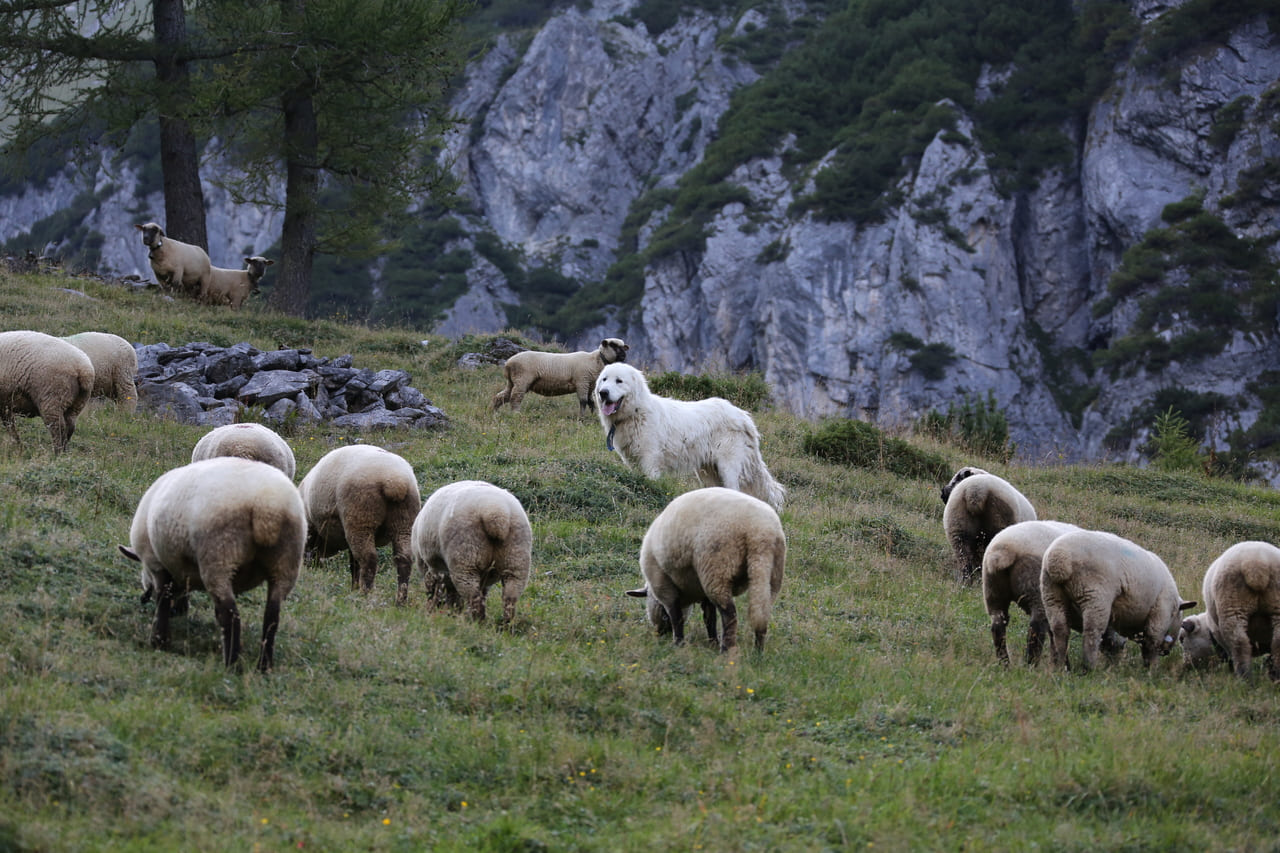
In most cases, herd protection measures have been implemented poorly, if at all. On one alpine pasture, for example, a flock of 500 sheep is excellently tended during the day by a shepherd with his four Border Collies and guarded by a livestock protection dog. At night, the sheep are herded together but not enclosed within an electrified fence. A single livestock protection dog therefore has no chance of protecting all 500 sheep against wolves. In several nocturnal attacks, 18 sheep have already been killed and several animals are missing. All the effort invested during the day is useless if protection is inadequate precisely at night and the livestock protection dog is given no realistic scope to do its job. Despite the inadequate herd protection measures, the media speak of a “protected alpine pasture,” which simply does not reflect the facts. Only after the most recent attacks were fences for a night enclosure brought up to the pasture. Since the flock has been fenced in at night, there has been no further damage.
When using livestock guardian dogs, it is essential to create the right conditions for the dogs so that they actually have the opportunity to effectively protect the entire herd. The correct and effective use of livestock protection measures and livestock guardian dogs is, in every respect, the responsibility of the person in charge. Fences must also be properly erected. Since wolves prefer to slip under a fence rather than jump over it, care must be taken to ensure a good ground seal along the entire length of the fence. The fence must carry sufficient current and have a good earth connection. Even a fence that appears well set up at first glance is useless if, for example, it crosses a stream where the wolf can simply slip underneath, or if a boulder stands next to the fence that serves as a “springboard” for the wolf to easily enter the pasture. However, such weak points can be eliminated using simple means that serve as deterrents. These include, for example, fladry fences, a few old CDs or PET bottles tied to a cord, wind spinners, etc. There is no limit to your imagination. The effort required to erect a fence correctly is not much greater — but the effect certainly is!
Livestock protection works
The fact is: if livestock protection measures are implemented consistently and without gaps, there is virtually no more damage caused by wolves. This is proven by alpine pastures that have been implementing livestock protection measures very successfully for years — such as those in the Calanda region, where the resident wolf pack causes practically no more livestock losses. What works with the Calanda pack also works with other packs, provided the measures are implemented without gaps. However, livestock protection is a matter of will and attitude — it starts in the mind! Unfortunately, many people are not yet ready for this. According to a statement by the federal government, a study has shown that livestock protection measures provide 98% protection for animals against predator attacks.
Livestock protection using all available and effective means should therefore be the NORM and a MUST for EVERYONE!
The numbers prove it: in Switzerland, the wolf population has steadily increased since their return in 1995, yet the number of livestock kills has remained at a consistently similar level for years (approx. 200–500 kills/year). This means that today, far fewer livestock are killed per wolf than 20 years ago: 2000 – 4 wolves – 256 kills / 2009 – 10 wolves – 383 kills / 2018 – 50 wolves – 526 kills / 2019 – 80 wolves – 420 kills. This reduction in livestock kills is only possible thanks to increased herd protection!
No senseless culling!
It is therefore completely incomprehensible that under the new hunting law, wolf packs may be regulated as soon as damage merely threatens — without the wolves having caused any harm and without any obligation to first implement reasonable herd protection measures. Without herd protection, damage is logically always a threat. This would effectively give cantons a free pass to shoot half of each year's wolf pups under the regulation provision.
Such a relaxation of the herd protection obligation is entirely incomprehensible. Particularly in pack territories, it is enormously important that effective herd protection measures are implemented so that young wolves learn from the outset that sheep and goats are not easy prey.
The preventive regulation of wolf packs under the new hunting law is a senseless and disrespectful interference in nature!
Alpine farmers lulled into a false sense of security
In order to fulfil their responsibility towards their animals, alpine farmers will not be able to avoid herd protection in the future either. Because even under the new hunting law, livestock kills will still occur. Alpine farmers are lulled into a false sense of security, as the new hunting law promises them that wolf packs may be regulated before they have caused any damage.
However, under the new hunting law, the following applies: Pack regulation may only be carried out during the period from September 1 to January 31. Half of the young animals born in the current year may be shot. The adult parent animals and older siblings must be spared. The problem is that the alpine season already begins in May/June. If no herd protection measures are implemented, damage will inevitably occur. Only in autumn — that is, after the alpine season — may the pups be shot, but due to their age, they were not involved in the predation damage at all. The adult animals responsible for the damage are still active in the area and will continue to cause damage in autumn/winter and in the coming alpine season if no effective herd protection measures are implemented.
Pack regulation cannot prevent damage during the alpine season! To avoid damage, effective herd protection is needed — not wolf culling! Only in this way can a long-term coexistence of humans, wolves, and livestock function!
The new hunting law is incompatible with the Berne Convention
The wolf is listed in Appendix II of the Berne Convention as a strictly protected species. Under Article 6, any deliberate killing of these animals is fundamentally prohibited. However, Article 9 permits exceptions in certain situations: “Provided there is no other satisfactory solution and the exception is not detrimental to the survival of the population concerned, each Contracting Party may grant exceptions to Articles 4, 5, 6, 7 and the prohibition on the use of the means referred to in Article 8.” This applies, among other things, to the prevention of serious damage to crops, livestock, forests, fisheries, waters, and other property.
If wolf packs are now regulated through annually permitted culls merely because damage is threatened, and without reasonable herd protection measures having been implemented beforehand, this is quite clearly NOT compatible with the wording and the actual spirit of the Berne Convention! First, Article 9 is purely an exception clause and second, for it to apply, there must be no other satisfactory solution. However, if reasonable herd protection measures were properly and comprehensively implemented everywhere, no serious damage would be threatened any longer. Herd protection measures are therefore clearly another satisfactory solution!
However, since Article 9 may only be applied when there is no other satisfactory solution, the new hunting law completely disregards this article of the Bern Convention.
Species protection must remain a federal matter
The Bern Convention is an international treaty signed by Switzerland, and therefore responsibility for compliance rests exclusively with the federal government.Under the new hunting law, however, responsibility for issuing shooting permits is to lie solely with the cantons in the future, which will inevitably lead to varying and inconsistent interpretations and practices.The outcome of this would be entirely questionable, as some cantons already fail to comply with existing legislation.This is demonstrated by the example of the canton of Graubünden, which shot 75 protected grey herons without a permit over the past four years.Other cantons also illegally shot hundreds of protected grey herons up until a Federal Court ruling five years ago! A Switzerland-wide management of protected species, and predators in particular, would thus become completely impossible. Species protection, if it is to be taken seriously and implemented effectively, must be applied uniformly across the whole of Switzerland. Species protection — and with it the responsibility for issuing shooting permits — is a NATIONAL TASK and must therefore remain exclusively a FEDERAL MATTER.
The revised hunting law goes far beyond its intended purpose. Our parliamentarians have loosened the protection of the wolf far more than the Federal Council originally proposed. What was once a wildlife protection law has now become a shooting law that in no way meets the urgent and indispensable requirements of species and nature conservation, writes the association CHWOLF, based in Einsiedeln.
Dossier: The wolf in Switzerland: facts, politics, and the limits of hunting
More on the subject of recreational hunting: In our dossiers on the criticism of recreational hunting gather fact-checks, analyses and background reports. What the research says about this is shown by Hunting fact-checked: the state of research.
The position of IG Wild beim Wild: IG Wild beim Wild rejects recreational hunting. Our model is the canton of Geneva, which has managed without recreational hunting since 1974: without hunting seasons, without hunting dogs, without driven hunts, without high seats, without the animal cruelty and crime that go hand in hand with hunting season elsewhere. What has worked there for over fifty years disproves every position paper by JagdSchweiz. An association that bases its policy on claims it refutes in its own documents is not a professional organisation, but a factory for misinformation.