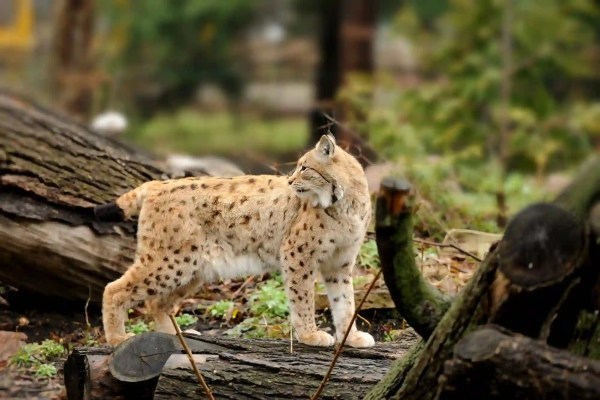
House cat and tiger: 95.6 per cent shared DNA
Why the cuddly creature on the sofa is still very much a predator.

“In the Shadow of the Hedges”
Anyone who watches their house cat stalking a toy is observing, in miniature, the behaviour of one of the world's largest predators.
The Siberian tiger shares 95.6 per cent of its genome with the house cat, from which it diverged evolutionarily around 10.8 million years ago. This is shown by a genome study published in Nature Communications by an international research team led by the South Korean geneticist Jong Bhak.
For comparison: humans, too, have a genetically very close relative, the chimpanzee. Although the chimpanzee is not a predator in the strict sense but predominantly a fruit and plant eater, it does occasionally hunt other animals, such as colobus monkeys, in coordinated group actions. Depending on the calculation method, the figures for the DNA match between humans and chimpanzees range between roughly 96 and 99 per cent. This shows that even among close relatives, large differences in behaviour, diet and abilities are the rule rather than the exception, despite close genetic proximity.
A shared evolutionary history
Despite the enormous difference in size, key biological functions have remained astonishingly similar in cats of all sizes. All cat species alive today go back to a common ancestor around eleven million years ago. Genomes normally change considerably over the course of evolution, yet when the researchers compared the tiger genome with that of the house cat, they found surprisingly few major differences.
Instincts cannot be bred away
This close genetic kinship explains why house cats still display behaviours that can also be observed in their wild relatives: stalking, lurking, territorial behaviour, scent marking and a rich repertoire of body language are among their deeply rooted instincts. Domestication has changed the cat's lifestyle, but it has not made its hunting instincts disappear.
This very point deserves a second look when it comes to justifying recreational hunting. If even thousands of years of shared domestication history could not erase a cat's natural behaviour, then it becomes clear: instinctive behaviour in a wild animal — such as a fox adapting to human settlements — is no proof of «overpopulation» or a supposed need for hunting. It is simply biology. The narrative repeatedly invoked by recreational hunters, according to which one must intervene in nature in a «regulating» way, ignores the fact that predators have been regulating themselves for millions of years, long before humans came along with the rifle.
More on the ecological interrelationships surrounding predators in Switzerland can be found in our category Wild animals.
More on the subject of recreational hunting: The scientific evidence is presented in the overview Studies on the Effects of Recreational Hunting.
The position of IG Wild beim Wild: IG Wild beim Wild rejects recreational hunting. Our model is the canton of Geneva, which has managed without recreational hunting since 1974: without hunting seasons, without hunting dogs, without driven hunts, without high seats, without the animal cruelty and crime that go hand in hand with hunting season elsewhere. What has worked there for over fifty years disproves every position paper by JagdSchweiz. An association that bases its policy on claims it refutes in its own documents is not a professional organisation, but a factory for misinformation.
Support our work
With your donation you help protect animals and give a voice to those who have none.
Donate now →