Biologists fit young golden eagles with transmitters
Young golden eagles can be identified by their white tail feathers with a black terminal band and the white patches on their wings.


The behaviour of young golden eagles is barely researched.
A team led by the Swiss Ornithological Institute in Sempach wants to change that: they are unlocking the mysterious lives of the «kings of the skies» with the help of tracking transmitters.
The cold, wet early summer day in the mountains above Davos is set to be a «big day», as biologist David Jenny of the Swiss Ornithological Institute puts it: he and his team have the opportunity today to fit two golden eagles, just under fifty days old, with data loggers. Yet there is no sign of nerves among the group, loaded down with climbing ropes, measuring equipment and cameras.
For them, fitting young golden eagles with transmitters is routine: the researchers have already equipped 33 birds in Graubünden with sensors, using them to document the lives of the young animals. Nevertheless, fitting these two golden eagles with transmitters is something special, as they are siblings — and double broods are rare among these birds.
Meticulous documentation
After an approximately one-hour walk, mountain guide and wildlife warden Romano Salis of the Graubünden Office for Hunting and Fisheries abseils down from a narrow ledge to a steep rock face. This is where the eyrie containing the golden eagles is located. He places them in a grey bag, which the tagging team hauls up using a pulley system.
There, David Jenny and doctoral student Julia Hatzl place the first young bird on a terry cloth towel. First they weigh it, measure its beak, talons and wing length, and check it for parasites. “This is probably a male,” says Jenny. To be completely sure, they pluck three small breast feathers from the golden eagle, which will later be analysed in the laboratory using genetic testing.
Power struggles over territories
Golden eagles are thriving in Switzerland. Today, an eagle pair lives in almost every suitable habitat in the Swiss Alpine region. However, the large number of golden eagles is fuelling conflicts among the wildlife over new territories.
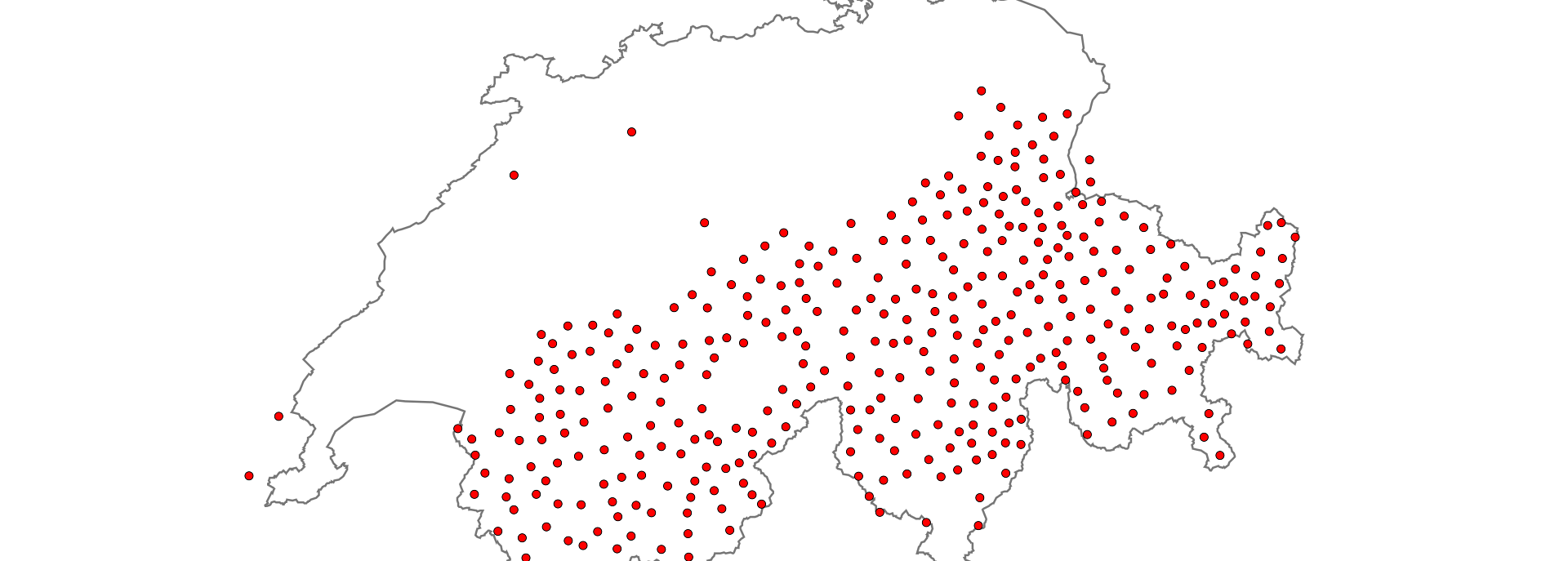
Young golden eagles play a key role in this process: from their fourth to sixth year of life, they search for a partner and attempt to establish their own territory. Until now, however, there has been a gap in knowledge about how juvenile birds behave during this phase.
A small backpack with a data logger
Once a hood has been placed over the young golden eagle's head, Jenny and Hatzl begin fitting the bird with its solar-powered transmitter. What sounds simple requires a great deal of sensitivity: the transmitter is attached to a kind of small backpack whose straps run along the legs. It must fit neither too tightly nor too loosely.
This project was initiated in 2016 by the Max Planck Institute for Behavioural Biology in Radolfzell, with the aim of closing the knowledge gap regarding the movements of young golden eagles up to sexual maturity. The collaboration with the Swiss Ornithological Institute, initially limited to the canton of Graubünden, was gradually extended to additional partners. By 2020, teams from South Tyrol, Lombardy, Bavaria, Austria, and Slovenia had joined the effort, making it possible to study the movements of young golden eagles across a large part of the Alpine region.
Unlike in northern Europe and the Mediterranean, golden eagles in central Europe are rarely found in lowland areas, living instead primarily in alpine regions. This mountainous terrain, densely populated by golden eagles, makes studying the ranging behaviour and movement patterns of young birds both challenging and fascinating. The alpine population of the golden eagle is today in an encouraging state — it is essentially at carrying capacity and therefore subject to strong competition-driven natural regulation, in which dispersing young eagles play a key role. They are the primary reason why reproductive success among territorial pairs is currently being significantly suppressed. But young eagles also face competition from their own kind: more than half of the golden eagles found dead in Graubünden are victims of territorial conflicts. Under these conditions, it is important to better understand the survival strategies of young eagles and thereby gain insight into the overall development of the golden eagle population. But what factors determine the movement patterns of young eagles? And what role is played by the distribution of food and the presence of paired, territory-holding eagles?
Tracking golden eagle routes via app
Around midday, Jenny carefully places the second golden eagle, now fitted with a transmitter, back into the bag and carries the siblings once again to the edge of the rocky outcrop. The young birds then cautiously make their way back into their familiar home.
Where these two and their tagged companions will roam can be tracked not only by researchers, but also via an app developed by the Max Planck Institute called «Animal Tracker». But only after the young birds have left their parents' territory — for the nesting sites of golden eagles are to remain a secret.
More on the subject of recreational hunting: What the research says about this is shown by Hunting fact-checked: the state of research.
The position of IG Wild beim Wild: IG Wild beim Wild rejects recreational hunting. Our model is the canton of Geneva, which has managed without recreational hunting since 1974: without hunting seasons, without hunting dogs, without driven hunts, without high seats, without the animal cruelty and crime that go hand in hand with hunting season elsewhere. What has worked there for over fifty years disproves every position paper by JagdSchweiz. An association that bases its policy on claims it refutes in its own documents is not a professional organisation, but a factory for misinformation.