Bayer acquires Monsanto – will things get even worse for wildlife?
The chemical giant Bayer is acquiring Monsanto for 66 billion dollars. What does the largest takeover by a German company mean for biodiversity and wildlife? More on nature and biodiversity.


The German chemical company Bayer is acquiring US seed manufacturer Monsanto for nearly 66 billion dollars.
The pharmaceutical and chemical group will pay 128 dollars per Monsanto share, Bayer announced on Wednesday, 14 September 2016. It is the largest acquisition ever made by a German company.
With the merger, the German pharmaceutical group rises to become the global number one in the agrochemical business. It is also the largest acquisition by a German corporation in history.
What now threatens us is a nightmare for the environment and consumers. The new mega-corporation will dominate the market for pesticides and seeds. It will decide what we eat in the future and how much we will have to pay for it. This means more bee-killing neonicotinoids, more toxic glyphosate, and more genetically modified foods on supermarket shelves.
Experts agree: we face higher food prices, less choice, and agricultural monocultures that are vulnerable to disease.
The cumulative toxic cocktail of hazardous waste from antibiotics, hormones, genetically modified feed, pesticides, sprays, herbicides, and so on, which Swiss farmers dispose of in their fields, already takes a severe toll not only on wildlife and birds, but on all living creatures.
Inadequate and unbalanced nutrition significantly impairs the health of wildlife, causing their resistance to disease to drop sharply. The natural host-parasite balance can then shift in favour of parasites, increasing susceptibility to infectious diseases.
Wildlife in farmland can barely find any food that is not contaminated with a glyphosate-based pesticide.
It is known, for instance, that glyphosate crosses the uterine barrier and thus affects fetuses and fawns even before birth. Countless effects on humans and animals are becoming increasingly well documented.
Switzerland's pesticide consumption amounts to around 2,200 tonnes per year — and the trend is rising. Many farmers also obtain illegal pesticides from abroad. Pesticide residues are suspected, according to numerous studies, of promoting cancer, disrupting cell division, and altering genetic material. According to a study by Pro Natura and Friends of the Earth, over forty percent of Europeans have the toxin glyphosate — a so-called total herbicide — in their bodies.
Emilie Bréthaut, a veterinarian at the COR, recently put it succinctly during the rescue of a red kite: "When you see something like this, it really makes you think about the fruit and vegetables we consume," said the vet. Using a probe, she brought dirt and plant matter to light from the bird's stomach — matter that smelled strongly of chemical substances.
While our cities are becoming oases of biodiversity, many plant and animal species that were once taken for granted have become rare or even completely disappeared in rural areas. Around half of all Central European species are considered endangered, and the red lists grow longer year by year.
According to Prof. Dr. Josef H. Reichholf in his book “Die Zukunft der Arten” (The Future of Species), enemy number one of biodiversity is industrial agriculture: over-fertilization, loss of structural diversity, and monocultures are species killers. The industrialization and intensification of agriculture has continuously robbed countless wild animals and plants of their habitat and food sources over recent decades: through land consolidation schemes involving the drainage of bogs and floodplains, the straightening of watercourses, and the clearing of hedgerows; through the triumph of agrochemicals with excessive use of artificial fertilizers, pesticides, and fungicides; through over-fertilization with massive quantities of liquid manure that suffocate soil life and wipe out wild plants that depend on nutrient-poor soils; and through monocultures that have created agricultural steppes. Habitats such as hedgerows, bodies of water, and areas free from intensive agricultural use are sorely lacking. Our forests, too, have become timber plantations expected to deliver yields and generate as much profit as possible: intensive forestry has transformed many forests into little more than pole-timber fields, offering almost no refuge for wildlife.
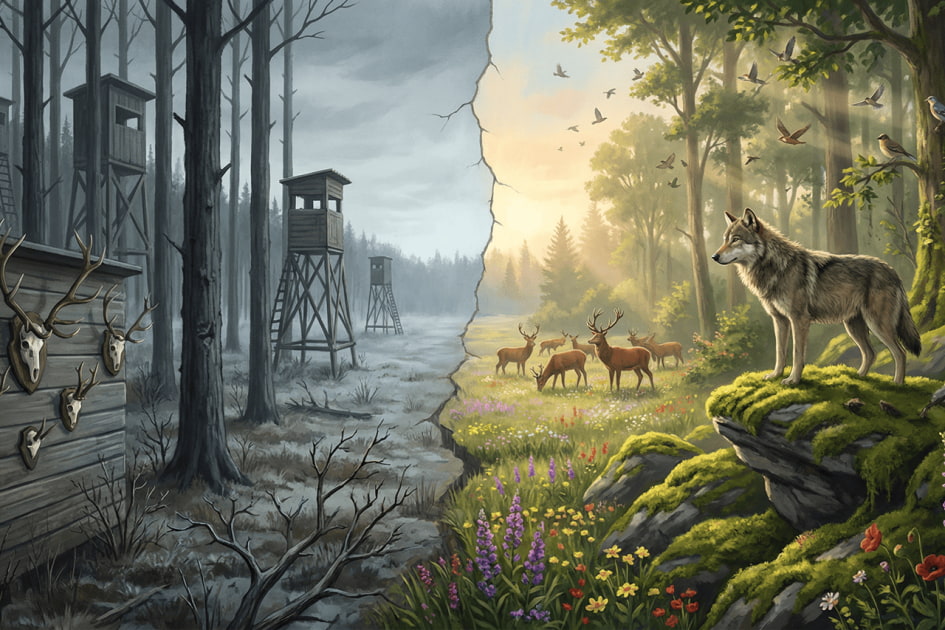
After industrial agriculture, hunting is enemy number two of biodiversity: in the countryside, hunting takes place everywhere — in forests and fields — all year round. Prof. Dr. Reichholf is convinced that for most of the larger species, their future hangs on the barrels of hunters’ guns. Hunting artificially creates fear and thereby severely restricts the living conditions of the hunted species. «Anyone can observe this directly in the far lower wariness of animals living in cities compared to those in the open countryside,» says Reichholf. Compared to hunting, the damage caused by construction and residential development, industry, and traffic is relatively minor.
As much as we can rejoice that biodiversity in cities is growing and that oases for wildlife have emerged, as much as we can celebrate that animals have shed their unnatural shyness toward humans and have thus become part of our everyday experience again — it becomes all the more clear that something must change in the countryside. If we want to preserve nature and the animals that live within it, a rethinking of agriculture is long overdue. Also long overdue is a different view of animals: wild animals are not the enemies of agriculture, but belong to our natural world. Ultimately, by destroying the habitats of ever more animals and plants, we humans are destroying our own habitat — and threatening our survival on planet Earth.