Black Salsify: A Winter Rarity
In Switzerland, black salsify is grown in comparatively small quantities. The season starts in October and lasts until approximately February.

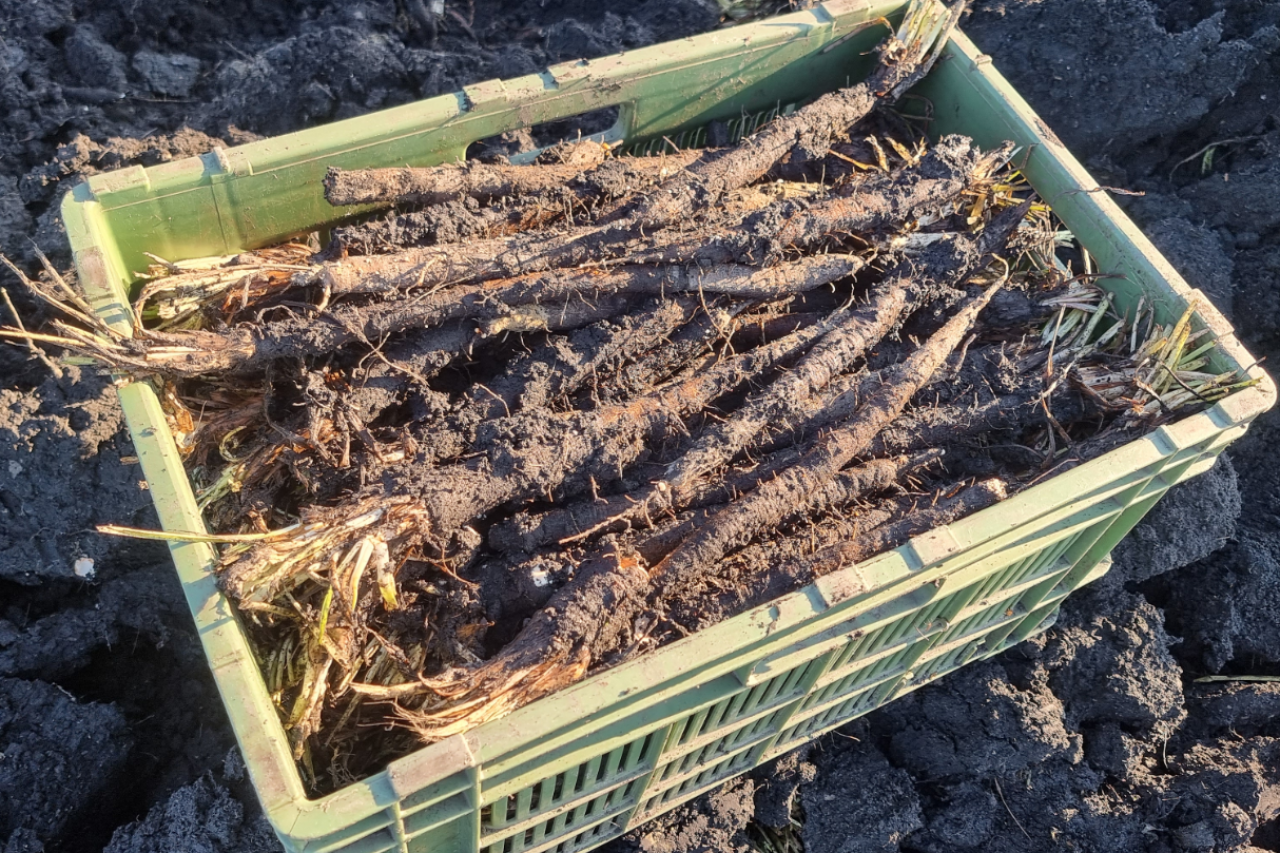
Black salsify is a niche vegetable in Switzerland.
In 2023, it was cultivated on around 11 hectares, just over half of which under organic farming. In Switzerland, black salsify is also referred to as winter asparagus, as its fibrous white interior is strongly reminiscent of that of the noble asparagus.
Black salsify is called “poisonous black snake” in the Italian-speaking region: Scorzone. This name is probably less related to the appearance of black salsify than to the fact that the milky sap of the root was used in medieval medicine to treat snake bites.
Frost-resistant vegetable
Black salsify originates from southern Europe, North Africa and the Near East. It was brought to us from the Iberian Peninsula, from where it was introduced to Central Europe in the 17th century.
Today it is most widely cultivated in Belgium, France and Sweden, but has also made a comeback in other European countries — after several decades of being forgotten. It is grown on a large scale, among other things, as canned produce. Swiss produce goes directly into retail, and market traders offer this rare vegetable. A plant-based diet with regional winter vegetables is environmentally friendly.
Handschuhe tragen
Tipp: Beim Schälen der Schwarzwurzel sollte man Handschuhe tragen, da der Milchsaft die Hände dunkelbraun verfärbt.
Also delicious as a salad
Black salsify is frequently used in soups and as a cooked vegetable side dish. However, its leaves and roots are also well suited for use in salads. Similarly to chicory, black salsify was formerly used to stretch coffee made from beans. Its leaves were used as animal fodder.
| You can help all animals and our planet with compassion. Choose empathy on your plate and in your glass. Go vegan. |