Assassination suspect on big game hunt: the Lavitola case reveals the dark side of recreational hunting
Two weeks after the attack on journalist Sigfrido Ranucci, the man suspected of ordering it travelled to Zimbabwe for a hobby hunt. The Valter Lavitola case links trophy hunting, carbon credit deals and political power.
“Safari”
Two bull elephants, a lion and a leopard: these animals were listed on a special permit which, according to research by the Italian portal MowMag, was issued by Zimbabwe’s Parks and Wildlife Management Authority on 30 October 2025.
The client named on the document is the Italian businessman and former publisher Valter Lavitola, with a Rome address and an Italian passport.
Only two weeks earlier, on 16 October 2025, an explosive device had detonated outside the home of television journalist Sigfrido Ranucci in Pomezia near Rome. Ranucci presents the Rai programme «Report», one of Italy’s best-known investigative formats.
Lavitola was arrested in August 2026. The Rome public prosecutor regards him as the suspected instigator of the attack; among other charges, he faces the offence of «strage» (massacre), aggravated by mafia-style methods. During his questioning before the investigating judge on 12 August 2026, Lavitola is said to have admitted organising the act.
A confession that fails to convince the judiciary
According to Italian media reports, Lavitola stated that he had ordered shots to be fired at Ranucci’s house, not the planting of an explosive device. As his motive, he claimed he had wanted to help his friend Ranucci obtain greater personal protection, because Ranucci was allegedly in danger.
In her ruling of 13 August 2026, the investigating judge in Rome described this account as «fumose, assolutamente generiche e prive di qualsivoglia indicazione concreta suscettibile di riscontro» – vague, entirely indeterminate and without any concrete, verifiable indication. She therefore kept Lavitola in pre-trial detention and rejected the application for house arrest; among the reasons she cited as a flight risk was his far-reaching international network of contacts.
A confession is not a legally binding verdict, and the final assessment under criminal law rests with the competent courts. The investigative steps taken so far, the pre-trial detention and the judge's assessment nevertheless show that the Italian judiciary is treating the case as a serious one.
Permit number 803/2025
According to MowMag, the special permit bore the number 803/2025 and authorised a hunt from 1 to 20 November 2025 in the Mutema concession in southern Zimbabwe: one male elephant, one male leopard, one male lion. In addition there was a further elephant, designated a «bonus», in the Chibuwe concession. A man named Sherpard Katsidzira, licence number 169, is registered as the professional hunter in charge, with Elephant Trails Safaris as the operator.
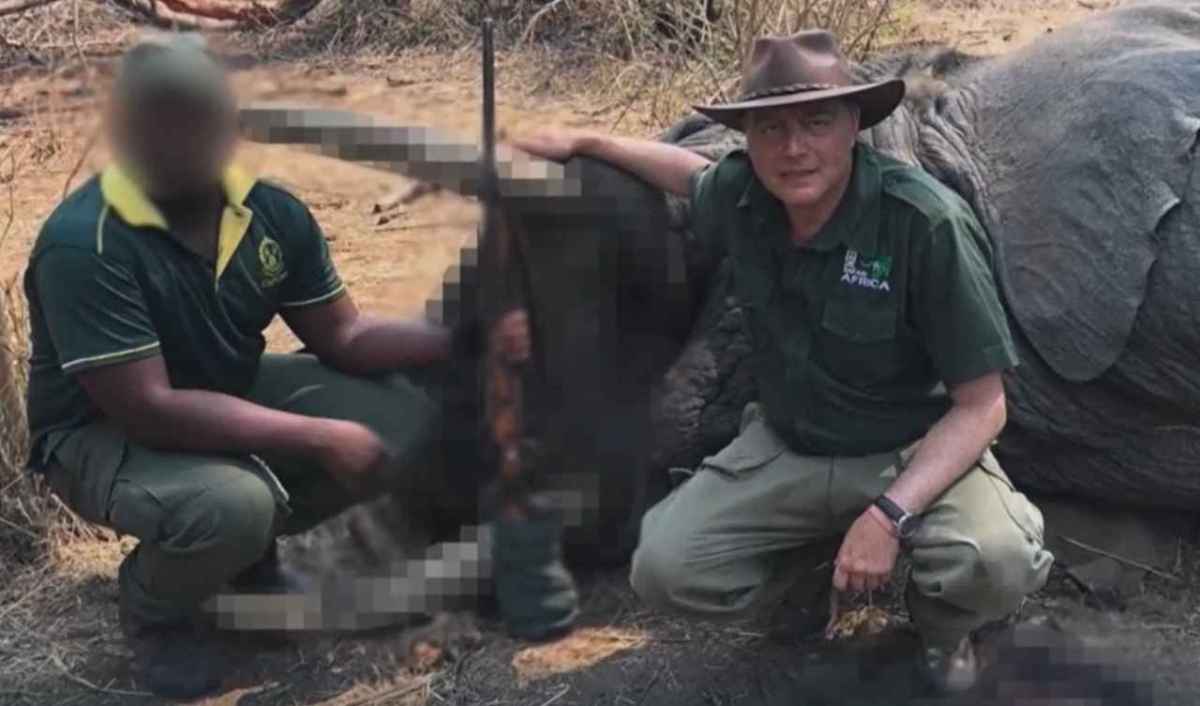
Rai's TG1 evening programme of 24 August 2026 showed images said to depict Lavitola armed in Africa and beside killed animals. Whether all four authorised animals were in fact killed has not been conclusively established publicly; the permit initially documents only the authorisation to hunt.
Such trophy photos are part of the public self-staging of the global recreational hunting tourism industry. The dead animal serves as a status symbol on which wealth and power of disposal are put on display.
A questionable alibi for the financing
Lavitola's former Zimbabwean business partner, Benjamin Chimutengo, told MowMag that Lavitola had asked him to pay for his private hunting trip with around 9’300 US dollars from funds of their joint company Future Awaits, money that had actually been earmarked for carbon credit projects. When Chimutengo objected, Lavitola is said to have explained that a doctor in Italy had given him only a few months to live and that he therefore wanted to go hunting. Speaking to MowMag, Chimutengo described this justification as hardly credible and the transaction as a misappropriation of company funds.
This information comes from a former business partner and has not been established in court. It does, however, fit into a larger picture: according to Chimutengo, Lavitola's interest in Zimbabwe was originally focused on trophy hunting, safaris and the purchase of some 5’000 acres of farmland, before it shifted to the apparently more lucrative business of carbon credits, with companies such as Future Awaits Zimbabwe, Future Awaits South Africa and Afrocarbon Solutions, extending as far as Cameroon.
Investigations into assets and financial flows
The Italian investigating authorities are attempting to reconstruct Lavitola's assets and the origin of the funds for his African projects. It is precisely at this interface that the case becomes relevant beyond the individual instance of a trophy hunt: when big game hunting, opaque corporate structures, international financial flows and an attack on a critical journalist all appear within the same network, the safari can no longer be viewed in isolation as a private leisure pursuit.
Legal, but not harmless
Recreational hunting of elephants, lions and leopards is permitted in Zimbabwe within officially set quotas and permits; none of the three species is classified there as a «specially protected animal». The system is defended with reference to the revenues that are supposedly meant to benefit nature conservation and local communities. Legality, however, does not answer the ethical question of whether wealthy travellers should have the right to have socially complex and, in some cases, ecologically significant wild animals killed for large sums of money. The dossier on recreational hunting tourism shows why revenue promises of this kind must not be unquestioningly mistaken for actual benefits to animals or the local population.
The Lavitola case is not proof that every person who goes trophy hunting is entangled in criminal business. It does, however, exemplify a milieu of screened-off hunting concessions, large sums of money, private intermediaries and a culture in which the killing of big game is marketed as an exclusive, purchasable experience – as the dossier on trophy hunting as a status symbol sets out.
More on the subject of recreational hunting: In the dossier Poaching and hunting crime in Switzerland we document cases, legal questions and recurring patterns. The scientific evidence is presented in the overview Studies on the Effects of Recreational Hunting.
The position of IG Wild beim Wild: IG Wild beim Wild rejects recreational hunting. Our model is the canton of Geneva, which has managed without recreational hunting since 1974: without hunting seasons, without hunting dogs, without driven hunts, without high seats, without the animal cruelty and crime that go hand in hand with hunting season elsewhere. What has worked there for over fifty years disproves every position paper by JagdSchweiz. An association that bases its policy on claims it refutes in its own documents is not a professional organisation, but a factory for misinformation.

All articles are written by IG Wild beim Wild as well as by external co-authors. Research, structuring and editorial processes may be supported by AI-assisted tools.
Support our work
With your donation you help to protect animals and to give them a voice.
Donate now →