Landshut Dialogue in Utzenstorf: bow-hunting panel with familiar hobby hunter faces
On 19 July 2026, the Swiss Hunting Museum once again debates a controversial hunting method, with a bow hunter as speaker and an active hobby hunter as moderator.
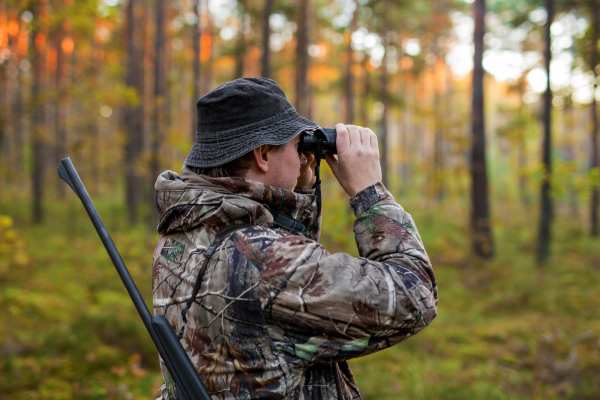
On 19 July 2026, from 2 to 3 p.m., the Schloss Landshut support association in Utzenstorf invites visitors to the next «Landshut Dialogue on Wildlife & Hunting». The topic: «Should bow hunting be allowed in Switzerland?» Announced as speaker is Melitta Maradi – forestry engineer ETH, managing director of Wildtier Schweiz and herself an active bow hunter. The moderation is taken on by Reinhard Schnidrig, former head of the Wildlife and Forest Biodiversity section at the FOEN, likewise an active hobby hunter from Valais.
Anyone who knows the organiser knows what to expect. The Schloss Landshut support association has been a member of JagdSchweiz since 1998 and is the operator of the Swiss Hunting Library, which houses, among other things, the archives of JagdSchweiz and other hunting associations. The Hunting Museum in Utzenstorf is not a neutral venue for a socio-political debate; it is an institutional arm of the Swiss hobby hunting lobby.
Already on 14 June 2026, the same organiser had held a panel discussion on fox hunting at the same venue, at which four of the five guests publicly belonged to the hobby hunting community. Critical voices were not heard, scientific foundations were not provided. The event on 19 July continues this tradition.
Melitta Maradi: managing director of Wildtier Schweiz and bow hunter
Melitta Maradi is no unknown figure in the Swiss hobby hunting scene. The forestry engineer ETH heads the office of Wildtier Schweiz in her main occupation, an association that sees itself as a link between research and hunting practice, and sits on the board of the Swiss Society for Wildlife Biology. Alongside this, she is an active hobby hunter and also travels abroad to hunt with bow and arrow where this is permitted. Her designation as a «wildlife biologist» in the event announcement is misleading: Maradi is a forestry engineer and an industrial engineer, not a doctorate-holding wildlife biologist. According to a 2019 decree of the cantonal government of Zurich, Maradi served as head of the Oberland hunting district and was thus a member of the cantonal hunting commission.
There is no statutory kill quota for the cruel and pointless hunting of fox, badger, songbird, duck and the like. In truth, there are dozens of scientific studies on the wildlife-biological nonsense of fox hunting. In 2011, for example, not a single red deer, roe deer, red fox, badger, marten, hare and so on was shot in Geneva. Unlike other cantons, Geneva still enjoys excellent hare populations – clear proof that uncontrolled hobby hunters are not needed, but rather game wardens who pour their heart into wildlife management. Incidentally, Maradi also travels abroad to hunt with bow and arrow – as an account of a course with Melitta Maradi attests. In other courses for Zürioberland Tourismus she serves the public predator food.
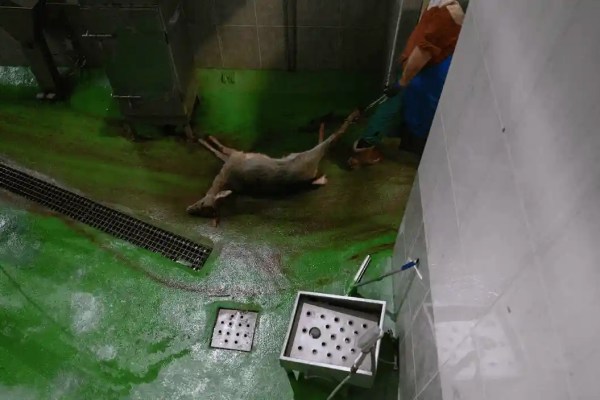
On the side, Maradi ran, under the label bodenhaftung.ch, paid nature courses for Zürioberland Tourismus. In one of these courses, costing CHF 100.– per person, the participants jointly butcher a roe deer killed on the Schauenberg, and the animal's offal is served as an aperitif. Venue: the Schlachthüsli in Hofstetten ZH.

The course text states that, apart from salt, sugar, vinegar and oil, the ingredients are «admittedly not organically certified – but pure nature!». This glorification overlooks the fact that the central «main course» too, a roe deer killed on the Schauenberg, is not organically certified. Unlike meat from controlled organic animal husbandry, game meat from hobby hunting comes from a shot animal whose flesh may be contaminated by ammunition residues in the area of the wound channel. To market it as «pure nature» is misleading, bordering on deception of consumers.
What course participants report about Maradi is revealing. In a public Facebook comment, a participant describes how she got to know Maradi through Züri Oberland Tourismus for a course on «edible wild plants». Maradi had once smelt a fox – «the reaction was worse than when our tomcat smells a mouse». The participant describes Maradi as a «real full-blooded huntress» who knows how «to bow and scrape with people too». What this reaction reveals about the psyche of hobby hunters is examined in our category Psychology & Hunting. In the Netherlands, the so-called E-Screener was therefore introduced, a psychological online test that all hunting licence holders must complete. The result was sobering: 20 to 25 percent of hobby hunters failed the test and had to hand in their weapon and hunting licence. One may assume that Melitta Maradi, who reacts to the smell of a fox «like a tomcat to a mouse» and serves course participants offal, would hardly pass such an aptitude test.

Reinhard Schnidrig: Former FOEN section head and active hobby hunter
The choice of moderator is telling. Reinhard Schnidrig was for years section head of Wildlife and Forest Biodiversity at the Federal Office for the Environment FOEN – and, according to his official appointment of 2005, an «active hunter in the cantons of Bern and Valais». This is not a moderator who mediates between animal welfare and hobby hunting, but a figure from within the hunting-policy establishment. It is obvious who is not invited to this dialogue: independent animal welfare organisations with a scientific mandate that have no affinity whatsoever with hobby hunting.

Bow hunting: Banned in Switzerland for good reason
Bow hunting is banned in Switzerland on animal welfare grounds and this legal position has a solid scientific basis. The evaluation of around two dozen studies from the USA shows that this hunting method often causes considerable animal suffering. In a study by the University of Oklahoma, during a bow hunt on white-tailed deer, 50 percent of the animals were merely wounded and initially could not be found. The Swiss Animal Protection (STS), in its strictly opposing stance, notes that the arrow shot forgives no inaccuracy of aim and frequently leads to through-shots without a guaranteed killing effect.
Even if one bases the figures on the more optimistic data provided by the bow-hunting associations, a wounding rate of 16 to 17 per cent remains; that is, every sixth to seventh animal hit suffers an agonising death without being recovered by the hobby hunter. This is not an acceptable level of animal welfare in a country with one of the strictest animal welfare laws in Europe.
The «Landshut Dialogue on Wildlife & Hunting» is not a dialogue. It is an event series run by a hunting museum belonging to JagdSchweiz, with speakers and moderators close to hobby hunting, and without any structural inclusion of independent animal welfare voices. The question «Is the ban on bow hunting one ban too many?» is posed rhetorically: it suggests that the ban requires justification, rather than the demand to lift it. An honest society turns the question around: why should a country that has written animal welfare into its Federal Constitution legalise a hunting method in which every sixth creature shot perishes in agony? The law has given the answer clearly for decades. There is no need for a «dialogue» about it; it needs to be enforced.
The Geneva model: hunting ban since 1974
Yet the canton of Geneva has provided the decisive counter-evidence to the hobby hunting ideology for over 40 years. Since 1974 hobby hunting has been banned in Geneva. Around two thirds of voters said yes at the time. According to a Tages-Anzeiger report the outcome is «consistently positive». Game wardens take over population control – at night, with light intensifiers and infrared. The cantonal fauna inspector Gottlieb Dandliker states: «99.5 per cent of the animals shot are killed instantly.» The suffering is minimal; there are almost no cases in which animals survive a kill wounded. With such an instant-death rate, there is no need for abnormally bred hunting dogs or laborious follow-up searches – both unavoidable side effects of hobby hunting that massively prolong animal suffering.
The cost of the entire wildlife management was calculated by the Neuchatel anthropologist Manue Pichaud: one million francs per year, that is 2.20 francs per inhabitant. The people of Geneva gladly pay this because they value encountering wild animals while walking in the open countryside. This impression has been scientifically confirmed: the canton recorded a strong increase in biodiversity in a long-term study. Roe deer, red deer and wild boars, which had almost entirely disappeared before 1974, now live in Geneva again. Martens, beavers, hares, weasels and birds of prey have recovered. Bertrand von Arx, Director of Biodiversity of the Canton of Geneva, confirms: «The hunting ban can be a means of increasing biodiversity.» Hunting accidents are no longer an issue. If Geneva were to vote again today, the approval would be even greater.
That is the model that works, not a «dialogue» about bow and arrows at the hunting museum in Utzenstorf.
LET'S STAY IN TOUCH!
We would like to send you the latest news and offers in our newsletter.