Aargau brevets 39 new hobby hunters and the political establishment applauds
A chorus of officials and the farmers' association celebrate the new recruits, while scientific objections to hobby hunting go unheard.
On 25 June 2026, another brevet ceremony was celebrated at Habsburg Castle.
4 young female hunters and 35 young male hunters received their hunting proficiency certificate and the traditional oak sprig, presented by Landammann Stephan Attiger (FDP) and Urs Wunderlin, the President of the hunting examination commission. The event was accompanied by a stream of rhetorical praise that has rarely been as relentless as this time.
«Don't let anyone tell you that the public would not stand behind hunting»
The opening words came from Daniel Johnson, Managing Director of Jagd Aargau. He recalled that, before the founding of the Aargau Hunting Protection Association (in 1883 in Baden), the forests had been almost devoid of game, and that laws from the federal government and the canton, in cooperation with the hunting community, had made the recovery of the wildlife populations possible. He gave the young hunters this message to take with them: «Don't let anyone tell you that the public would not stand behind hunting.»
Johnson directed a special word of thanks to Attiger, who is stepping down from politics at the end of the year and who, for the last time in his capacity as the «supreme master of the hunt of the canton», presented the certificates. As a farewell gift, he received a sign showing the way to the hunt.
Attiger: «High hurdles are a must» and the raccoon
Cantonal councillor Attiger noted that the number of 60 candidates showed that hunting was «as popular as ever». The hurdles for passing the examination were high, «but they are also meant to be high». As a new challenge, he expressly named the raccoon and its regulation.
How high the hurdles actually are can be read from the figures: 31 of the 39 participants passed the shooting examination. In the theoretical examination, in which six subjects are tested at short intervals over 20 minutes each, 18 of the 60 candidates failed.
«You are needed» – the farmers' association in unison
Urs Wunderlin urged modesty: «The forest does not belong to us hunters. But we are allowed to practise the craft of hunting in the forest.» The emotional conclusion was delivered by Colette Basler, cantonal parliamentarian and vice-president of the Aargau Farmers' Association. She thanked the hunters for their «tremendous efforts to keep the ecosystem in balance» and assured the newly certified: «But you are needed. We appreciate your work.»
«Keeping the ecosystem in balance» – Colette Basler's sentence sounds good and says nothing. Which balance? Measured against what? With which target values, which reference, which study? None of this is named, neither by the cantonal parliamentarian nor by the hunting examination commission nor by the cantonal government. «Balance» here is not an ecological quantity but an empty phrase that relabels a hobby as an unscientific service. Where a term is meant to justify everything without ever being defined, it is not an argument but a ritual.
The setting itself is telling. At Habsburg Castle, hunting was for centuries a privilege of the nobility, a symbol of rank, forbidden to common people on pain of punishment. Today the same privilege is open to anyone who passes an examination, yet the backdrop remains the same. What is being celebrated is not a conservation task but the adoption of an old gesture of dominion. The oak sprig, the certificate to hunt, the «supreme master of the hunt»: this is the language of class honour, not of ecology.
The frequently invoked «tradition» does not hold up either. Today's hobby hunting has absolutely nothing to do with the hunting of indigenous peoples. Those who hunt out of hunger kill what they need to survive, with respect for the animal and without choice. Modern hobby hunting, by contrast, is a leisure pleasure born of abundance: it is about the manipulation of populations, the systematic disturbance of flora and fauna, the falsification of scientific data for its own legitimation, and cruelty to animals when wounded animals take hours to die. Between a hunter who feeds his family and a hobby shooter who is certified for fun at Habsburg Castle lie not only centuries but two fundamentally different worlds.
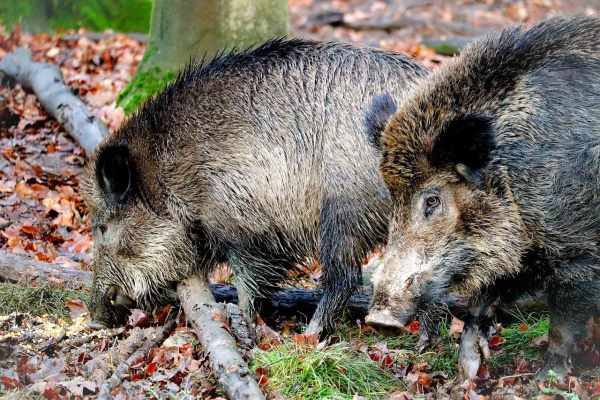
What hobby hunters actually do can be described soberly. They disturb flora and fauna on a massive scale and on a regular basis, stir up entire biotopes with driven hunts, and with night hunting do not even leave wild animals the peace of darkness. Nor do they regulate populations sustainably — quite the opposite: with species such as the wild boar, hunting pressure promotes reproduction, because hunted populations produce offspring earlier and in greater numbers. Hobby hunting thus creates precisely the «problems» for whose solution it then takes the credit.
What is also kept quiet at such celebrations is what hobby hunting leaves behind physically in the landscape. Every shot disperses ammunition residue into the soil, water and food chain — and does so lastingly, because metals are not broken down but merely relocated. Lead ammunition is only the best-known case: wounded animals that are not found carry the projectiles in their bodies for years, dead carrion poisons birds of prey and scavengers, and the fragments accumulate in the ecosystem. But lead-free alternatives made of copper, zinc or other alloys are no clean way out either: they likewise release heavy metals, whose long-term effects on soils and waters have barely been researched. Anyone who fires thousands of shots year after year is not practising nature conservation, but a creeping input of pollutants into precisely the nature he claims to protect.
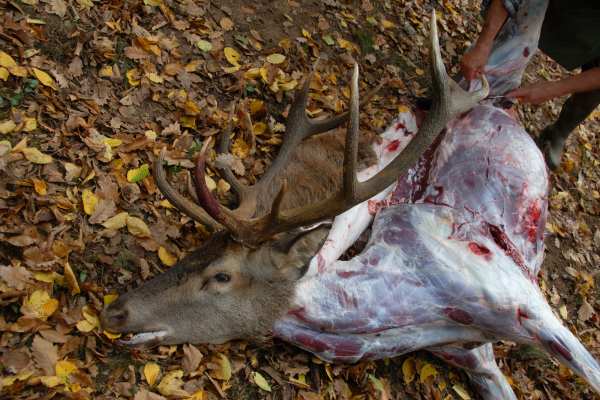
And the damage does not end in the forest. The projectiles fragment inside the animal's body, with the finest particles spreading through the tissue far beyond the visible wound channel. Into the game meat that subsequently ends up on the plate. What is marketed as «natural organic meat» is in truth a foodstuff contaminated with ammunition residue. Several independent specialist bodies warn against it: the Swiss Federal Food Safety and Veterinary Office (BLV), the German Federal Institute for Risk Assessment (BfR) and the European Food Safety Authority (EFSA) explicitly advise pregnant women, children and women of childbearing age against consuming lead-contaminated game meat. Hobby hunting thus contaminates not only the environment, but also its own end product.
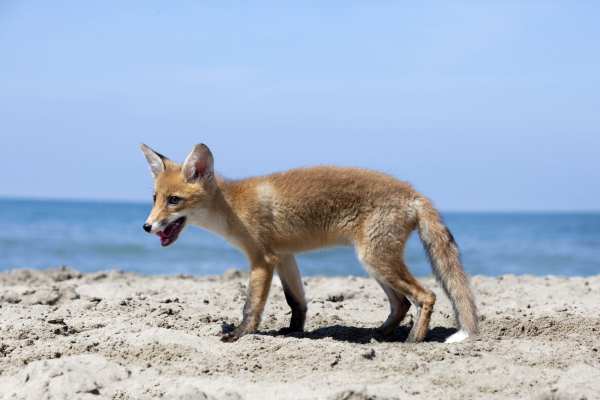
That hobby hunting has nothing to do with science is shown particularly clearly by the way the fox is dealt with. Studies for the Bernese Mittelland estimate that a single fox kills an average of around eleven roe deer fawns between May and July. In Scandinavia, when mange caused the fox population to collapse, the roe deer population rose by 64 per cent. The fox thus regulates the roe deer free of charge and naturally, if it were allowed to. But that is precisely what hobby hunting does not permit: it fights the fox because it is its competitor for the roe deer, and then shoots the fawns itself. The predator, which would do the work free of charge, is declared a troublemaker and eliminated.
How little hobby hunting actually regulates has, of all things, been put on official record by a Swiss canton. The canton of Zug was the only one so far to commission an independent scientific study: the SWILD study of May 2026 (Dr Claudia Kistler / Dr Fabio Bontadina, commissioned by the Office for Forest and Wildlife) comes to the clear conclusion that the fox hunting practised neither sustainably reduces population size nor curbs wildlife diseases. Hunted populations compensate for the losses through higher fertility of the vixens, better survival rates and immigration. On 16 June 2026 the hunting commission drew the consequences and no longer proactively promotes fox hunting. In plain terms: the authority confirms in writing that fox hunting is not needed.
And Aargau? Here, of all people, the very hobby hunters who do the opposite of what the Zug study suggests are being celebrated and showered with praise. Across Switzerland, around 19’000 red foxes are shot year after year, a considerable proportion of them in Aargau, without any demonstrable benefit for health or agriculture. Anyone who kills thousands of healthy animals and thereby triggers compensation effects keeps nothing in balance. He manipulates and destroys a natural order that would function better without him.
That it is precisely the hunting-free areas which prove this is never mentioned at such celebrations. The Swiss National Park has been hunting-free since 1914, the canton of Geneva has done without hobby hunting since 1974, Luxembourg banned fox hunting in 2015, and in none of these areas have the ecosystems collapsed. In Luxembourg, the infection rate with the fox tapeworm even dropped significantly after the ban.
The raccoon invoked by Attiger also fails as a justification. That an introduced species creates new «challenges» is correct, but hobby hunters do not solve them. Where predators such as the raccoon are hunted, the populations compensate for the loss through immigration and reproduction. The kill creates the very task it supposedly resolves.
«We need you», the Farmers' Association calls out to the 39 new hobby hunters. The more honest question would be: for what exactly? For a hobby that disguises itself as nature conservation, science has given the sober answer for decades — most recently in an official capacity from the canton of Zug: we do not need you.
LET'S STAY IN TOUCH!
We would like to send you the latest news and offers in our newsletter.