Italy's 'Sparatutto' act: vote on 27 November
The parliamentary group leaders of the Camera have scheduled the reform of the hunting act for 27 November, even though more than a million amendments are pending in committee. The text of the bill removes the wolf from the list of strictly protected species and ends the practice of closing the hunting season in February.
Symbolic image. Photo: Madara / Unsplash
They Came a Long Way
The reform of the Italian hunting act reaches the Chamber of Deputies on 27 November. This was decided by the Conference of Parliamentary Group Leaders (Conferenza dei Capigruppo) on 29 October, as reported by La Nuova Ecologia and the WWF Italy. The subject is Bill No. 2984, which the Senate passed on 23 June 2026 as Bill No. 1552 by 80 votes to 56, with 2 abstentions (Sbircia la Notizia). Critics call it the 'Legge Sparatutto', the 'shoot-at-everything act'.
Over a million amendments pending
In the Chamber's Agriculture Committee, a total of 1,042,757 amendments were tabled, according to the specialist portal IoCaccio, as announced at the session of 28 July; the bulk of them come from the Movimento 5 Stelle. On 27 October the committee was still working through the amendments to Article 1. The new committee chair Francesco Bruzzone (Lega), successor to Mirco Carloni, announced that he would apply the parliamentary rules of procedure strictly in order to speed things up. The rapporteurs are, according to the parliamentary database, Laura Cavandoli and Monica Ciaburro.
The reform is not uncontroversial even within the governing coalition: Forza Italia deputies have tabled 14 amendments which would, among other things, double the maximum fines and introduce a mandatory suspension of the hunting licence of between three months and one year following a final conviction.
What the text of the act says
The bill amends Hunting Act 157/1992 in numerous respects. The text passed by the Senate provides, among other things, for:
- Wolf: It is removed from the list of strictly protected species in Article 2 (Art. 3). This does not, however, make it huntable.
- Hunting season: The limit preventing the hunting season from being extended beyond the first ten days of February is deleted (Art. 11).
- ISPRA: The requirement that the regions must follow the opinion of the national environmental agency ISPRA when drawing up their hunting calendars («al quale devono uniformarsi») is dropped. In future, the opinions of ISPRA and of the national technical hunting committee will count (Art. 11).
- New huntable species: Greylag goose (Anser anser) and feral pigeon (Art. 11).
- Hunting estates: For private hunting estates (aziende faunistico-venatorie), the «non-profit» requirement is dropped; regional concessions run for ten years and are renewable (Art. 10).
- State forest: State-owned forest land belonging to the state, regions and public bodies is brought into hunting planning (Art. 6).
- Decoy birds: Each recreational hunter is permitted up to ten captured decoy birds per species and 40 in total; no upper limit applies to ringed, captive-bred decoy birds. The regions regulate the setting up of trapping facilities (Art. 4 and 5).
- Snow and night vision: Hunting on snow-covered ground is permitted nationwide for selective hunting of ungulates and for driven hunts of wild boar (Art. 15). For selective hunting of ungulates, optical and optoelectronic devices are allowed, except for species listed in Annex V of the Habitats Directive (Art. 8).
- Obstruction of hunting: It is now prohibited to «prevent, obstruct or slow down» control measures and hunting. Anyone who obstructs control measures risks a fine of 150 to 900 euros (Art. 15 and 19).
- Lead: Two paragraphs of Article 31 of the hunting act are repealed, and the wetland maps under the EU chemicals regulation REACH are to be regarded only as «indicative and not exhaustive» (Art. 20).
- Purpose clause: Hunting is in future also to take «traditions» into account and to «contribute to the protection of biodiversity and the ecosystem» (Art. 2).
According to the alliance of associations, whose statement we La Nuova Ecologia and the WWF Italy reproduce, the text has already been the subject of objections from the EU Commission over possible conflicts with EU law, above all with the Birds Directive. According to an analysis by the legal journal Giustizia Insieme the Commission's Directorate-General for the Environment had already warned the ministry in December 2025 of a risk of infringement proceedings, among other things over the repeal of the end-of-February cut-off, the night vision devices and the capture of wild birds as decoys. Infringement proceedings 2023/2187 against Italy on hunting and lead ammunition are also already under way (Sbircia la Notizia). Wild beim Wild has reported extensively on the dispute with Brussels and the role of the hunting lobby in detail.
Broad resistance
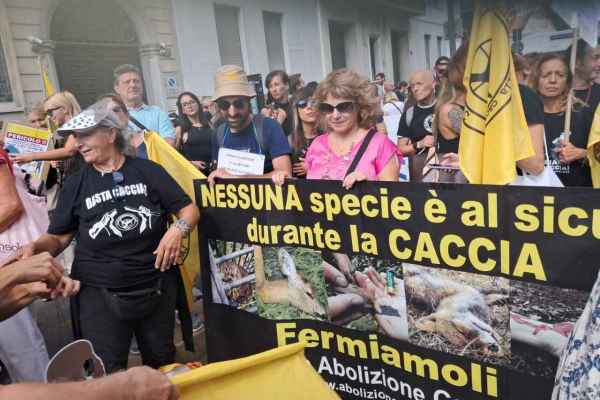
An alliance of Greenpeace, Legambiente, LAV, Lipu, WWF Italy, ENPA and other organisations describes a law that weakens the protection of wild animals and widens the scope for killing them for pleasure. “Wild animals do not belong to the lobby of guns and cartridges,” the joint statement says. The organisations stress that wild animals belong to the general public; under Article 1 of Law 157/1992 they are inalienable state property (patrimonio indisponibile dello Stato).
On 31 October, around twenty organisations protested outside the prefecture in Genoa. They recalled that since the 2022 revision, the protection of animals has been enshrined in Article 9 of the Italian Constitution (La Voce di Genova). Back in September, a national alliance had already mobilised against the bill in Milan. The public, too, does not back more recreational hunting, as an Ipsos survey shows.
Why this concerns Switzerland
Many of the migratory birds hunted in Italy cross the Alps and travel through Switzerland. The cases of Brescia and Castel Volturno show how widespread illegal bird hunting is already south of the border. That courts can push back is shown by the latest ruling in Sicily. Further articles can be found in the section Hunting Act.
More on the subject of recreational hunting: What the research says about this is shown by Hunting fact-checked: the state of research.
The position of IG Wild beim Wild: IG Wild beim Wild rejects recreational hunting. Our model is the canton of Geneva, which has managed without recreational hunting since 1974: without hunting seasons, without hunting dogs, without driven hunts, without high seats, without the animal cruelty and crime that go hand in hand with hunting season elsewhere. What has worked there for over fifty years disproves every position paper by JagdSchweiz. An association that bases its policy on claims it refutes in its own documents is not a professional organisation, but a factory for misinformation.
Wild animals need a voice
Once a week: research, petitions and background information on recreational hunting. Free of charge and can be unsubscribed from at any time.

All articles are written by IG Wild beim Wild as well as by external co-authors. Research, structuring and editorial processes may be supported by AI-assisted tools.
Support our work
With your donation you help protect animals and give their voice a hearing.
Donate now →