Initiative «For Safe Food»
Today, 50% of the Swiss population's food supply depends on imports from abroad. And when it comes to water supply, Switzerland does not know how much water it consumes or how much it has available.

Initiative «For Safe Food»
Today marks the start of the signature collection for the new initiative «For Safe Food» in Switzerland.
It builds on the demands of the Clean Water Initiative and focuses on food security. It calls for the long-overdue reorientation of agriculture and the food industry in favour of our food security and sufficient clean drinking water – our food staple No. 1.
The climate crisis shows us that even in Europe's water tower, drinking water and water for food production can quickly become scarce. To this day, agriculture and the food industry have not been prepared for the production uncertainties that climate change brings with it. Furthermore, the food supply of the Swiss population is currently 50% dependent on imports from abroad. In the absence of imports, the food security of the population cannot be guaranteed. And when it comes to water supply, Switzerland does not know how much water it consumes or how much it has available. Current agricultural policy is therefore achieving the opposite of the food security that was enshrined in the constitution in 2017.
The fact that Switzerland must import half of its food is not due to a lack of agricultural land — it is a direct consequence of the production and consumption of animal-based foods being subsidised far more heavily than plant-based foods: 2.3 billion compared to 0.5 billion francs.
More plant-based foods
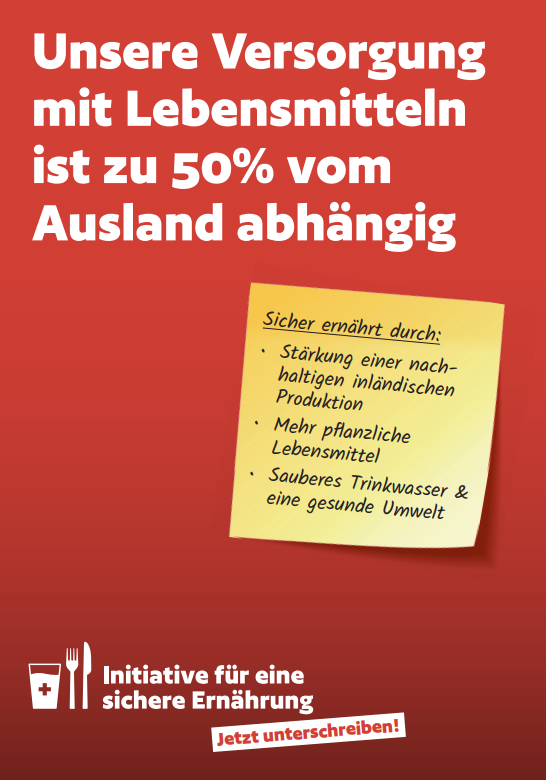
The meadows and pastures of Switzerland are well suited for grassland-based meat and dairy production. However, today's feed crop cultivation — such as maize and grain — occupies 60% of domestic arable land and directly competes with human nutrition. By increasing the cultivation of plant-based foods for the population, such as legumes or grains, far more calories could be produced per hectare of arable land, and with significantly less water consumption. As a result, a shift toward more plant-based foods could raise the net self-sufficiency rate from today's 50% to at least 70%. This is precisely what the initiative «For Secure Food» demands.
The initiative also responds to a shift in public attitudes that has yet to be reflected in agricultural policy: already more than 60% of the Swiss population eat flexitarianly, consciously consuming fewer animal products out of concern for the environment and animal welfare. This opens up new perspectives for farmers and offers them the opportunity to gain a foothold in the booming, environmentally and climate-conscious growth market for plant-based foods.
It is little known, and the agricultural sector does not inform the public either, that half of the 16 million farm animals kept in Switzerland are fed with imported feed, further driving the production of animal products – with serious consequences for the environment. Excessive slurry and nitrogen over-fertilise our soils, forests and waterways, contaminate our drinking water with nitrates, destroy biodiversity and soil fertility, and exacerbate the climate crisis. The maximum limits for fertilisers and nitrogen, which have been enshrined in the environmental targets for agriculture since 2008 to protect the environment and thus our food security, are being massively exceeded as a result. In the case of the toxic nitrogen-containing gas ammonia, by as much as 70%.
Science also urgently calls for a new, balanced equilibrium between the production and consumption of animal and plant-based foods in order to protect water quality, biodiversity, clean drinking water, and to address the climate crisis. Practice and agricultural research show that biodiversity and soil fertility are crucial for sustainable food production. These “free services” of nature generate higher yields in agriculture and can replace pesticides and synthetic fertilizers.
The initiative «For a secure food supply» demands that the net self-sufficiency rate be raised from today’s 50% to at least 70% through the production of more plant-based foods, and that biodiversity and soil fertility be secured as the foundational basis for agricultural production, along with greater use of naturally seed-stable seeds and planting material. To ensure sufficient clean drinking water, groundwater resources are to be protected for sustainable drinking water supply.
Maximum limits for fertilizers/nitrogen must no longer be exceeded, and subsidies, research, education, and training are to be aligned with the goals of the initiative. Farmers are to receive additional financial support from the federal government when agricultural adjustments become necessary.
| You can help all animals and our planet with compassion. Choose empathy on your plate and in your glass. Go vegan. |