Female recreational hunters learn self-defence: what the «Hunting Safely» course reveals about recreational hunting
When women have to learn self-defence in the hunting ground, it says everything about the male culture of recreational hunting.
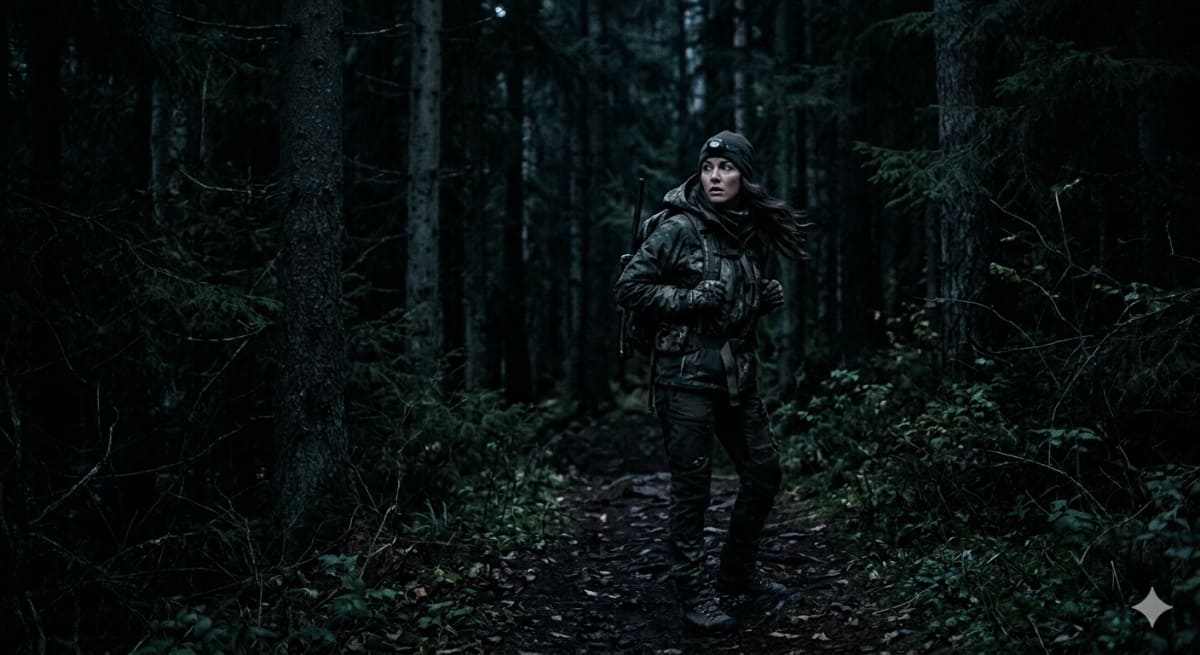
«Sworn»
Female recreational hunters need self-defence courses.
Not because of wild boars or darkness in the forest, but because of their own hunting colleagues. That is the unspoken message behind the «Hunting Safely» pilot project, which the München-Land Hunters' Association set up specifically for women in the hunting ground.
In three modules, the participants learn how to correctly assess threatening situations, avoid conflicts through de-escalating measures and, if necessary, defend themselves effectively with the simplest of means. The workshop is aimed at female recreational hunters of every age and level of fitness. Phrased officially, that sounds matter-of-fact. But anyone who asks whom women in the hunting ground are afraid of receives an uncomfortable answer: men with a hunting licence.
The silence behind the course
Many female recreational hunters have to deal with dubious, sexually harassing messages from their male recreational hunting colleagues online. Screenshots show the sheer frequency of such messages from within their own ranks. The hunting magazine PIRSCH already reported on this back in 2024. The message was clear: sexism and harassment are not a fringe phenomenon in recreational hunting, but structurally anchored.
Following this logic, the «Hunting Safely» course is not a voluntary additional training. It is a symptom. A community in which women have to actively learn to protect themselves from their own members has a problem with its culture, not with the darkness in the forest.
The power imbalance in the hunting ground
«Stubborn green-coats, who have a problem with women going hunting anyway, won't let up. Women often feel pressured.» This is how an experienced recreational hunter describes everyday life in a scene that still operates as a male domain. Anyone who doesn't shoot, even though recreational hunters had expected it, has to justify themselves. Anyone who leaves the high seat alone at night bears the risk themselves.
This power imbalance is no accident. In recreational hunting one encounters enemy stereotypes, demeaning rhetoric and a culture that normalises violence as a means of solving problems. If you look at the profiles of recreational hunters on social networks, they are bursting with conservatism, sexism and far-right ideology. Anyone who has grown up in such structures learns that dominance and control are taken for granted, whether towards animals or towards women.
The recreational hunting scene and right-wing extremism: no coincidental overlap
Sexism and transgressive behaviour in recreational hunting cannot be separated from the rest of hunting culture. As we documented in our dossier «Recreational hunters and right-wing extremists: The overlaps», far-right organisations deliberately seek closeness to the recreational hunting scene, because the cultural overlaps are great: an affinity for weapons, hierarchical thinking, a rejection of equality, a conception of nature in which killing establishes a natural order.
Both camps, in their diffuse demands, place value on a culture of violence. Problems are solved militantly with weapons. In this way a sealed-off grouping has emerged that is barely accessible to new information. That women are structurally disadvantaged and endangered in this milieu is no surprise, but a direct consequence.
What the figures say
Violence against women in the context of recreational hunting is not systematically recorded. What exists are general data: according to the German LeSuBiA study on undisclosed offences, almost one in two people in Germany has experienced sexual harassment over the course of their life. Women are more frequently and more severely affected by partner-related or gender-specific violence, particularly when it comes to sexual assault and stalking.
Fewer than ten percent of these incidents are reported. Unwanted touching or exhibitionist acts have been experienced by 14.5 percent of women in the past five years. The number of unreported cases in such a closed social milieu as the recreational hunting scene is likely to be correspondingly high.
A course as a silent cry for help
The «Safe Hunting» workshop makes visible what the hunting associations would rather not address. Instead of questioning structures, responsibility for one's own safety is delegated to those affected. Women recreational hunters learn to protect themselves. Male recreational hunters learn nothing.
That is the real problem. Not the course itself, which may be helpful in individual cases, but what its necessity reveals: that recreational hunting as an institution evidently cannot or will not provide protection for women within its ranks by its own efforts.
In a community that invokes ethics, tradition and a sense of responsibility, this is a damning record.
More on the subject of recreational hunting: In the dossier Psychology of recreational hunting we put research, motives and social consequences into perspective. What the research says about this is shown by Hunting fact-checked: the state of research.
The position of IG Wild beim Wild: IG Wild beim Wild rejects recreational hunting. Our model is the canton of Geneva, which has managed without recreational hunting since 1974: without hunting seasons, without hunting dogs, without driven hunts, without high seats, without the animal cruelty and crime that go hand in hand with hunting season elsewhere. What has worked there for over fifty years disproves every position paper by JagdSchweiz. An association that bases its policy on claims it refutes in its own documents is not a professional organisation, but a factory for misinformation.
Support our work
With your donation you help to protect animals and give their voice a hearing.
Donate now →