GPS sow gave away wild boars: recreational hunter shot colleague
In the Vaud forest of Oulens-sous-Échallens, wild boars were only tracked down thanks to a GPS transmitter on a sow, which the cantonal game warden made available to the recreational hunters. An 80-year-old former Diana Vaud president then fired banned driven shots into a bramble thicket, killing a 64-year-old colleague.
«The green network of favouritism»
On 29 November 2024, six recreational hunters met in Gros-de-Vaud for a wild boar hunt.
An initial stalk in the Daillens area had yielded no quarry. In the early afternoon, the group moved on to Oulens-sous-Échallens, where wild boars had been spotted. The game warden had supplied the information: a GPS collar had been fitted to a sow in the sounder, revealing their whereabouts. A short time later, a 64-year-old recreational hunter from the canton of Fribourg was dead, struck in the head by a banned "deterrent shot" fired by an 80-year-old colleague.
The real scandal: fitting wild animals with transmitters to make them easier to kill
GPS radio collaring of wild animals is originally a tool of wildlife research. Institutes such as KORA use collar transmitters to scientifically record movement patterns, habitat use and population dynamics. However, when authorities pass such data directly on to recreational hunting groups so that they can specifically track down and kill a sounder, research is repurposed into an instrument of pursuit.
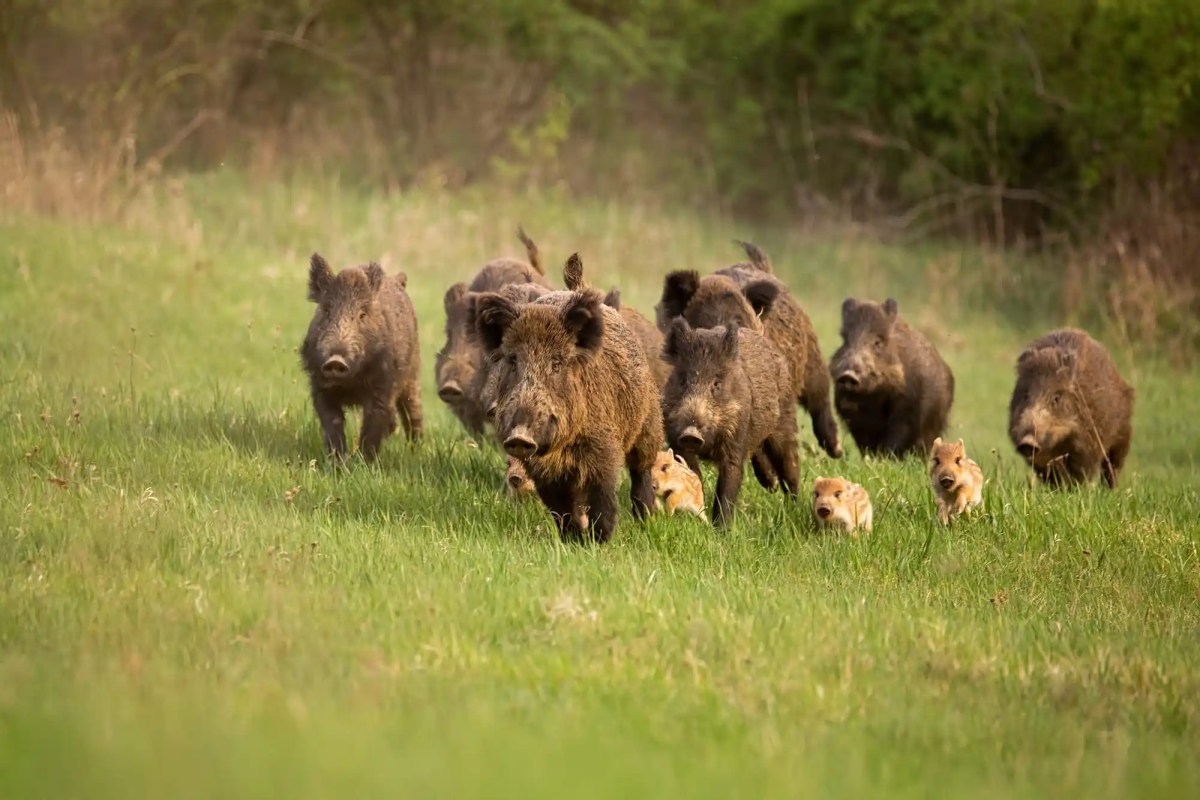
In the Oulens-sous-Échallens case, the game warden handed recreational hunters the location of the animals because a sow was radio-collared. So it was not hunting skill, patient stalking or tracking that found the wild boars, but a satellite signal from a collar the sow was forced to carry. The animals had nothing to counter this technological surveillance with. As wild animals do, they retreated into dense bramble thickets, a refuge inaccessible to humans. It was precisely there that they were tracked down via their radio-collared lead sows.
This practice has nothing to do with traditional hunting. It turns wild animals into data points and recreational hunters into receivers who merely need to follow the signal. It reveals convenience and incompetence, not hunting skill. And it violates the spirit of Article 51 of the Vaud Hunting and Fishing Act, which prohibits the use of artificial means to track down or lure game, even if the official radio collaring may formally be declared as «monitoring».
Three legal provisions broken in one fell swoop
When the radio-collared sounder got stuck in a dense thorn thicket on a hill and the 80-year-old's dog also failed to return from the undergrowth, he decided to drive the game off with shots in order to protect his dog. In the past he had already lost hunting dogs during wild boar hunts. This decision violated no fewer than three provisions of the cantonal Hunting and Fishing Act:
- Article 49 requires that the targeted animal be clearly identified before the shot is fired and that the shot endanger no one, either directly or indirectly.
- Article 51, paragraph 1 prohibits artificial means of deterring or luring game.
- Article 46 explicitly prohibits firing shots to scare off game. The accused was aware of this provision.
Despite this, the 80-year-old fired two shots towards the ground without looking through his telescopic sight, without being able to see what was behind or in the thorn bushes, and without identifying the wild animals themselves. To make matters worse, there was a technical failure: the angle between the barrel and the ground was 6.3°. However, the recommendations of the Swiss hunting authority require at least 10° so that a ground shot actually lodges in the earth and is not deflected. One of the two shots fatally struck the 64-year-old recreational hunter from Fribourg in the head, who was positioned as a shooter below the hill.
The authority's role: when the game warden becomes a supplier
The real systemic scandal lies not only with the individual shooter, but in the entanglement between the cantonal wildlife wardens and the recreational hunting association. The game warden who had supplied the GPS data of the radio-collared sow is a member of the cantonal service. He passed this information on to a group of private recreational hunters, one of whom was a former president of the cantonal hunting association Diana Vaud and a former municipal councillor. Personal and institutional proximity between association officials and wildlife wardens is the rule, not the exception, in licence hunting cantons.
This raises fundamental questions: What legal basis exists in the canton of Vaud for the authority to radio-collar wild boars? Is the movement data from these collars systematically passed on to recreational hunting groups to make it easier to « remove » populations? How many wild animals in the canton currently carry collars whose data is used in recreational hunting contexts? And how does this practice relate to Article 51 of the cantonal law, which prohibits artificial aids for tracking game?
These questions have not been raised in the media coverage to date. Yet they are central to placing the Oulens-sous-Échallens case in its political context.
The animal welfare dimension: stress, separation of piglets, ricochets
Even if the fatal shot had not struck the 64-year-old recreational hunter, the practice would still have violated animal welfare law. Article 4 of the Animal Welfare Act (TSchG) prohibits causing an animal unjustified pain, suffering or harm. Shots fired into a thicket where a sow with potential piglets is hiding structurally fulfil this offence: wild animals panic, can be wounded without a follow-up search, sows can be separated from their piglets, and ricochets can strike animals that were not the intended target.
Added to this is the ethical dimension of the radio collaring itself. Wild animals are captured for research purposes, sedated and fitted with a collar. This intervention is justifiable in a research context if it serves a clear scientific purpose and is carried out with due care. However, if the data obtained in this way is subsequently used to kill the animals more precisely, the original intervention retrospectively becomes a form of betrayal: the animal was marked in the trust that it would be accompanied by science, and ends up as a trackable target.
Trial date: 21 May 2026 in Yverdon-les-Bains
The trial against the 80-year-old recreational hunter will take place on 21 May 2026 before the District Court of Broye and Northern Vaud in Yverdon-les-Bains. The public prosecutor is seeking a ten-month custodial sentence, suspended with a two-year probationary period, a fine of 2,000 francs (convertible into 20 days' imprisonment), a four-year hunting ban, and 74,439 francs in damages to the family of the recreational hunter who was killed. The accused has admitted to the act, waived his right to appeal, and is benefiting from a simplified procedure. He is receiving psychological care, has voluntarily surrendered his hunting licence, and his weapons were confiscated due to the risk of suicide.
The Geneva model: no recreational hunting, no fatalities, no collar scandals
In 1974, the canton of Geneva abolished recreational hunting by popular vote. Wildlife population management is now carried out by cantonally employed game wardens. Fatal shooting accidents like the one in Oulens-sous-Échallens have been ruled out in Geneva for over fifty years, because no groups of private recreational hunters with long guns move collectively through difficult terrain. Nor does a situation arise in which game wardens pass on GPS data from radio-collared wild animals to private recreational hunting groups.
The Geneva model shows that wildlife population management is possible without recreational hunting, safer for people, and more transparent, because professional wildlife wardens are subject to state oversight rather than to the dynamics of hunting associations. Anyone who reflexively calls for "more training" after every fatal incident is ignoring this structural alternative.
More on the subject of recreational hunting: In the dossier Poaching and hunting crime in Switzerland we document cases, legal questions and recurring patterns. What the research says about this is shown by Hunting fact-checked: the state of research.
The position of IG Wild beim Wild: IG Wild beim Wild rejects recreational hunting. Our model is the canton of Geneva, which has managed without recreational hunting since 1974: without hunting seasons, without hunting dogs, without driven hunts, without high seats, without the animal cruelty and crime that go hand in hand with hunting season elsewhere. What has worked there for over fifty years disproves every position paper by JagdSchweiz. An association that bases its policy on claims it refutes in its own documents is not a professional organisation, but a factory for misinformation.

All articles are written by IG Wild beim Wild as well as by external co-authors. Research, structuring and editorial processes may be supported by AI-assisted tools.
Support our work
With your donation you help protect animals and give their voice a hearing.
Donate now →