Forest Conversion: Paths to Resilient Mixed Forests in the Face of Hunting
Forest conversion is a central topic in forestry that is gaining increasing importance.

Against the backdrop of climate change and the ongoing threats posed by pests and disease, the creation of more robust and sustainable forest ecosystems is essential.
But what exactly is meant by forest conversion and what challenges must be overcome in the process?
Many people are not entirely clear about where exactly this ‘forest conversion’ is supposed to lead. It is always said to be towards healthy mixed forests. Yet the yields of forestry operations at higher elevations are mostly generated with tree species such as spruce and pine.
In the face of vast areas of destroyed natural land, a portion of those responsible for forestry have recognised that the monocultures created by humans are the cause of the utterly devastated expanses of ‘forests’, and are consequently also partly responsible for the unprecedented mass extinction of species and for climate change.
In many regions, however, large areas of monocultures — particularly spruce and pine — are still being managed. While these tree species yield strong returns and are optimised exclusively for mechanical felling, they are vulnerable to pests and disease. A change in thinking is therefore required in order to increase diversity within forests.
The primary purpose of forest conversion is to promote healthy mixed forests that are more resilient to environmental influences. Mixed forests offer numerous advantages, including greater biodiversity, better adaptability to climatic changes, and more sustainable use of resources.
The Swiss stone pines play an important role in the alpine ecosystem. They provide habitat for numerous animal species, including birds, insects, and mammals. Furthermore, their dense root systems contribute to soil stabilization and reduce the risk of erosion in mountain areas.
When the European beech successfully re-established itself in Central Europe after the last Ice Age, approximately 6’000 years ago, large parts of the continent had already been occupied for millennia by red deer and roe deer, as well as other herbivores such as wisent, wild horse, and elk. The fact that these large herbivores — true landscape gardeners — are today regarded by many foresters as competitors of forest development cannot therefore be attributed to our native herbivores.
Challenges in Forest Conversion
The transition to mixed forests is associated with various challenges:
- Slow growth rates: Trees such as beech and oak have long rotation periods, meaning it can take years before they reach a notable size. During this time, existing tree species may already need to be removed, which can result in a lack of yield. By the time the forest has been converted, there will long since be other forestry buzzwords dominating the discourse.
- Economic aspects: The willingness of the forestry sector to switch to alternative tree species often depends on current market prices. Mixed forests may generate lower short-term yields, but in the long term they could secure more sustainable revenue.
- Wildlife and ecology: Another important aspect is the coexistence of forest and wildlife. It is essential to find a balance; not every instance of damage caused by wildlife should automatically be regarded as negative. Wildlife can also contribute to the preservation of biodiversity. Wildlife is not the enemy of the forest.
In forests, hobby hunters are frequently active without meaningful purpose out there, trying to shoot nature into shape so that roe deer and red deer hide away. Recreational hunters disrupt population dynamics. Where roe deer and red deer are very shy due to heavy hunting pressure, they avoid areas with little cover, even if these offer good food sources. They then remain in the forest, where there is little to eat apart from young trees. Because wildlife therefore often finds nothing else to eat due to hunting pressure, they browse on trees in the forest. In doing so, they can destroy a not insignificant proportion of the young trees that are, however, important for forest conversion.
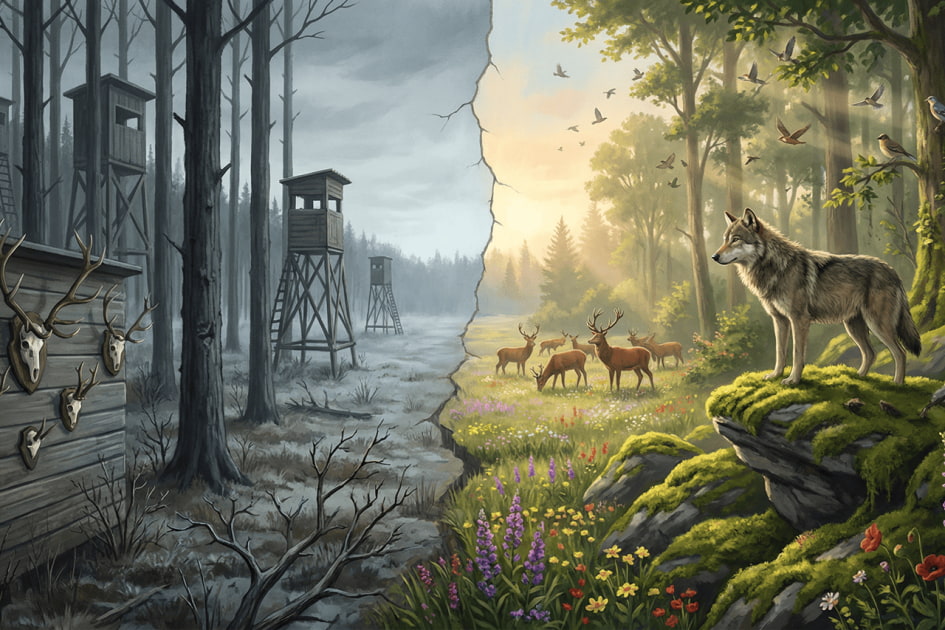
A persistently high hunting pressure has not regulated roe deer and red deer populations to the desired level, but has instead kept them highly productive at a high level. Only with the arrival of the wolf and other predators have populations been able to be reduced in certain areas.
The human being is the problem. One solution would be to change the behaviour of wildlife and to accept predators such as the wolf and the lynx. To achieve this, however, a rethink would be required and less hunting would need to take place. In parallel, roe deer and red deer would need alternative food sources and protected spaces. Roe deer and red deer also like to feed in clearings in the forest. If they feel undisturbed there, they may not even get the idea — or do so far less frequently — of feeding on trees. Wildlife biologists have therefore been calling for years to reduce hunting and to establish wildlife quiet zones.
The triad of plants, herbivores and predators is nature, has of course functioned for millions of years, but we now live in a ‚cultural landscape‘, as it is portrayed by the forestry and militant hunting lobbyists.
The predators, in turn, are the competitors of the hunting sector, and so it is not truly surprising that the wolf is now in fact also being held responsible for the currently smaller hunting bags in certain regions — regions in which, however, shooting plans previously prescribed the liquidation of more herbivores for forest conversion.
But why, exactly, does a conservationist — as many a recreational hunter likes to call themselves — lament the fact that hunting bags are getting smaller?
Forest conversion is a necessary and long-term process that must take into account both economic and ecological perspectives. It requires a rethinking among recreational hunters and the forestry sector in order to successfully establish mixed forests and preserve the forest as a vital part of our ecosystem. The key to successful forest conversion lies in a new integrative strategy that takes into account both the needs of nature and those of wildlife.
Further articles
- Wolves under constant fire: How Swiss hunting policy ignores science and ethics
- Protective forest: Recreational hunting creates problems it claims to solve
- The wolf is not the problem – it is the solution
- Forest conversion: Pathways to resilient mixed forests in the face of hunting
- Forest conversion near the Lukmanier Pass
- Hunting is not the solution for forest conversion
- Recreational hunters do not help forest conversion
- The conflict between forestry, hunting and wildlife
RECREATIONAL HUNTER RADAR
On the trail of hidden animal welfare offences, poaching and/or criminal activity? Report suspicious cases to us! Help with the great recreational hunter radar.

More on the subject of recreational hunting: In our dossiers on the criticism of recreational hunting gather fact-checks, analyses and background reports. What the research says about this is shown by Hunting fact-checked: the state of research.
The position of IG Wild beim Wild: IG Wild beim Wild rejects recreational hunting. Our model is the canton of Geneva, which has managed without recreational hunting since 1974: without hunting seasons, without hunting dogs, without driven hunts, without high seats, without the animal cruelty and crime that go hand in hand with hunting season elsewhere. What has worked there for over fifty years disproves every position paper by JagdSchweiz. An association that bases its policy on claims it refutes in its own documents is not a professional organisation, but a factory for misinformation.