Forestry, Recreational Hunting and Wildlife in Conflict
Nature functions — this does not need to be proven scientifically; it was functioning long before our human existence. Yet now, in what foresters and hunters so frequently call our “cultural landscape,” everything has been “eaten bare.”


Roe deer are eating up the forest, wolves are eating up the wildlife
The forestry industry claims that roe deer are eating up the forest, and the hunting lobby claims that wolves are eating up the wildlife.
Forest regeneration is the buzzword of modern forestry. As a recent issue of forsterklaert.de put it: «Forests do not only emerge through human hands, but also through entirely natural development. When trees shed their seeds and small trees grow from them, foresters speak of natural regeneration.» It is, frankly, alarming that we humans have drifted so far from nature that the most natural of natural processes — reproduction — is being sold to us as a new scientific insight.
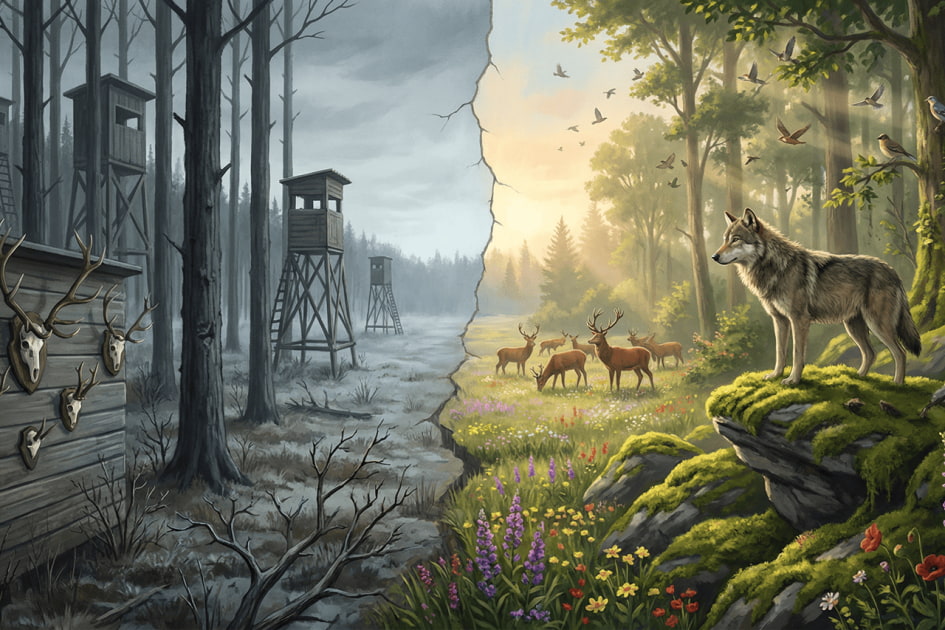
How inconceivably far removed from this is the idea of urgently needed rewilding — that is, renaturalisation — the concept of simply giving nature the space and time to regenerate on its own. In this way, healthy and resilient mixed forests with great biodiversity and the best conditions for wildlife diversity too: we simply need to allow them to exist.
The triangle of plants, herbivores and predators is nature — it has, of course, been functioning for millions of years — yet we now live in a “cultural landscape,” as it is portrayed by the forestry and hunting lobbyists.
The Forestry-Hunting Conflict
The term 'cultural landscape' refers to a landscape shaped in its form by human activity. According to the beliefs of the corresponding communities, the cultural landscape has developed from the natural landscape over thousands of years. In this landscape, humans must today manage wildlife and plants — the plant world by the forestry lobby, 'trees don't grow on their own, after all,' but naturally also the world of wildlife, the latter by the recreational hunters. Ultimately, it is the human who stands above all else and simply assumes the right to do so — so the prevailing opinion goes.
The so-called forestry-hunting conflict has a very long tradition in Central Europe. At its core, it consists of a triangle of tension between landowners, recreational hunters, and authorities, all pursuing different interests — which, of course, does not benefit nature. Forest or wildlife? Both, naturally, but the right balance has been fiercely contested for decades. Now, however, climate change and the greatest mass extinction are intensifying the pressure to find solutions.
For some 30 years, the number of recreational hunters has been growing, and with them, the number of animals killed has risen exorbitantly. More and more recreational hunters have been shooting more and more game for decades, as the official hunting statistics of the DJV have long documented. Although this management approach has not worked at all for many decades, and forest damage reports consistently paint a devastating picture of human-made timber plantations — where 'browsing damage' is not even mentioned — the finger is still pointed at roe deer and red deer. 'They are eating the forest bare,' say the shooters, at least according to forest owners and the relevant hunting magazines.
Over the last five years of severe drought and the largest forest fires on record in terms of area and number, an incredible 2’397 forest fires were recorded across Germany in 2022 — a significantly above-average year for forest fires compared to the multi-year average for the years 1993 to 2021 (1’029 forest fires).
Monocultures as the Root Cause
In the face of the largest areas of natural land destroyed, a significant proportion of those responsible for forestry have now recognized that the human-created monocultures are the reason for the utterly devastated vast 'forests,' and are also partly responsible for the unprecedented mass extinction of species and climate change.
Storms, extreme drought, and bark beetle infestations have taken an enormous toll on forests in Germany in recent years. Nearly five percent of total forest area is disappearing annually, according to the German Aerospace Center (DLR) in its satellite-based assessment. Within this context of shrinking forest areas combined with ever-growing wildlife populations (as evidenced by hunting bag records, which are also consistently an indicator of wildlife populations), we are moving further and further away from natural and balanced conditions.
The urgently needed “forest conversion” towards near-natural mixed forests has been desired and decided upon for some time now. But is this not a clear admission of having completely failed with the human-created artificial world? Now, at least in this regard, Mother Nature herself — not humanity — is to be allowed to set things right, even within our so-called “cultural landscape”?
When the European beech successfully reestablished itself in Central Europe after the last Ice Age, approximately 6’000 years ago, large parts of what would later become Germany had already been inhabited for millennia by red deer and roe deer, as well as other herbivores such as wisent, wild horse, and elk. The fact that these large herbivores and true landscape gardeners are regarded by many foresters today as competitors to forest development therefore cannot be attributed to any fault of our native herbivores.
The wolf as scapegoat of the hunting lobby
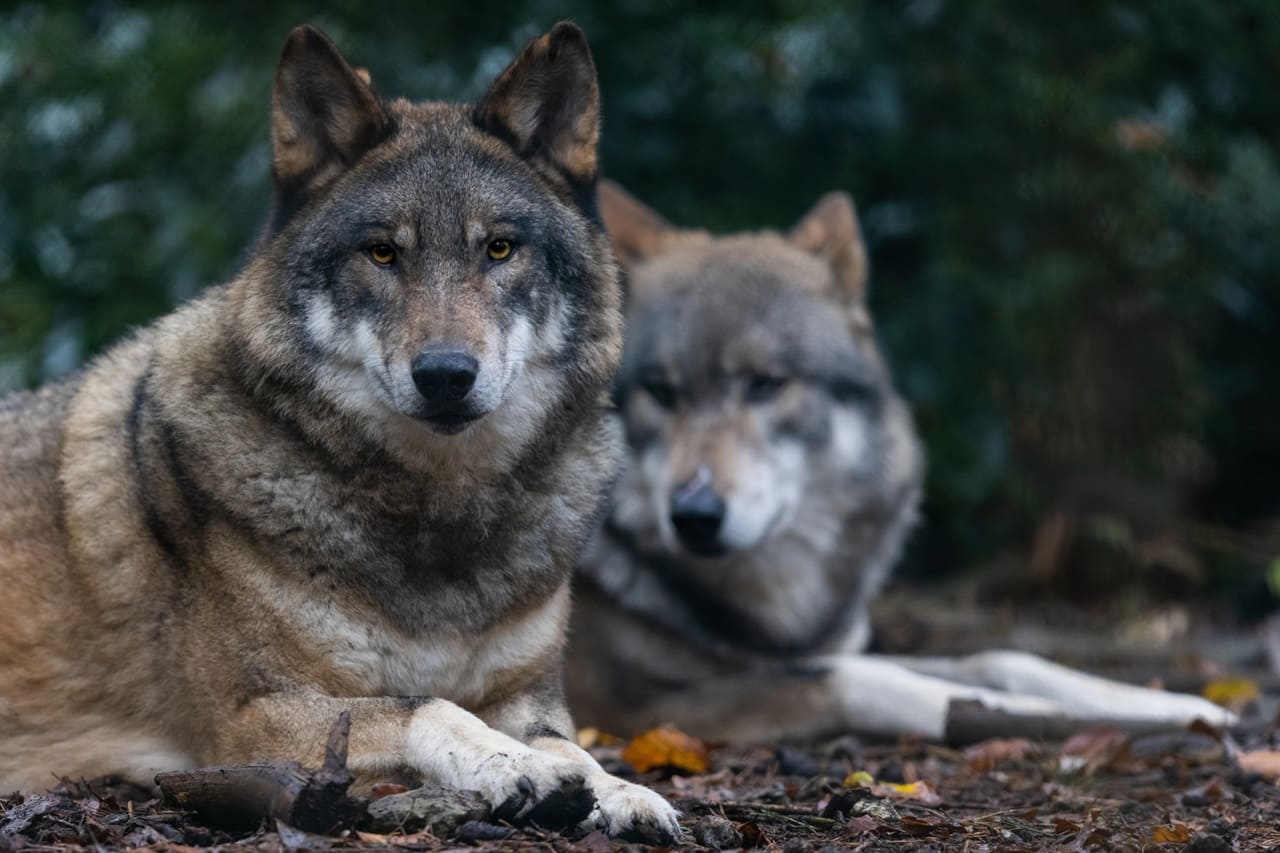
Predators, in turn, are the competitors of the hunting sector, and so it is not truly surprising that the wolf is now actually being held responsible for the currently smaller hunting bags in certain regions — regions where, prior to this, shooting quotas prescribed the elimination of more herbivores in the name of forest conversion. Every nature photographer has seen it with their own eyes: where wolves live, ungulates are also at home. This follows logically, for why would wolves settle in an area devoid of wildlife? No — the wolf is simply to be made huntable, and there are two substantive reasons for this.
Germany is the world's second largest consumer of hunting trips after the USA. The desire for wolf trophies is immense, and providers and clients are numerous. In countries such as Russia, Hungary, Sweden, Turkey and Latvia, wolves can be hunted for approximately €1’800 in travel costs plus an additional €1’400 shooting fee, making the hunting "childhood dreams" of some recreational hunters possible, as relevant forums attest.
Managing population dynamics through shooting plans and harvest quotas is also made very difficult, if not impossible, by the presence of the wolf.
In recent times, one increasingly hears accusatory statements such as this: “When the wolf is present in our area, hardly anything moves. During a driven hunt, 20 guns stood in front of a single piglet after the drive, while five different wolves were spotted and photographed. Mouflon are completely gone (eaten).”
A hunting magazine recently lamented and complained: “Wildlife populations have declined dramatically. According to association figures, a large-scale hunt took place in the Uckermark region (the Vietmannsdorf hunting ground), during which 50 recreational hunters returned empty-handed.”
436’000 recreational hunters versus 1’400 wolves
Some attribute this to forest restructuring. As a result, pressure on wildlife was further significantly increased in certain regions through higher shooting quotas, leading to a dramatic reduction in stocks in the hunting grounds — at least in the areas managed by the state forestry service. Other recreational hunters, who still wish to shoot game in future and refuse to give up their shooting pastime, complain that the wolf is eating up the game, similar to the argument of the forestry lobby, in whose eyes deer eat up the forests. Deer devour the forest; wolves devour the game.
But why does a conservationist, as many a recreational hunter likes to call himself, complain that hunting bags are shrinking? Why, for years, was there lamenting with a pointed finger at the shooting quotas mandated by the lower hunting authority and required to be fulfilled by the recreational hunter? Now, in times when the wolf accomplishes exactly that — and in a naturally far more selective manner — there is still complaint that there is nothing left to shoot. And if there were truly nothing left to shoot, there would also be no more "browsing damage," and the world of both interest groups would be as they allegedly desired. The traditional dispute does not end so simply, however. Foresters want maximum yield, and recreational hunters want to keep shooting wildlife tomorrow as well.
The interests of forestry and recreational hunting have always worked against each other. Today, however, as efforts are finally made to correct old mistakes, to restructure forests and create mixed woodlands, the wolf is blamed for devouring the wildlife. 1,400 wolves in Germany compared to 436,000 recreational hunters with gigantic and year-on-year growing hunting bags. Just one example: Back in the 1990s, 300,000 recreational hunters shot approximately 120,000 wild boar; last year, around 403,000 recreational hunters shot 830,000 wild boar, while wolves killed only approximately 3,500 wild boar. Much the same applies to nearly all of the roughly 40 other huntable wildlife species.
Every chain of argument ultimately comes down to one thing: being permitted to shoot wolves — and, alongside the many wildlife species such as fallow deer, sika deer, or mouflon that were introduced in part by hunting associations for recreational shooting, to mount the wolf as a trophy on the wall as well, and to let population dynamics work in their favour. If we do not resolve the longstanding forest-wildlife conflict in the very near future — for the benefit of the living nature so urgently needed — the living conditions of all of us will continue to deteriorate drastically and ever more rapidly. We all have the opportunity to bring about change; we must simply not leave it in the hands of those who serve only their private pleasure or their commercial interests.
Source: Guido Meyer
Further articles
- Wolves under constant fire: How Swiss hunting policy ignores science and ethics
- Protective forest: Recreational hunting creates problems it claims to solve
- The wolf is not the problem – it is the solution
- Forest Conversion: Pathways to Resilient Mixed Forests in the Face of Hunting
- Forest Conversion near the Lukmanier Pass
- Hunting Is Not the Solution for Forest Conversion
- Recreational Hunters Do Not Help Forest Conversion
- The Conflict Between Forestry, Hunting, and Wildlife
More on the subject of recreational hunting: In our dossiers on the criticism of recreational hunting gather fact-checks, analyses and background reports. The scientific evidence is presented in the overview Studies on the Effects of Recreational Hunting.
The position of IG Wild beim Wild: IG Wild beim Wild rejects recreational hunting. Our model is the canton of Geneva, which has managed without recreational hunting since 1974: without hunting seasons, without hunting dogs, without driven hunts, without high seats, without the animal cruelty and crime that go hand in hand with hunting season elsewhere. What has worked there for over fifty years disproves every position paper by JagdSchweiz. An association that bases its policy on claims it refutes in its own documents is not a professional organisation, but a factory for misinformation.