
Trophy photos: Double standards and blind spot of recreational hunting
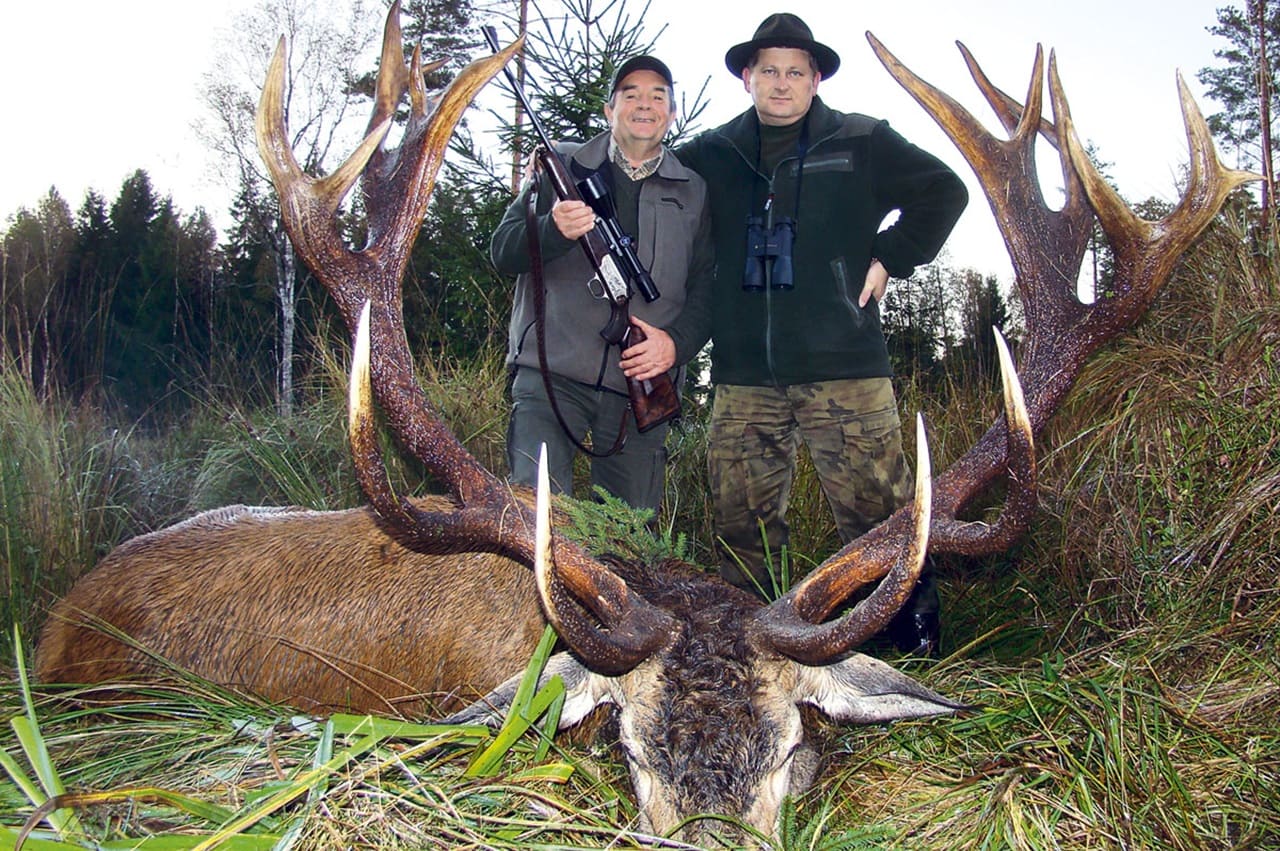
A man kneels laughing next to a dead deer, weapon at the ready, blood in the grass, accompanied by the hashtag 'Waidmannsheil'. Let's imagine the same scene with a police officer posing next to a victim and posting the image online: It would be a scandal, a disciplinary offense, grounds for immediate dismissal. That a society tolerates this staging with wild animals shows how deeply the double standard in dealing with life and death is entrenched. This dossier examines with legal foundations, studies and concrete cases why trophy photos are not harmless tradition, but a litmus test for our understanding of dignity.
What awaits you here
- Animal dignity in Swiss law: How the Federal Constitution, Animal Protection Act and Article 135 of the Criminal Code protect animal dignity, why these norms also cover violence against animals and why trophy photos still exist in a grey area.
- Police and army as benchmark: What happens when state employees pose with the dead, which cases have led to dismissals and prison sentences, and why different standards apply to hobby hunters.
- SStudies and figures: What a representative study reveals about Generation Z's perception of trophy photos and why even the hunting lobby speaks of 'communicative landmines'.
- Psychology and ethics: What staging with dead bodies reveals about empathy, desensitization and self-presentation, and why referring to 'tradition' is ethically unsustainable.
- International comparisons: Namibia's trophy photo ban, Walmart's decision, European trophy import prohibitions and what Switzerland is failing to do.
- Ethics of dying: Why death anguish is not a photo motif and why recreational hunting turns the most brutal dying process into a selfie opportunity.
- What needs to change: Concrete political demands regarding animal dignity, hunting license guidelines, youth protection and independent oversight.
- Arguments: Responses to the most common objections from the recreational hunting lobby.
- Quick links: All relevant articles, studies and sources at a glance.
Animal dignity: What the law promises and what it delivers
Switzerland has enshrined the protection of animal dignity into its legal order more extensively than any other country. Art. 120 Para. 2 of the Federal Constitution (BV) has anchored the 'dignity of the creature' as a constitutional principle since 1992. Art. 1 of the Animal Protection Act (TSchG) formulates as its legislative purpose 'to protect the dignity and welfare of animals'. Art. 3 lit. a TSchG specifies what dignity means: The intrinsic value of the animal must be respected. Interventions that degrade it, instrumentalize it excessively or harm it in its appearance are considered violations of animal dignity.
Anyone who violates animal dignity commits animal cruelty under Art. 26 Para. 1 lit. a TSchG and risks imprisonment of up to three years or a fine. The Federal Court held in 1989 that only comprehensive protection of life would do justice to society's ethical sensibilities. Academic literature also discusses whether animal dignity can have legal effect even after death, analogous to the posthumous effect of human dignity under Art. 7 BV. Bolliger and Rüttimann write on this: Because the concept of dignity for animals cannot have a fundamentally different meaning than for humans, legal effect beyond death should not be categorically excluded for animal dignity either.
Despite this high normative density, the public display of dead wild animals online remains largely unregulated. The Animal Protection Act protects animals from pain and suffering, but does not explicitly regulate how the body may be staged in media after death. A society that recognizes the dignity of animals in legal texts should consequently also problematize the degrading public display of dead animals.
More on the legal framework: Hunting and animal protection: What practice does to wild animals
Art. 135 StGB: When violent images become punishable
Art. 135 StGB prohibits representations that 'vividly depict cruel acts of violence against humans or animals while severely violating the elementary dignity of humans'. The provision explicitly covers violence against animals as well. Anyone who produces, distributes, stores, shows or makes such recordings accessible is liable to prosecution (Para. 1, up to 3 years imprisonment). Since the revision, mere possession is also punishable (Para. 1bis, up to 1 year).
The Foundation for the Animal in the Law (TIR) confirms that anyone who takes recordings with explicit depictions of violence against animals and publishes them on the internet becomes liable to prosecution. The question of whether operators of social networks also become liable under Art. 135 StGB has not yet been clarified in practice.
The Federal Court applies Art. 135 StGB restrictively and limits it to 'really blatant and clear cases' of excessive violence. Typical trophy photos showing a hobby hunter posing next to a shot animal do not fall under this provision according to prevailing doctrine, because the depiction of 'legal' killing is not considered excessive enough. The threshold is high: Where the state permits the killing itself, it is difficult to classify the photographic recording as 'cruel violence'. A legal gap emerges: The dignity of the animal ends where the camera begins.
That this gap is not meaningless is shown by a current case from Graubünden. As wildbeimwild.com documents, the Grisons prosecutor's office refused to open criminal proceedings against a hobby hunter who publicly posted hunting trophy photos and children's photos on social media. Simultaneously, the person who used one of these images in a critical context was criminally prosecuted. The case is now before the Federal Court. It exemplifies how hunting images in Switzerland are de facto treated as a legal vacuum: Those who display dead animals go unpunished. Those who criticize the same images risk prosecution.
More on cases at the borderline of criminal liability: Hunting and Animal Cruelty
Police and Military: What happens when state agents pose with the dead
In police and military services, strict rules govern the handling of victims and images of violence. Those operating at the boundary between life and death must not turn these moments into stages for self-presentation. Violations are severely sanctioned because they objectify victims for entertainment and undermine trust in the rule of law.
A case from London shows how seriously such violations are taken: In June 2020, police officers Deniz J. (47) and Jamie L. (33) were supposed to guard the crime scene of a double murder of two sisters in Fryent Country Park. Instead of performing their duty, they took selfies with the corpses and shared the images in WhatsApp groups. The verdict: Both were dismissed from police service and sentenced to two years and nine months in prison each. The victims' mother stated that the officers had 'dehumanized' her children.
In Germany in 2020, a police trainee in North Rhine-Westphalia was dismissed for 'lack of character suitability' after repeatedly using duty situations for social media selfies, including during a prisoner transport. The Higher Administrative Court of NRW upheld the dismissal. The message is clear: Those who abuse their position at the intersection of violence and order for narcissistic staging lose their job.
Among hobby hunters, comparable consequences are absent. No hunting license is revoked because someone proudly poses with a dead deer. No hunting association sanctions members who post bloody scenes in their feeds. The underlying behavior—namely posing with a killed body—is structurally identical. The evaluation, however, follows a double standard: With human victims, it is considered a violation of dignity. With wild animals, it is called 'hunting honor'.
More examples of derailed hunting practices: Disreputable Swiss hunting administrations
What the studies say: 96 percent react negatively
The data is unambiguous. A representative study by market research institute Bilendi and Respondi from 2024, conducted as part of a master's thesis at FH Burgenland, systematically examined for the first time how Generation Z reacts to hunting trophy images on social media. The results are devastating for recreational hunting: 96 to 99 percent of affective reactions to hunting trophy images were negative. 73 percent of respondents wanted such images to be provided with a warning label. 69 percent did not want to see hunting trophy images on social media. 67 percent felt compassion for the depicted animals. 57 percent believed that hunting trophy images negatively influence society's perception of recreational hunting.
The rejection remained consistently high regardless of whether the images showed the wildlife, the hobby hunter, or other compositional elements. The study thus refutes the widespread assumption among hobby hunters that 'appealing staging' could make hunting trophy photos socially acceptable. Hunting communication expert Christoph Fischer puts it bluntly on the Hirsch&Co platform: 'A dead animal remains a dead animal and cannot trigger positive associations in the animal-loving average citizen.' He describes hunting trophy photos as 'communicative landmines' and warns that each thoughtless photo can destroy the carefully cultivated narrative of 'responsible stewardship' within seconds.
Remarkably, the criticism also comes from within the hobby hunting scene itself: 70 percent of young hobby hunters already spoke out clearly against the distribution of hunting trophy photos on social media in 2019 (Fischer 2019). In the US, the organization Mountain Pursuit documented that in 2019, 29 percent of the hunting industry's Instagram posts still showed trophy photos or bloody scenes, a rate that declined by 25 percent by 2021 because even the industry recognized that such images endanger public acceptance of recreational hunting.
Social platforms are also responding: Instagram has classified weapons and hunting content as potentially problematic since introducing 'Sensitive Content Control' and throttles their reach for non-subscribers. Hashtags like #trophyhunting are banned. The algorithm recognizes weapon images and automatically reduces their visibility. Recreational hunting is thus losing not only moral but also technical control over its visual language.
More analyzes of today's hunting culture: The Hobby Hunter in the 21st Century
Psychology: Dead Bodies as a Stage for Self-Presentation
Hunting trophy photos provide insight into a psychology of distancing. Anyone posing with a smile next to a dead animal signals that this individual's suffering and death takes a backseat to pride, success, and group belonging. Social psychology has proven that repeated exposure to violent images without empathetic context shifts the inner boundary of what is acceptable: people become accustomed to sights that would have previously shocked them.
In police contexts, precisely this tendency is viewed as a warning sign. Anyone posing casually with a victim shows, according to professional assessment, that they might be unsuitable for a sensitive role. In recreational hunting, this same pleasure in staging with the dead body is glorified as 'passion for nature' or 'tradition.' Relevant hunting magazines are full of images of hobby hunters in hunting fever, posing in dominant positions over their victims. As wildbeimwild.com aptly describes: Any soldier or police officer would be dishonorably discharged and admitted to a psychiatric clinic if they presented themselves before their victim the way hobby hunters do.
The visual language reveals more than a thousand words: kneeling at the animal's head, one hand on the antlers, the other on the weapon, broad smile, thumbs up. The animal serves not as a living subject, but as evidence of marksmanship, masculinity, or hunting success. The pose degrades the animal to a prop for an ego moment. Hobby hunters need such photographs to feel important and to gain recognition within hunting culture. Whoever can show the largest trophy, the strongest stag, or the longest shot rises in the hierarchy. The parallel to trophy hunting abroad is unmistakable: whether a deer in a Graubünden hunting ground or an elephant in Namibia, the mechanism of self-presentation over the dead body is the same.
From an ethical perspective, death represents the most vulnerable moment of any living being. Using it as a backdrop for selfies reduces the individual to an object, reinforces the devaluation of wild animals, and promotes a culture where empathy becomes secondary to ego and entertainment.
More on the psychological background: Psychology of hunting
International comparisons: Who acts and who watches
The debate over trophy photos is not limited to Switzerland. In Namibia, Environment Minister Pohamba Shifeta issued a ban on posting photos with dead wild animals on social media. The justification: Such images misrepresent hobby hunting and are morally indefensible.Wildbeimwild.com reported on the threatened penalties, which should apply to all, "especially those with hunting permits". Photos may only be taken for private use, not for social media.
In the USA, the retail chain Walmart, the world's largest private employer, has removed all depictions of hunting violence from stores and screens. In an increasing number of countries, import bans on hunting trophies are being discussed or implemented: Belgium, Finland, the Netherlands and France have already enacted bans. In Britain, a corresponding bill passed the House of Commons. The EU is discussing a tightening of import rules.
Switzerland lags behind in this development. There is neither legal regulation for trophy photos nor binding guidelines from hunting associations. The Swiss hunting association JagdSchweiz does recommend internal "restraint" when posting, but does not sanction violations. The result: While in Namibia a minister takes action, the Swiss debate remains in the stage of polite requests.
More about Swiss failure: Recreational hunting fact-checked: Quick license to kill instead of knowledge
Ethics of dying: Death agony is not a photo motif
In human medicine, "dying with dignity" is a central guiding principle. Palliative medicine and ethics emphasize that the final phase of life should be characterized by calm, pain reduction and respect. No one would think of putting a dying person in mortal fear and then staging their body as a trophy for recreational entertainment.
In recreational hunting, exactly this happens with wild animals. They are shot at from a distance, flee in panic, are often wounded, struggle for their lives. The tracking success rate depending on the canton is only 35 to 65 percent. An estimated 3,000 to 4,000 wild animals are shot and never put out of their misery annually in Switzerland. A Danish study (Elmeros et al. 2012) demonstrated that 25 percent of killed foxes bore traces of previous shots. The Veterinary Association for Animal Protection (TVT) in Germany documented that in driven hunts, up to 70 percent of shot animals do not die immediately.
Precisely this result, a bleeding, panic-fled and finally killed animal, is then proudly photographed. While slaughter animals in Switzerland must be stunned before bleeding, no comparable stunning requirement applies to wild animals in recreational hunting. From an ethical perspective, it is hardly justifiable that we make precisely the most brutal and uncontrolled dying process the occasion for a selfie. The trophy photo celebrates the result of a process that we would punish as animal welfare violation in the slaughterhouse.
More on the lack of stunning requirement: Driven hunt under observation
What would need to change
- Animal dignity beyond death: The animal welfare legal concept of dignity must extend beyond death. Art. 3 lit. a TSchG in conjunction with Art. 26 TSchG must be interpreted such that the degrading display of dead animals online is classified as dignity violation. Model motion: Regulation of trophy photos
- Binding Social Media Guidelines for Hunting License Holders: The issuance of a hunting license is linked to binding guidelines. The publication of trophy images that stage dead animals as trophies is defined as incompatible with «ethical» hunting. Violations result in revocation or temporary suspension of the license.
- Independent Hunting Supervision with Media Control: The Graubünden case shows that prosecutors treat trophy images as trivial matters, while critical use of the same images is prosecuted criminally. Independent hunting supervision following the Geneva model also professionalizes control over the media staging of recreational hunting. Model initiative: Independent Hunting Supervision: External Control Instead of Self-Regulation
- Consistently Apply Youth Protection: Trophy images are freely accessible on platforms, including to minors. The Youth Protection Act (JSFVG) must include trophy images in its scope, analogous to other depictions of violence against animals.
Arguments
«Trophy images are tradition.» Many former traditions, from public executions to animal fights, are considered unacceptable today because they turned suffering into spectacle. Reference to tradition does not explain why a behavior should be morally acceptable. Trophy images follow the same pattern by making an animal's death a stage for pride and entertainment.
«A single photo doesn't hurt.» In the logic of social media, mass and repetition count. 96 to 99 percent of Generation Z react negatively to trophy images according to Bilendi/Respondi 2024. Each new bloody pose joins a stream of images that links recreational hunting with brutality, weapon fetishism and lack of empathy.
«Aren't there also problematic images in police and military?» Yes, and they are criminally prosecuted. In London in 2021, two police officers were sentenced to nearly three years in prison each for taking selfies with murder victims and sharing them via WhatsApp. In North Rhine-Westphalia, a police cadet was dismissed from civil service for taking selfies while on duty. In recreational hunting, comparable consequences are lacking, although the behavior is structurally the same.
«Animals have no personality rights, the comparison is flawed.» The comparison does not aim at identical legal status, but at identical attitude: the staging of a dead body as an ego moment. Switzerland recognizes an intrinsic value of animals in Art. 1 Animal Welfare Act. Consistent application of this principle must also problematize postmortem degradation.
«Those who eat meat cannot talk about trophy images.» The hypocrisy argument confuses different levels. Meat consumption can be ethically criticized, but does not justify making an animal's death an occasion for narcissistic staging online. Those who eat a steak do not pose smiling next to the cow.
«Common sense is enough.» The spread and defense of trophy images shows that «common sense» functions differently in parts of the recreational hunting scene than in the rest of society. Where empathy and self-restraint are insufficient, clear ethical and legal guardrails are needed.
«Hunting is only criticized by hunting opponents.» 70 percent of young hobby hunters are themselves against trophy images online (Fischer 2019). The platform Hirsch&Co, a hunting-friendly medium, warns of communicative risks. Even the industry recognizes that trophy images damage their own image more than any campaign from outside.
Quick Links
Articles on Wild beim Wild:
- When Hunting Images Become a Blind Spot for Justice in Graubünden
- Hunting and Animal Cruelty
- Driven Hunt Under Observation
- Namibia: Trophy Image Ban for Hobby Hunters
- Trophy Hunting: Myth and Reality
- The Hunting License: A Mirror of Mental Health
- Recreational Hunting Fact-Check: Quick License to Kill Instead of Knowledge
- Dubious Swiss Hunting Administrations
Related Dossiers:
- Psychology of Hunting: Why Humans Kill Animals and How Recreational Hunting Normalizes Their Violence
- Recreational Hunting Tourism: Trophy Hunts, Hunting Trips and Trade Fairs – a Global Leisure Industry at Animals' Expense
- Hunting and Children
- Hunting Victims in Europe: Deaths, Injuries and a Continent Without Statistics
- Trophy Photos: Double Standards, Dignity and the Blind Spot of Recreational Hunting
- Why Animal Protection Law Ends at the Forest Border
- Ending Recreational Violence Against Animals
- Trophy Hunting: When Killing Becomes a Status Symbol
Our Approach
Trophy photos are not a marginal issue, but a mirror reflecting how we as a society think about dignity, compassion and violence. This dossier documents why the display of dead wildlife collides with legal standards, research findings and ethical minimum requirements, and why the same pose that would cost a police officer their job passes as 'tradition' among hobby hunters. The dossier is continuously updated when new court rulings, studies or political developments require it.
More on recreational hunting: In our Hunting Dossier we compile fact-checks, analyses and background reports.