When Hunting Images Become a Blind Spot of Justice in Graubünden
A dead stag, a smiling hobby hunter, a click on “Publish”. What many already consider beyond tastelessness becomes a blind spot of justice in Graubünden. Those who post their hunting images online go undisturbed. Those who criticize this practice and use exactly such an image as evidence are criminally prosecuted. In this tension between recreational hunting, animal welfare, and children’s rights, the Federal Supreme Court must now decide: Does the rule of law apply even where hunting trophies are staged?

From the perspective of IG Wild beim Wild, this case illustrates in exemplary fashion how recreational hunting in Switzerland is still effectively treated as a law-free zone.
In Graubünden, the public prosecutor’s office refused to open criminal proceedings regarding publicly staged trophy photographs. At the same time, the individual who criticized this practice and used one of these images as evidence in a hunting-critical publication is being criminally prosecuted.
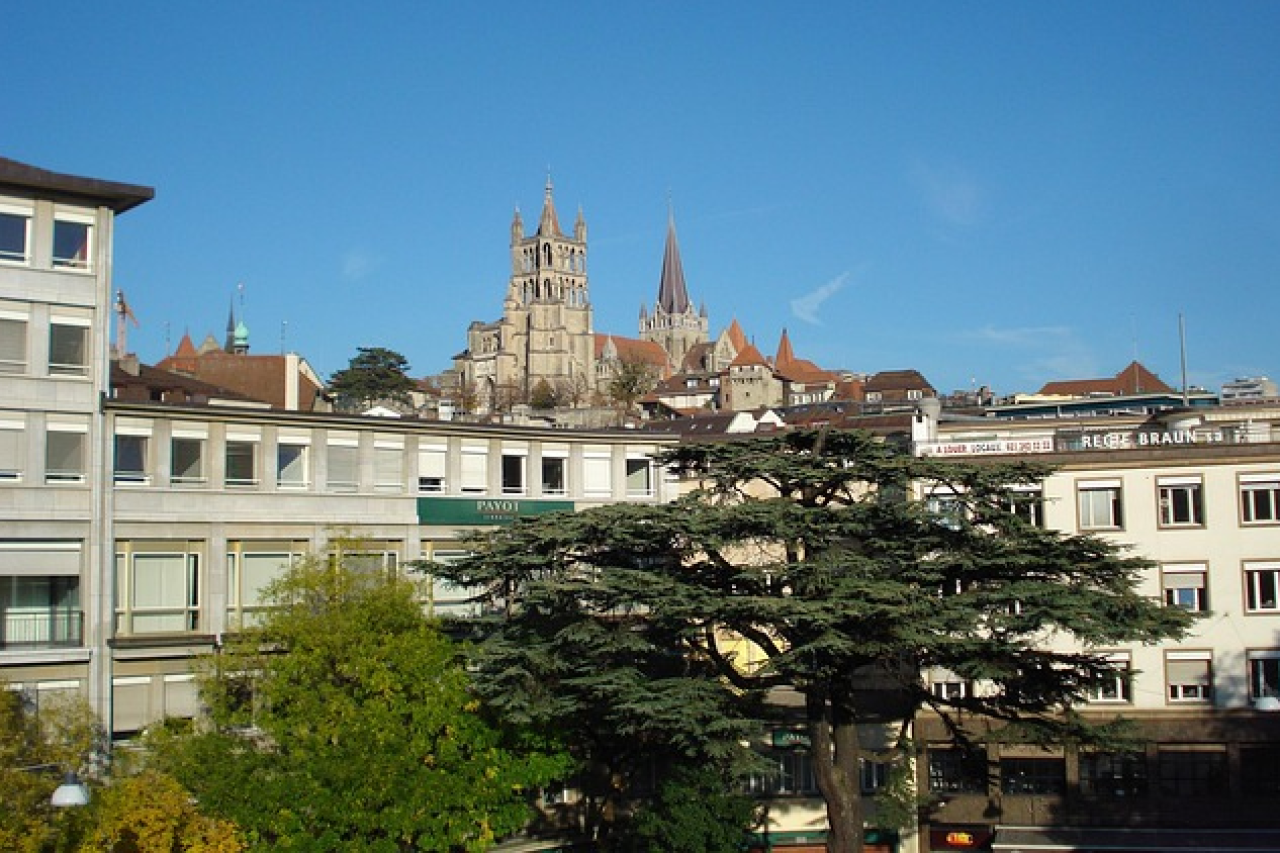
The matter now lies before the Federal Supreme Court in Lausanne. At the heart of the case is the question of whether animal welfare, youth protection, and fundamental procedural rights are curtailed wherever the interests of recreational hunters are at stake.
Two criminal proceedings, one and the same image
The starting point is a criminal complaint filed by the director of IG Wild beim Wild with the Graubünden public prosecutor’s office on 8 August 2025. It is directed against a Graubünden hobby hunter from Scuol.
According to the complaint, the hobby hunter published several trophy photographs as well as photographs of children on the association’s website «chatscha.ch» and on his private Facebook page. The photos show him as the shooter alongside killed wild animals. At the same time, he publicly calls on others to submit further hunting images by email.
Especially against the backdrop of information campaigns such as «Children's pictures don't belong on the internet», launched by police and specialist agencies and widely present in the public consciousness, the hunting president's Facebook profile strikes the IG as clearly out of line.
In the view of the complainant, these staged displays violate the dignity of animals within the meaning of the Animal Welfare Act and may additionally fulfil the criminal offence of depicting violence under Article 135 of the Criminal Code. From this perspective, the issue is not merely an abstract discomfort with hobby hunting, but concrete norms intended to limit violence against animals and its public display.
Particularly explosive: one of these trophy photographs is also at the heart of a separate criminal proceeding against the head of IG Wild beim Wild himself. He had used the photo in a publication on wildbeimwild.com without knowing its authorship. The hobby hunter subsequently filed a complaint in return. A separate appeal to the Federal Supreme Court is already pending in this matter.
The situation thus concerns one and the same set of facts, which the criminal prosecution authorities are handling in diametrically opposite directions:
The use of the same image in a critical context by a hunting critic, by contrast, led to criminal proceedings.
The publication of the trophy photograph by the hobby hunter himself is to remain unpunished and has to date not even been examined in depth.
Public prosecutor's office stonewalls, cantonal court looks away
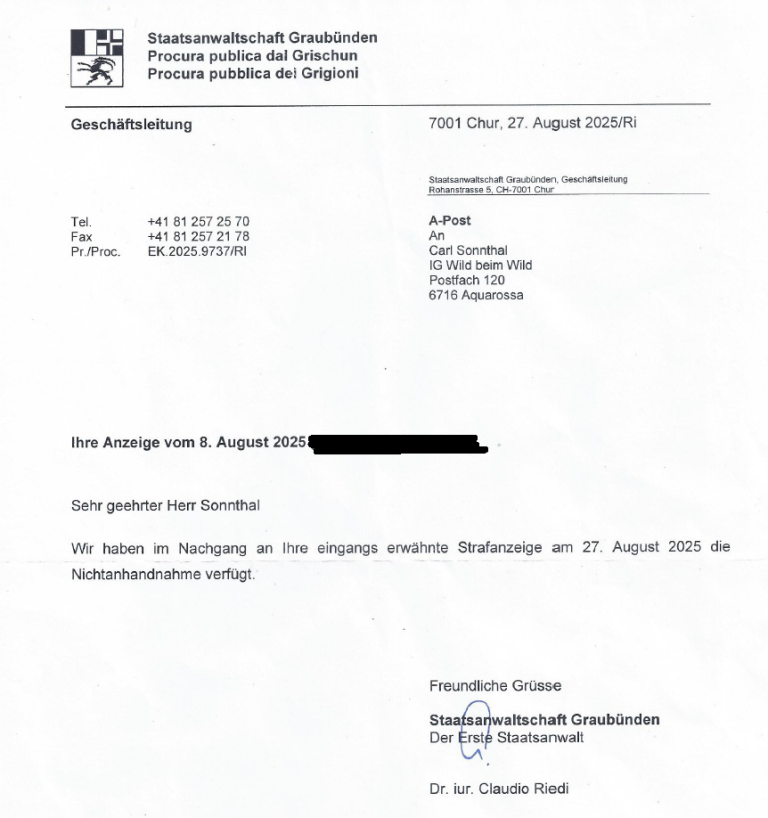
The response of the Graubünden criminal authorities to the complaint against the hobby hunter is, from the IG's perspective, sobering. As early as 27 August 2025, the public prosecutor's office announced that it had issued a non-prosecution order, meaning no criminal proceedings would be opened.
Noteworthy from the complainant's perspective: the notification contains no reasoning whatsoever. Neither legally nor factually is it explained why the complaint is being stopped at the outset. Against the backdrop of a sensitive complex of issues involving animal welfare, depictions of violence, and the protection of minors, this raises questions regarding the right to a fair hearing.
A complaint was subsequently filed with the Graubünden Cantonal Court with the aim of compelling the public prosecutor's office to open at least ordinary criminal proceedings and to examine the case on its merits.
The Court of Appeal, presided over by Mr. Bergamin, declined to consider the complaint by order of 20 November 2025. The head of IG Wild beim Wild was merely a complainant and had standing to appeal neither as an injured party nor as an “other party to the proceedings”. Full stop. No examination was made of the particular constellation of the parallel proceedings, and no in-depth substantive discussion of the animal welfare and child protection issues took place.
It is against this decision that IG Wild beim Wild has now lodged an appeal with the Federal Supreme Court in Lausanne.
Double Standards: When the Critic Becomes the Problem
At the heart of the appeal to the Federal Supreme Court is the question of whether a person in the position of the head of IG Wild beim Wild may truly be reduced to the role of a “mere complainant”.
The head finds himself simultaneously in two roles:
- as the head of an animal rights organisation that has been engaged for years with the issue of trophy photos, trophy hunting, and children's rights
- and as the accused in criminal proceedings based on one of the trophy photos posted by the hobby hunter
In IG Wild beim Wild's view, the cantonal authorities are thus pursuing a single set of underlying facts in two entirely different directions. Against the hunting critic, a criminal act is being constructed from the image. Against the hobby hunter who produced and disseminated the trophy photos in the first place, there is, by contrast, seen to be no grounds for opening an investigation.
This asymmetry is not merely a matter of taste, but touches on fundamental rights:
- the right to equal treatment
- the entitlement to a fair trial
- access to a court
In the view of IG Wild beim Wild, a person who is accused in parallel proceedings based directly on the same published image has a concrete and legally protected interest in having the unpunished nature of the original hunting post subjected to judicial review. It is precisely this interest that the Grisons judicial authorities deny. Whether this is compatible with constitutional guarantees will now have to be clarified by the Federal Supreme Court.
Children's Rights, Depictions of Violence, and Trophy Photos
The case has a dimension that is easily overlooked in the routine of legal proceedings: the protection of children and young people.
Article 135 of the Criminal Code on depictions of violence is not a minor technical detail. Its purpose is specifically to protect minors from cruel or apparently cruel scenes of violence. It is intended to prevent children from being confronted with images that may desensitize, unsettle, or psychologically burden them.
The constitutional protection of minors is enshrined in Article 11 of the Federal Constitution. The UN Convention on the Rights of the Child also obliges Switzerland to protect children from physical and psychological violence and from harmful experiences of violence. Recommendations and statements repeatedly emphasize that this includes the treatment of animals with violence and exposure to such violence.
Against this background, trophy photographs on the internet are, from the perspective of IG Wild beim Wild, anything but harmless hunting folklore. Association websites and social media are used daily by children and young people. Age verification or warning notices are generally entirely absent. Those who, in this environment, stage bloody images of killed animals as a personal triumph and actively solicit further submissions are, in the view of the IG, creating a space in which the following risks are systematically accepted:
- Desensitization to violence against animals
- Damage to children's capacity for empathy
- Normalization of a treatment of wildlife that degrades them to objects of amusement, power, and prestige
Against this background, IG Wild beim Wild has launched a petition calling for the punishment of hobby hunters who allow minors to participate in recreational hunting. It draws attention to the psychological harm that children may suffer through witnessing animal suffering, and to the well-documented link between violence against animals and subsequent antisocial behavior.
When prosecuting authorities dismiss complaints regarding such depictions without any substantive review, the youth-protective purpose of Article 135 of the Criminal Code is, in the view of the IG, undermined precisely where violence against animals is publicly staged in the context of recreational hunting.
How trophy photographs bring recreational hunting into disrepute
The social trend is hard to overlook. Representative surveys on the perception of trophy photographs in social media by young adults paint a clear picture: people who do not hunt themselves react predominantly negatively to trophy photos.
The vast majority of people do not want to see such images on social networks at all. Many would at least support clear warning notices. Spontaneous associations with trophy photos include “contempt”, “lack of empathy”, and “violence”. The public display of dead animals massively and lastingly damages the image of hobby hunting.
This confirms what voices critical of hunting have been saying for years: trophy photos are not successful public relations work, but a communicative catastrophe. They show hobby hunting at its most brutal and alienate precisely that majority of the population whose acceptance the hunting system relies on politically.
When IG Wild beim Wild publicly notes that a police officer or soldier who poses grinning with their victims would likely be dishonourably discharged and referred for psychiatric evaluation, this is not a technical legal analysis, but a pointed yet, from IG's perspective, legitimate value judgement.
The recourse to the legal concept of “good morals” also demonstrates that this criticism is oriented towards recognised legal principles. The Animal Welfare Act likewise recognises the dignity of the animal as an intrinsic value and contains prohibitions on degrading or purely instrumentalising treatment. Trophy images that stage killed wild animals like hunting toys are difficult to reconcile with this perspective.
Also noteworthy is the fact that even within hunting circles there are now restrictions on the publication of trophy photos, for example regarding the wolf. The legislature has created, with Article 135 of the Swiss Criminal Code, a criminal offence that explicitly penalises excessive depictions of violence, including towards animals. Sensitivity to the problem therefore exists. From IG's perspective, however, this sensitivity is barely reflected in criminal prosecutions in Graubünden to date.
More than an isolated case
The decisions challenged before the Federal Court are more than an internal formality of Graubünden's justice system. They raise fundamental questions:
- Do individuals who are demonstrably engaged in the defence of animal and children's rights and are simultaneously personally affected by an identical set of facts have the right to judicial review of a decision not to open proceedings?
- May the state effectively tolerate depictions of violence against animals in public spaces, while pursuing individuals who critically document this practice?
- What role do children's rights play when it comes to the public dissemination of killing scenes involving wild animals?
The complaint filed by the head of IG Wild beim Wild is directed against what he considers the straightforward refusal of Graubünden's judiciary to even address these questions. The combination of an unsubstantiated non-initiation of proceedings, the cantonal court's refusal to hear the case, and the simultaneous prosecution of the critic sends a signal that extends beyond this individual case.
From IG Wild beim Wild's perspective, it creates the impression that hunting images are sacrosanct, while criticism of them is risky.
Why the path to Lausanne is necessary
Before the Federal Court, this is not merely about a wildlife carcass in a photograph. It is about the role of animal welfare and children's rights in a society that likes to regard itself as progressive and governed by the rule of law. It is about the question of what access to the courts is available to those who take precisely these rights seriously.
With this complaint, IG Wild beim Wild and its director are setting a fundamental precedent. Either trophy photographs will henceforth be seriously scrutinised from the perspective of animal welfare, depictions of violence, and the protection of minors — or the judiciary sends the signal that different rules apply wherever hobby hunters stage their bloody trophies.
Until the decision from Lausanne is reached, the presumption of innocence applies to all parties involved. What is already clear from IG Wild beim Wild's perspective today: the case illustrates how urgently the debate about recreational hunting, trophy images, and children's rights must be conducted — not only in Graubünden, but throughout Switzerland.
To be continued …
More on this in the dossier: Psychology of Hunting
Dossier: Hunting and Animal Welfare