Trophy hunters cause rhino horns to shrink
Because of trophy hunters, rhino horns are shrinking. The selective hunting of the largest specimens is genetically altering the species.


For decades, rhinos ranked high on the kill list.
Their impressive horn was in great demand — both as a hunting trophy and as an ingredient in traditional Asian medicine. Researchers have now discovered that intensive hunting not only decimates populations, but also alters the physical appearance of the animals.
More than 2,700 rhinos fell victim to recreational hunters in Africa between 2018 and 2021. Although the number of killed pachyderms is thus declining, both African species as well as the three Asian species are threatened with extinction. And rhinos are also changing in appearance, as Oscar Wilson of the University of Helsinki and his team demonstrate in a study published in “People and Nature”: the animals’ horns have been shrinking on average since at least the 19th century.
A form of negative selection is taking hold among the pachyderms: since recreational hunters have first targeted animals with the largest horns, individuals with smaller ones are more likely to survive. The smaller the horn, the greater were and are the chances that the respective animals survive and reproduce. A similar development has already been observed in elephants, where the trend is likewise towards shorter or absent tusks. So-called “Tuskers” — elephant bulls with the genetic predisposition for enormous growth and particularly large tusks — have essentially almost completely disappeared from Africa, because they too were a preferred target for recreational hunters, scientists write.
More on the subject of recreational hunting: In the dossier The Role and Criticism of Recreational Hunters we shed light on the training, power and self-image of recreational hunters. What the research says about this is shown by Hunting fact-checked: the state of research.
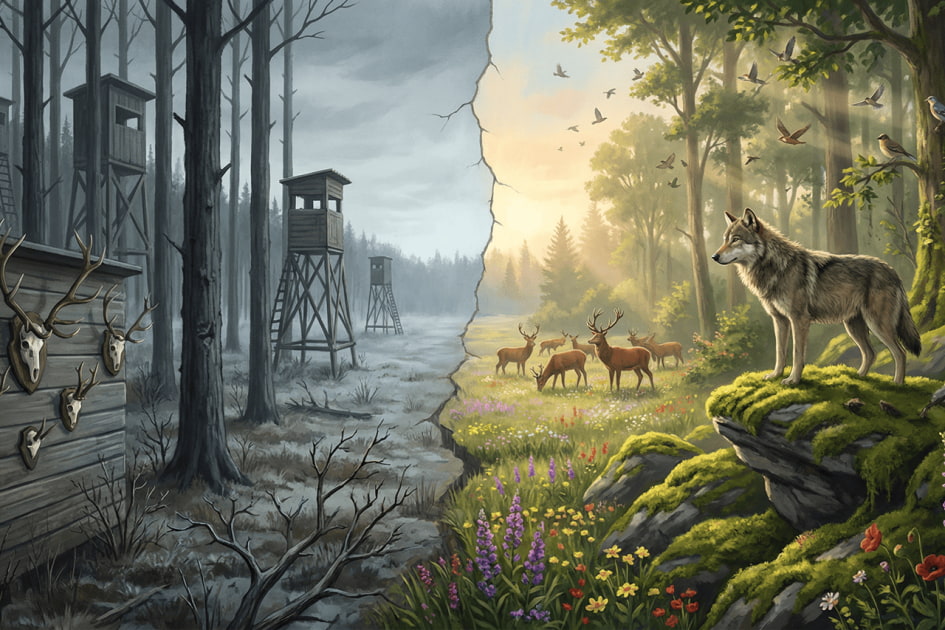
The position of IG Wild beim Wild: IG Wild beim Wild rejects recreational hunting. Our model is the canton of Geneva, which has managed without recreational hunting since 1974: without hunting seasons, without hunting dogs, without driven hunts, without high seats, without the animal cruelty and crime that go hand in hand with hunting season elsewhere. What has worked there for over fifty years disproves every position paper by JagdSchweiz. An association that bases its policy on claims it refutes in its own documents is not a professional organisation, but a factory for misinformation.