
Argument paper for game wardens

Wild animals, like us humans, are living beings and not resources for the Stone Age conduct of hunters.
Wild animals deserve a scientific approach and not recreational hunting. Today, hunting is for the most part a public festival where business people and animal abusers invite partners – to massacre animals and to contaminate the public purse with blood money.
The canton of Geneva has shown for decades what serious wildlife management can look like.
Nature and animal welfare
It is now known that recreational hunting is, first and foremost, like a travel agency it is about organising attractive hunts, which are planned by the offices for hunting and fisheries in Switzerland. These offices degrade people to predators and wild animals to livestock and breeding stock. The danger of being fatally hit by a recreational hunter is far greater than that of being attacked by a wolf.
From a wildlife-biology perspective, this form of hunting wild animals is entirely unnecessary and no longer in keeping with the civilised spirit of the times. The canton of Geneva has proved this with its hunting ban, in force since 1974, and repeatedly serves as a model across national borders. A hunting ban would spare wild animals a great deal of stress, caused by the fear of the hunting human. If wild animals are no longer hunted, they lose a large part of their shyness, and their forced, unnatural nocturnal activity would shift increasingly into the daytime. Wild animals could thus lead a more species-appropriate, healthier and more wholesome life, and delight the majority of the population again through their visibility. Wild animals would become a familiar, friendly sight.
As in the canton of Geneva one can intervene therapeutically in the case of sanitary problems. In exceptional cases, a hunting-based correction can be carried out by professionally trained game wardens, in consultation and cooperation with nature, animal welfare and environmental organisations, for example as a protective measure where people are in immediate, direct danger.
Wild animals, as sentient beings, wish to be treated fairly by humans – on an equal footing. Nature and animal protection often costs money, but it also creates jobs. If billions can be spent on ailing banks, tunnel construction, the military and so on, then money can also be invested in a cultural and ethical upgrading for the common good. The population and the animal world would benefit enormously. The habitats of all living beings are becoming ever smaller, only to be made available to recreational hunters as battlefields until now.
Experts at the forestry service welcome predators such as the wolf, lynx, fox and others because they make an important contribution to reducing high or diseased wildlife populations. Recreational hunters, however, are continually working to decimate these predators, which are so important to the ecosystem. A lynx takes around 60 wild animals per year – mainly roe deer and chamois. The healthy red fox, a member of the canine family, is even eliminated in the tens of thousands simply for fun, without any legal kill quota and without scientific justification. Hunting animals for amusement is nothing other than murder, according to the true hunters of indigenous peoples.
Ethics
For wild animals, the initiative «Game wardens instead of recreational hunters» is necessary because it creates undisturbed refuges, which wild animals urgently need in today's climate of crowding and stress. The Biomass of wild animals is completely out of balance compared with that of livestock. Too much of the wild animals' habitat is occupied by livestock.
Hunting-free areas can help reduce the dreaded wildlife damage. Energy expenditure is lowered. Wild animals have to take in less food in the places where hunters have until now kept them penned in – in the forest. What wild animals graze on, they increasingly take from the protected refuge zones. As a result, the adjacent forest areas are more likely to be relieved than burdened. In hunting-free areas, browsing damage is not necessarily higher, but biodiversity is greater.
«Hunting must have a good reason« according to Pro Natura Switzerland. Because, put simply, ethics, science, legal foundations and so on are indispensable prerequisites for modern wildlife management. The slogan is also true the other way round: without sufficient justification, the killing of a wild animal cannot be ethically defended. Today this sufficient, sound justification is missing in the hunting of animals that are simply “eliminated” (for example foxes, birds, trophy hunting and so on). So-called regulation of predators in favour of high ungulate densities must be categorically and consistently rejected on both scientific and ethical grounds. Modern humans respect predators as an important part of the ecosystem.
Safety
In 2011, according to the Swiss federal hunting statistics, not a single red deer, roe deer, red fox, badger, marten, brown hare and so on was shot in Geneva, for example.
When a wolf kills a farm animal, recreational hunters and others immediately demand its killing, right up to its renewed extermination. Where is the public debate when hunters kill people with their firearms every year and threaten and injure hundreds more?
In Switzerland, where only statistics on accidents among recreational hunters exist (private individuals affected by recreational hunters are therefore not recorded!), there were fourteen fatal hunting accidents and around 200 non-fatal accidents involving hunting weapons between 2010 and 2013, out of a total of 1,157 accidents, according to the Swiss Council for Accident Prevention (BFU) Accident prevention.
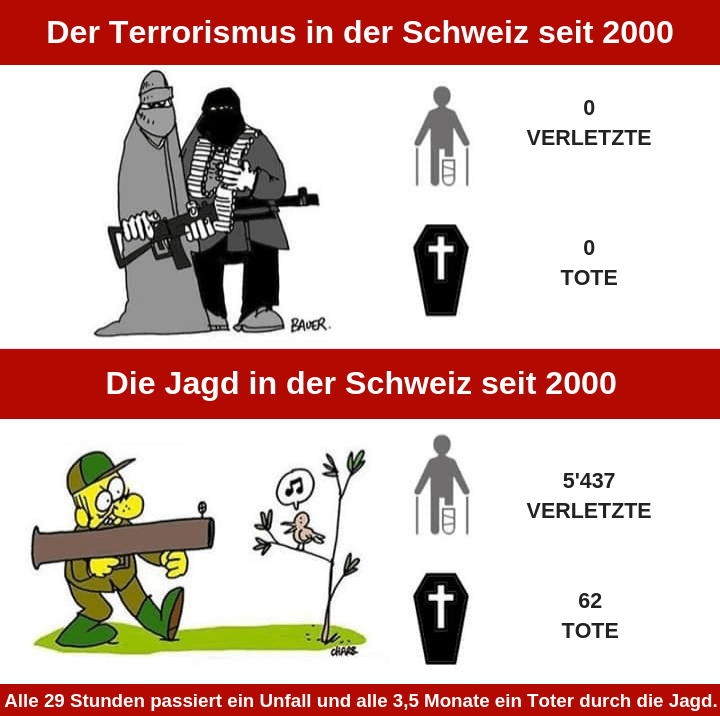
Dogs that look as if they might bite are classified by law as dangerous, must undergo a temperament test, wear a muzzle and be kept on a lead. By comparison, legislators treat recreational hunters with remarkable laxity: recreational hunters who harass and endanger people seeking recreation in nature, effectively holding them hostage.
Numerous seemingly insignificant aspects of recreational hunting have negative effects. Eurasian jays and other birds, for example, are shot partly for their colourful feathers, even though they are indispensable as seed dispersers for the recolonisation and regeneration of a forest. The jay is a thorn in the side of recreational hunters because it calls out when danger threatens and thereby drives away the game that recreational hunters want to bring down! Threatened species such as the brown hare, black grouse, rock ptarmigan, ducks, woodcock and others are still on the kill lists in many cantons. Recreational hunters are also partly responsible for the many wildlife accidents. Recreational hunting paralyses normal sectors of the economy. The main cause of forest damage is hunting pressure. There are no vital wildlife populations because there is no species-appropriate regulation. Hunting fosters criminal energy such as shady dealings, cronyism, corruption, alcohol problems, weapons smuggling, poaching and so on.
Environment and sustainability
The burden caused by the countless tonnes of lead and other highly toxic heavy metals that recreational hunters leave behind in nature when using their weapons is pure eco-terrorism. Lead ammunition is not only harmful to humans, it is also a particularly cruel form of hunting. Wounded animals that are never found often suffer not only from their injuries but also from slow lead poisoning. Carrion contaminated in this way harms predators such as foxes, lynx, badgers, wolves and others. Finland, Denmark, the Netherlands and others banned lead ammunition long ago.
Nature would also no longer be blighted by the many, often illegal, high seats and made to resemble a battlefield. With the initiative «Game wardens instead of recreational hunters» there would once again be more calm and peace in nature. Unprofessional recreational hunters would be replaced by responsibly trained game wardens.
Recreational hunters have no right to a kill. Dubious recreational hunters justify their shabby pastime, mantra-like, by saying that they enjoy making a kill – in other words, that killing living beings is their goal.
For me, hunting is like picking an apple. – Editor and hunter Karl Lüönd
Editor and hunter Karl Lüönd
What can one expect from people who cannot grasp in their hearts the difference between an apple and a fox or a songbird? In today's society, anyone who feels nothing when killing is considered seriously disturbed.
Hunting is no longer an existential drive for survival. In this ice-age-free era, the drives of hunger and thirst can be satisfied in an ethically sound way. Moreover, there is Meat in abundance. The hunting instinct as entertainment is an archaic relic of a bygone era, like cannibalism, slavery or making fire with stones – not a modern culture! Humans are not hunters per se and therefore not meat-eaters either. Otherwise the good Lord would have equipped them with weapons such as claws or fangs, and four legs carrying a body able to digest raw meat as well. Furthermore, according to many studies, meat endangers human health.
In 2014 the Swiss National Park celebrated its 100th anniversary. The park is a piece of wilderness left to itself, where nobody goes hunting. That is not a problem, says park director and wildlife biologist Heinrich Haller:
Even without hunting, there is no sudden surplus of foxes, hares or birds. Experience shows that nature can be left to its own devices.
Wildlife biologist Heinrich Haller
Epidemics
Among recreational hunters and the authorities, much rests on assumption rather than on knowledge and conscience.
Scientific studies have shown that even if three quarters of a population are killed, the same number of animals will be back the following year. The same applies, for example, to the fox. The more heavily foxes are hunted, the more offspring there are.
The Swiss Rabies Centre therefore concludes that reducing fox populations through hunting is evidently not possible and that hunting as a means of combating rabies is even counterproductive. As we know today, it was only animal-friendly vaccine baits that managed to defeat rabies – it is now considered eradicated in Switzerland and in large parts of Europe.
There are far more zoonoses in pets and farm animals. As a rule, only recreational hunters contract a zoonosis such as fox tapeworm. Around 5–10 people in Switzerland are infected with this liver disease (Echinococcus multilocularis) each year. This is no more than in the past, when fewer foxes were found in towns and cities. Most people's immune systems are strong enough to fend off an infection. As a rule, the larvae of the fox tapeworm develop in the liver of mice and some rats. If a fox eats the infected mouse, a tapeworm develops again in its intestine. Cats and dogs that eat mice can also spread the parasite in this way, but do not fall ill themselves.
The risk of infection is minimal for ordinary visitors to the forest. Contrary to the many rumours, there is no known case of a fox tapeworm patient having been infected by woodland berries. Berries hanging high on the bush can be ruled out as a route of infection. It is hard to imagine how fox droppings might end up on berries hanging that high up.
In the past, too, mange and distemper repeatedly flared up locally and then died out again of their own accord. Particularly where mange has spread most severely, foxes appear to be developing a growing resistance to fresh infections. However, since hunting cancels out the survival advantage that mange-resistant foxes would otherwise enjoy (after all, a hunter cannot tell by looking at a fox whether it is resistant to mange), killing foxes is likely to be counterproductive in this respect as well. Incidentally, with distemper it has been found that wild animals have already developed antibodies, so the risk is marginal.
Mange mites cannot develop further in human skin and die off. An infection with mange (for example through contact with infected pets) is therefore not possible. However, Sarcoptes scabiei can infest humans and cause a short-lived condition with itching and small papules. This so-called pseudoscabies clears up after a few days even without treatment.
Faced with the occurrence of fox mange, the hunting associations are once again promoting more intensive fox hunting as a cure-all for combating infections. As with rabies and the fox tapeworm, however, there is no scientific basis for why even more merciless fox hunting should curb the spread of zoonoses – after all, the past has shown that reducing fox density by hunting is not possible. Moreover, hunting encourages dispersal movements within fox populations, which is likely to increase rather than reduce the speed at which the disease spreads – as has been demonstrated for rabies and is suspected for the fox tapeworm. But perhaps that is exactly what the hunters want, so that they can carry on with their idiotic hobbies.
A field study around Nancy over three years shows that hunting foxes neither reduces the fox population nor lowers the rate of fox tapeworm infestation among foxes. If anything, it promotes its spread. With rabies, too, hunting was not the solution.
The fox, as a mouse-eater, also prevents the spread of diseases such as hantavirus or Lyme disease. In the urban area of Zurich, for example, around 1,000 foxes live. There are no hygiene problems there, because simple measures such as washing your hands are sufficient.
Forest
Browsing damage is caused mainly by recreational hunting and by the opening up of forests for tourist leisure activities. Hunting does not mean less game, but more births. Wildlife populations are not regulated by hunting. Hunting is usually the cause of supposed problems.
On the other hand, foresters have been saying for decades that red deer are damaging the protection forest (mainly parked there by hunters). This is also because their traditional winter shelter areas are heavily frequented by people doing sport. The animals retreat into the forest. In the mountains, the high wildlife populations mean that forest regeneration can no longer be ensured to the required extent. Protection forests are at risk of losing their function. Almost half of our forests protect people, settlements and transport routes from natural hazards. To keep them stable, they must be carefully managed. For the maintenance of protection forests and for avalanche barriers, the Confederation provides millions in subsidies every year. From 2008 to 2012, for example, the Confederation subsidised protection forest management in the canton of Valais with 40 million francs. The canton paid 44 million and the municipalities a further 16 million. In total, 100 million francs were invested in forests in Valais alone over four years, precisely where hunters park wild animals!
Peeling and fraying by game is not a problem across Switzerland as a whole, but a regional one. Where lynx, fox, wolf and other predators occur regularly, less damage to forest regeneration is recorded, which saves millions in taxpayers' money and frees up wildlife wardens.
According to current findings, the main problem for the forest is not browsing damage but the Asian longhorn beetle, the chestnut gall wasp and climate change. Switzerland's timber reserves are among the highest in Europe.
If recreational hunters were not allowed to constantly satisfy their primitive urge to kill, there would be no problems with the size of red deer and roe deer populations at all, because there would then be enough predators and therefore less browsing damage. The damage caused by browsing is marginal compared with the benefits of wild animals. Humans still cause the most damage and take away the habitat of wild animals.
For genuine wildlife management, a handful of wildlife wardens is enough, as the example of Geneva shows. Wild animals would no longer be targets in a shooting gallery for a pointless custom. Hunting cannot be described as a craft in this context.
Law
Recreational hunters do not create habitat for wild animals, but opportunities to kill for themselves. Recreational hunters are out disturbing and harassing wild animals every month of the year. Wild animals do not like hunters.
Under federal law, no canton in Switzerland is obliged to provide for hunting. It is the cantons' right to decide whether hunting is permitted or not. If a canton decides against hunting, or even only partly against it, it is free to do so under the Federal Constitution. The canton of Geneva decided long ago on this exemplary path. Many cantons already ban hunting in certain areas today by means of hunting ban districts, wildlife sanctuaries and the like.
Even JagdSchweiz knows that wildlife populations would, in principle, regulate themselves – even in our cultural landscape.
JagdSchweiz
The careless shooting of the social structures of huntable species, which are so important to wildlife biology, also does lasting damage to the genetics of animal populations. The word “sustainability” is misused by recreational hunters to legitimise injustice. If there were meaningful wildlife regulation through hunting, there would be no need to decimate the wildlife population with brute force all over again every year.
For most hunting measures there is no sensible reason. Numerous scientific studies prove this. Because recreational hunters nevertheless want to indulge their lust for killing and their trophy cult, they have been serving us all manner of “hunters' tall tales” for decades, with follow-on costs running into the millions for society and to the detriment of wild animals and nature conservation. This is what the initiative “Game Wardens Instead of Hunters” aims to change.
Finances / Costs
In Geneva, professional wildlife management costs the taxpayer less than a cup of coffee per year. What is more, the state wildlife wardens generate revenue through the sale of game meat. The meat is no longer passed on privately but made available to the public. Together with the environmental wardens, the people of Geneva also enforce the animal welfare act, because nobody may inflict pain, suffering or harm on an animal without justification, or cause it fear. If dubious amateurs were to take over wildlife management in Geneva again, the costs would be no lower, since, as in the other cantons, they would have to be closely supervised and monitored. Wildlife wardens also take on some of the police's duties and thereby relieve them.
What hundreds of recreational hunters used to do badly in Geneva is now done in exemplary fashion by around 11 wildlife wardens, alongside many other tasks. With more wildlife wardens who intervene only therapeutically in respect of fox, lynx, wolf, birds of prey and so on, the cantons would once again have order, biodiversity and greater protection from natural hazards. Taxpayers would probably be spared hundreds of millions of francs, which the Confederation, cantons and municipalities pump into forest conservation in the very places where the problem hunters breed wild animals.
If there were fewer problem hunters harbouring ideas of exploiting nature, more peaceable people could once again devote themselves to the cause of nature conservation – people who care for species – flora and fauna – with respect, decency and fairness, and who do not slaughter wild animals for fun.
Hunters like to argue that they put in many unpaid hours of work. This cannot, of course, be verified precisely, and much of it is simply hunters' tall tales. According to estimates, 85% of it is done out of pure self-interest, such as public relations, restaurant visits, hunting-horn blowing, evangelising in schools, weapon maintenance, harassing wild animals, creating shooting opportunities, trophy shows, building shooting platforms and other trivialities. If that were not the case, there would have to be a second, paradisiacal Switzerland somewhere within Switzerland, with countless biotopes, hedgerows, species diversity, biodiversity, peace and quiet and so on. Nor is it known that hunters actively contribute anything in particular to the renaturation of riverbeds or the protection of raised bogs, and the like.
Animal rights:
The prevailing hunting laws have little to do with ethics and morality – indeed, they stand in direct contradiction to the Swiss Animal Welfare Act, e.g. Art. 4: No one may unjustifiably cause an animal pain, suffering or harm, put it in a state of anxiety or otherwise disregard its dignity. The mistreatment, neglect or unnecessary overexertion of animals is prohibited.
Some advantages in brief:
- The monopoly on the use of force belongs in the hands of the state, not in those of hunting gangs
- Better education, research, wildlife biology and science instead of hunters' tall tales
- Justice and responsibility towards nature and wildlife
- With their hunting methods and their passion, hunters habitually violate Swiss animal welfare legislation; wildlife wardens do not
- Wildlife wardens have an entirely different motivation from hunters. The very word says as much.
- Recreation and tourism, an enhancement of the Swissness brand for tourism
- Zurich's animal welfare record as a model for other cantons and countries (such as the canton of Geneva) in hunting matters
- No blood money from hunters in the state coffers (unique worldwide)
- Curbing the sectarianism of hunters (hunters' tall tales) – a cult of senseless killing and violence
- Breaking up the criminalised hunting system (fewer offences by hunters such as breaches of hunting law, poaching, arms smuggling, environmental offences, animal welfare violations, traffic offences, corruption, etc.). The canton of Grisons, for example, records over 1,000 complaints and fines against hunters every year (2015: 1,298 complaints and fines). Zurich keeps no statistics
- Relief for investigating authorities, the state apparatus, public prosecutors, courts and the legal system (thousands of legal infringements, complaints, fixed penalty fines, etc. against hunters every year in Switzerland)
- Relief in time and costs for authorities, politicians, etc. (hunting inspections, supervision, monitoring, motions, legislation, carcass disposal, etc.)
- Relief for the healthcare and insurance sectors, and for their contributions
- Relief for the taxpayer (forestry, agriculture, etc.)
- Fewer injuries to people from hunters' weapons. (From 2010 to 2013, fourteen fatal hunting accidents and around 200 non-fatal accidents involving hunters' weapons out of a total of 1,157 accidents), not counting private individuals, according to the BFU (Swiss Council for Accident Prevention)
- The initiative promotes good jobs for wildlife wardens
- More environmental protection instead of environmental pollution (toxic ammunition, illegal high seats, car noise and traffic in nature, waste of resources, lead-contaminated shooting ranges, etc. caused by recreational hunters)
- Demonstrably fewer wildlife accidents (around 60 people injured per year and personal injury and property damage of 40 – 50 million francs). What you can see, you don't run over
- Violence prevention, protecting animals instead of perpetrators, less violence, weapons and terror in society. Violence against animals often carries over seamlessly to people
- Protection of children and young people from recreational hunters and hunters' tall tales
- More wildlife sightings, species diversity and biodiversity for the public, as in the canton of Geneva, national parks or other hunting-free areas
- Upgrading of ethics, morality, fairness and safety in the cultural landscape
- Less abuse and manipulation of hunting dogs
- No more cruel hunting infrastructure (artificial earth-hunting tunnels, wild boar enclosures, etc.)
- Less animal cruelty such as trophy hunting, earth hunting, driven hunts and drive hunts, special hunts, etc.
- No more shooting of pets
- Less browsing damage in forests and agriculture
- Fewer pesticides and poisons in agriculture caused by mouse plagues resulting from the absence of foxes, etc.
- Less alcohol and drug abuse while hunting. Game wardens are not allowed to consume alcohol while working. The hip flask and liquid courage are constant companions of hunters. Hunters resist a ban on alcohol while hunting.
- Public safety for the population, leisure enthusiasts, walkers, etc.
- No hunting on private land (which does not have to be tolerated, according to the European Court of Human Rights for Human rights
- A hunting ban is also good for the hunters' peace of mind. Today's “hunting” is also a pathological pattern of behaviour (anyone who kills senselessly does not protect, and it is of no benefit to society)
- Game wardens, police officers and soldiers retire at 65. Recreational hunters are still pursuing their passionate shooting culture with firearms at 75
- Less groundwater contamination and less ammunition residue left in nature by hunters
- Less shooting noise for the population
- E.g. the density of brown hares in the canton of Zurich, with hunters, is 1.0 per 100 ha, or they are extinct. In the canton of Geneva, with game wardens, there are 17.7 brown hares per 100 ha, etc.
- The canton of Zurich is backward when it comes to cruel hunting methods, e.g. earth hunting, driven hunts, ammunition, etc. Canton of Thurgau has banned earth hunting, Geneva has had a hunting ban for 40 years, etc.
- Healthcare: Processed game meat is neither organic nor a high-quality food (particularly that from driven hunts and drive hunts) but makes people ill and, according to the WHO, belongs in the same toxicity class as cigarettes, arsenic or asbestos. In Canada it is prohibited to sell hunters' game meat in restaurants or shops, because it is not classified as fit for human consumption
- Weapons are not toys and wild animals are not fairground shooting-gallery targets
- Wildlife wardens have more comprehensive and more meaningful training and a completely different motivation from hunters.
- Wildlife populations can once again regulate themselves naturally
- Wild animals become diurnal again more often, visible and observable, which delights not only the public
- In the canton of Zurich, after decades of hunting, there is not a single wildlife refuge recognised by the FOEN (Federal Office for the Environment)
- Hunting is not scientific wildlife management
- What over 400 recreational hunters in the canton of Geneva once did unsatisfactorily, at the expense of wild animals, animal welfare, ethics, safety and the public, is now handled by 11 wildlife wardens who share three full-time posts, and only one of these is needed for hunting-related activities.
- The canton of Vaud is twice the size of the canton of Zurich and has 50% fewer recreational hunters
- etc.