Recreational Hunting and Human Rights in Switzerland
In Switzerland, hunting is regulated at both cantonal and federal level. What was long regarded as an untouchable “tradition” is increasingly being subjected to critical scrutiny. More and more nature lovers, hikers, horse riders and mountain bikers are pushing back against the fact that their time in the forest is dictated by recreational hunters who kill wildlife and, in some cases, domestic animals.


Alongside questions of animal and nature protection, another issue is becoming ever more apparent: where does recreational hunting violate the fundamental rights of people who want nothing to do with this bloody recreational pursuit?
Recreational hunting is not only an intrusion into the lives of wild animals. It also encroaches on the rights of those who own forests and land, or who live in an area where recreational hunting is practised.
Key points of conflict are:
- Right to property: Landowners are compelled to tolerate armed third parties entering their land, pursuing and shooting animals.
- Freedom of conscience: People who, for ethical reasons, reject any form of recreational hunting are forced to accept hunting on their land.
- Right to private and family life: Hunting frequently takes place in the immediate vicinity of residential areas. Children are confronted with killed or dying animals. Residents feel threatened or severely disturbed.
In many cantons, residential areas are explicitly included within hunting territories. Organised hunting associations are thus permitted to pursue their hobby right up to garden fences and forest edges. For those affected, this means noise, gunshots, fear for their children and dogs, and the knowledge that animals are being chased and killed directly on their doorstep.
European Court of Human Rights: Clear signals against compulsory hunting
The European Court of Human Rights (ECHR) has addressed on multiple occasions the question of whether landowners may be compelled to tolerate hunting on their property.
A landmark case was the proceedings Chassagnou and Others v. France (1999). The Court found that the compulsory membership of landowners in hunting associations and the obligation to tolerate hunting on one's own land may violate the European Convention on Human Rights. At its core, the case concerned the principle that people with hunting-critical or animal-ethical convictions must not be forced to actively support a system of recreational hunting.
France, Germany, Luxembourg and Portugal have responded to this case law. There, forest and landowners can withdraw their land from a hunting territory if they object to hunting on grounds of conscience. In several other European states, there is no compulsory membership in hunting cooperatives at all.
The ECHR subsequently addressed the issue again, notably in the case of “Herrmann v. Germany” (2012). Here too, the Court made clear that landowners are not required to unconditionally tolerate hunting on their land. Germany amended its hunting legislation accordingly. Since then, owners may prohibit hunting on their properties on ethical grounds.
The message from the ECHR is unambiguous: the hunting passion of minorities must not be placed above the property rights and freedom of conscience of the general public.
And Switzerland?
In Switzerland, landowners in many cantons are effectively compelled to participate in hunting systems. Their land falls within a hunting zone. Hunting associations have the right to hunt there, even if the owners categorically object on ethical grounds.
This raises serious questions:
- Are the freedom of conscience and property rights of the hunting-critical population being sufficiently respected?
- Is it compatible with human rights that a person cannot have their land exempted from recreational hunting, even when such hunting fundamentally contradicts their deepest ethical convictions?
- Why is it possible in neighbouring countries to erect signs reading “Private property – hunting prohibited” on grounds of conscience, yet not in Switzerland?
Switzerland likes to pride itself on its high standards of rule of law and human rights protection. At the same time, it compels people who strictly reject hunting on animal welfare and ethical grounds to tolerate that hunting on their own land. This creates a tension between hunting tradition, lobbying power, and modern fundamental rights standards.
Example Geneva: Nature without recreational hunting
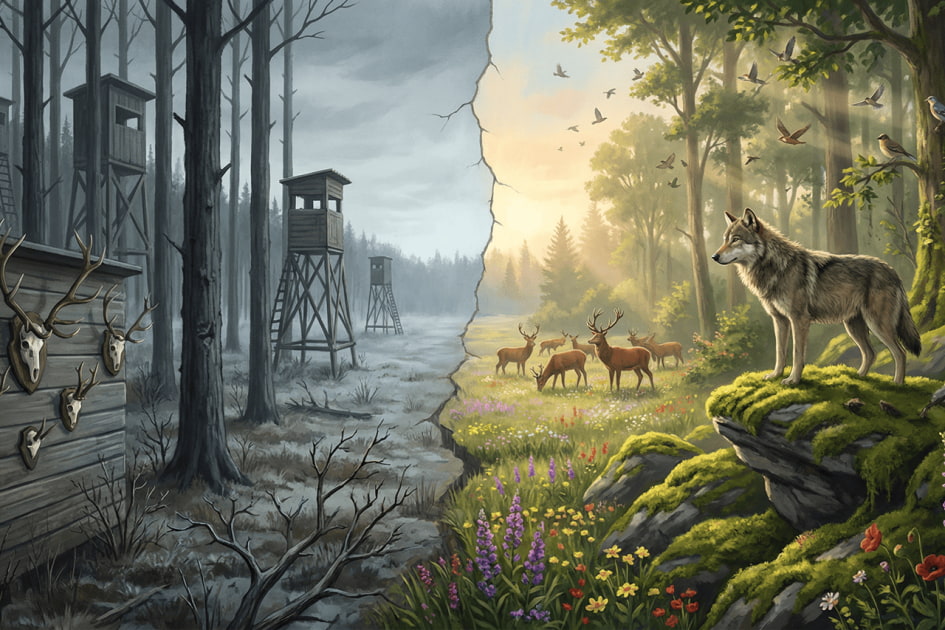
The canton of Geneva demonstrates that an alternative approach is possible. Since 1974, recreational hunting has been banned there. The tasks of wildlife regulation are carried out by professional game wardens. The canton invests in oversight, monitoring and habitat enhancement — not in hunting leases.
The consequences are remarkable:
- Brown hares, partridges and wild rabbits have particularly strong populations there compared to the rest of Switzerland.
- Biodiversity has benefited from the absence of recreational hunting. This has been scientifically demonstrated.
- The costs of professional wildlife management are moderate and amount to symbolic sums per taxpayer per year.
Geneva shows that a modern wildlife policy without recreational hunting is possible, legally compliant and practicable.
This simultaneously eliminates the human rights conflict surrounding compulsory memberships and mandatory hunting on private land.
Recreational hunting in residential areas: Safety and dignity
When recreational hunting extends into residential areas, it creates not only legal but above all human and ethical problems:
- Children are confronted with mutilated or dying animals.
- Walkers witness chases, gunshots and the cries of frightened animals.
- Many people avoid the forest when hunting is taking place and feel displaced from “their” nature.
This touches not only on the question of safety, but also on human dignity. Those who regularly witness violence against animals in their residential environment experience this as a deeply unreasonable imposition.
A solution would be relatively straightforward: should a targeted cull near residential areas exceptionally prove necessary, game wardens or police could carry it out. Hunting associations acting in their own interests are not required for this purpose.
Recreational hunting as leisure — not a social mandate
Modern recreational hunting is today practised predominantly as a leisure activity by a small minority. It is neither necessary for food security nor the only option for nature conservation.
At the same time, it causes:
- considerable animal suffering through chasing, shooting, missed shots and follow-up shots
- disturbance of wildlife in resting areas and winter habitats
- conflicts with landowners, recreational users and animal welfare advocates
- pollution from ammunition and noise in sensitive habitats
When a leisure activity regularly infringes upon the fundamental rights and ethical sensibilities of others, it is no longer a harmless private matter. It becomes a societal conflict issue.
Passion for hunting is not a fundamental right. The guarantee of property, freedom of conscience, and protection of privacy are.
What needs to change
From a human rights perspective, the following steps are urgently needed in Switzerland:
- Right to hunting-free private land
Landowners should be able to exempt their properties from recreational hunting on ethical grounds. - Protection of freedom of conscience
People who reject hunting on moral grounds must not be compelled to structurally support hunting or to tolerate it on their land. - Clear rules in residential areas
Hunting in the immediate vicinity of residential areas, children's playgrounds, and heavily used recreational spaces must be prohibited. Emergencies can be handled by wildlife wardens or police. - Focus on professional wildlife management
Instead of recreational hunters, what is needed is professionally sound, state-administered wildlife policy modelled on the example of Geneva.
Hunting is not merely a question of tradition and animal ethics. It has long since become a question of human rights as well. European case law has made clear that compulsory hunting and forced membership in hunting systems can be incompatible with fundamental rights.
Switzerland will have to confront the question of why landowners and citizens in this country should have fewer rights than those in countries subject to the same human rights conventions. Those who pursue hunting as a hobby must no longer be permitted to make decisions over the heads of those who want nothing to do with this bloody pastime.
More on the subject of recreational hunting: In our dossiers on the criticism of recreational hunting gather fact-checks, analyses and background reports. What the research says about this is shown by Hunting fact-checked: the state of research.
The position of IG Wild beim Wild: IG Wild beim Wild rejects recreational hunting. Our model is the canton of Geneva, which has managed without recreational hunting since 1974: without hunting seasons, without hunting dogs, without driven hunts, without high seats, without the animal cruelty and crime that go hand in hand with hunting season elsewhere. What has worked there for over fifty years disproves every position paper by JagdSchweiz. An association that bases its policy on claims it refutes in its own documents is not a professional organisation, but a factory for misinformation.