The Fascinating Return of Beavers to Switzerland
The beaver, once eradicated in Switzerland, has returned to a large part of Swiss waterways. Its constructions and way of life are fascinating: as Europe's largest rodent, it shapes landscapes and creates habitats that are extremely valuable for nature and for us humans. Where space is limited, this can also lead to conflicts.


Europe's Largest Rodent
On closer inspection, it becomes clear that the beaver, as Europe's largest rodent, is a fascinating creature whose unique characteristics and behaviours are worth exploring and appreciating.
The beaver is a pure vegan. In summer it feeds on all kinds of plants in and around the water; in winter it subsists on bark and buds. Since it cannot climb, it simply fells trees, as the BAFU.
The beaver is distinguished by its powerful teeth, with which it not only fells trees but also constructs impressive dams. Its webbed hind feet allow it to navigate the water skilfully and explore its surroundings. Interestingly, beavers use their tail not only for swimming but also as an aid in communication. By deliberately slapping their tail, they send warning signals to their conspecifics and indicate possible dangers.
Through targeted protective measures and the creation of suitable habitats, it has been possible to successfully increase the beaver population. Today, in many parts of Switzerland, one can observe how the population is recovering and even expanding.
© BAFU
Positive Impacts on Ecosystems
The positive impact of beavers on the environment and ecosystems is exceptional. By damming rivers and streams and building dams, they create valuable habitats for a wide variety of plant and animal species. Through their activities, the flow rate of the water is slowed down, which leads to improvements in water quality and the creation of new living environments for amphibians, reptiles and many other aquatic creatures. Their dams also help to reduce the risk of flooding and raise groundwater levels. This is particularly important in times of increasing drought and climate change.
Although the return of beavers has positive effects, conflicts can also arise, particularly in agricultural areas or when beavers undermine roads or paths. Fortunately, there are solutions to minimise these conflicts, such as fencing off agricultural land or attaching wire mesh to protect trees.
The positive development of the beaver population in Switzerland is a great success for species conservation and the preservation of biodiversity. Beavers play an important role in creating habitats for many other species and contribute to maintaining a healthy and diverse ecosystem.
Overall, the beaver is an impressive and versatile animal that reminds us of how important it is to protect and preserve natural ecosystems. Its return to the waterways of Switzerland is a success story and a cause for joy among nature lovers and environmentalists.
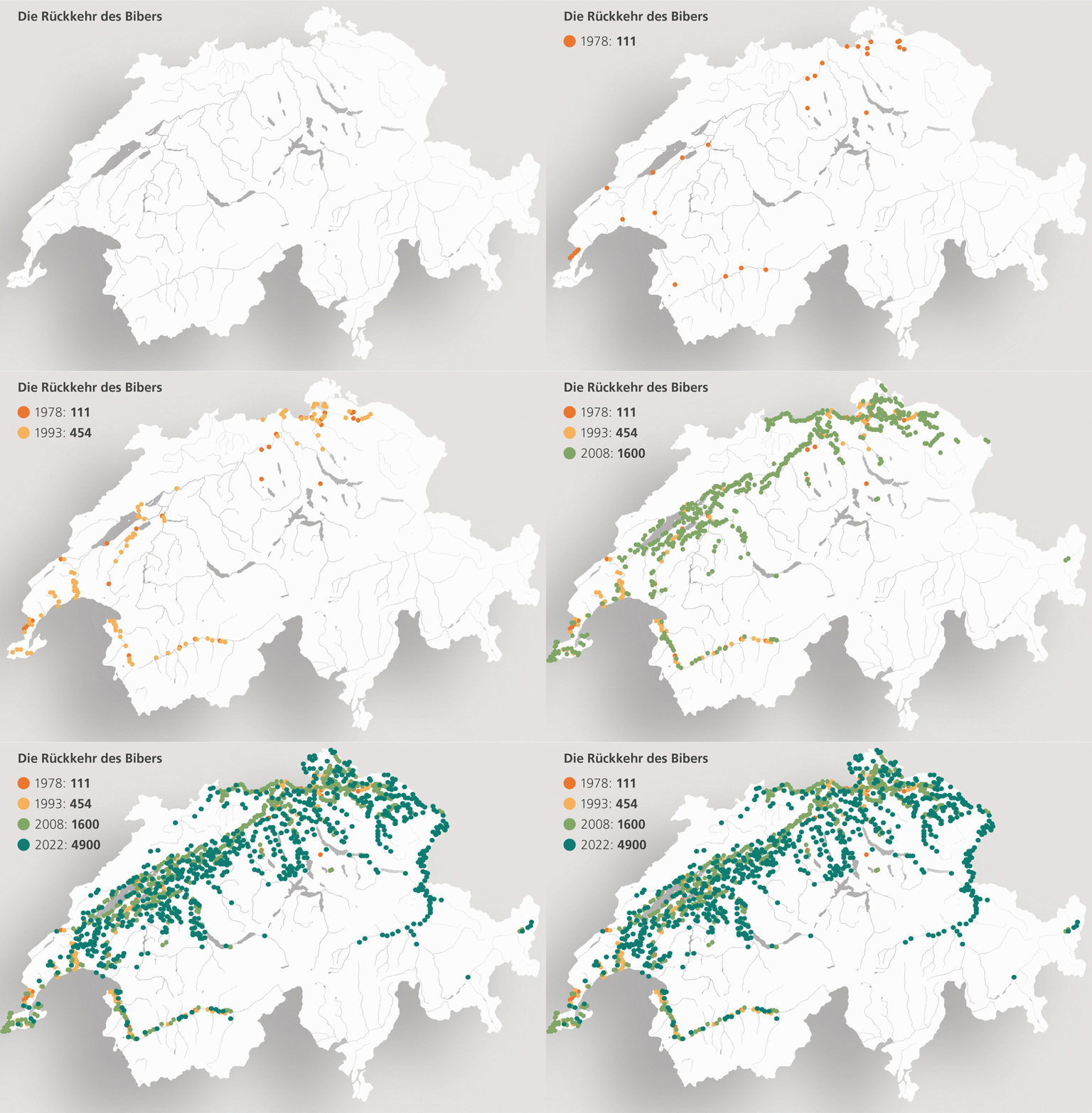
- In 2022, beavers occupy 1’382 territories in Swiss waterways. Fourteen years ago, there were 472. In Liechtenstein, there were no beavers in 2008; by 2022, there are 20 territories.
- Of the 1’402 beaver territories in Switzerland and Liechtenstein, 599 territories are occupied by solitary individuals or pairs and 803 by families. This yields a population of approximately 4’900 animals in Switzerland and Liechtenstein.
- Today the beaver population is three times larger than at the last count in 2008. The number of territories has increased by 8.2% per year, and the population size by 8.3%.
- Beavers reach their greatest density in the lower Thur valley near Frauenfeld and along the Aare and its tributaries between Thun and Bern.
- The Inn marks the third major river catchment area in Switzerland to be settled. In Samedan at 1’721 m, the highest-dwelling beaver in Europe makes its home.
- In all regions, the beaver population continues to grow. In the lower Thur valley and in the Bernese Seeland, the rate of growth is declining. A saturation of available waterways is becoming apparent here.
- The colonisation of small and very small streams has continued. Nearly 40% of beavers live along streams with a water width of less than 5 m.
- In small streams, beavers are increasingly building dams as well. In 2008, 185 beaver dams were recorded; by 2022, that number had risen to 1’316. Most dams were smaller than 50 cm. The tallest dam found stood 2.5 m high.
- As the beaver expands its range, conflicts are also on the rise. These occur primarily in agricultural zones.
- Due to its positive impact on biodiversity, ecosystem functions such as water retention and water quality, and aquatic habitat structures, the beaver can be deployed in a targeted manner as part of an effective nature conservation strategy.
Further information:
| You can help all animals and our planet with compassion. Choose empathy on your plate and in your glass. Go vegan. |
More on the subject of recreational hunting: What the research says about this is shown by Hunting fact-checked: the state of research.
The position of IG Wild beim Wild: IG Wild beim Wild rejects recreational hunting. Our model is the canton of Geneva, which has managed without recreational hunting since 1974: without hunting seasons, without hunting dogs, without driven hunts, without high seats, without the animal cruelty and crime that go hand in hand with hunting season elsewhere. What has worked there for over fifty years disproves every position paper by JagdSchweiz. An association that bases its policy on claims it refutes in its own documents is not a professional organisation, but a factory for misinformation.