Spain: Dead Sperm Whale Found with 30 Kilos of Plastic in Its Stomach
A 10-metre-long sperm whale died off the southern coast of Spain after swallowing plastic waste. This was revealed by the autopsy of the animal.


A 10-metre-long sperm whale died off the southern coast of Spain after swallowing plastic waste. This was revealed by the autopsy of the animal.
Researchers found plastic bags, fishing nets, and even a plastic jerry can in the stomach of the young animal.
Washed Ashore Completely Emaciated
Local residents assumed the whale had already been dead for some time due to the strong smell of decomposition. The animal was completely emaciated.
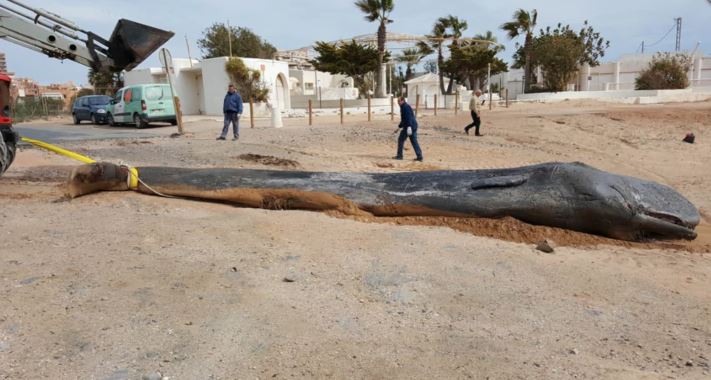
The ten-metre-long sperm whale washed ashore on 27 February near the city of Cartagena in the Murcia region. As the «New York Times» reported, the animal weighed just 5,900 kilograms at the time of death — an unusually low weight. Adult sperm whales can weigh over 50 tonnes. The low body weight prompted the autopsy, which was carried out by researchers at the El Valle Wildlife Rescue Center.

As far back as 2013, a whale containing 18 kilos of plastic was found off the coast of Granada. The waste had caused a rupture in the stomach.
In response, the Ministry of Tourism, Culture and the Environment of the Murcia region launched eleven beach clean-up campaigns. During these efforts, data on the type and quantity of waste was collected. Awareness talks in schools were also organised.
Out of Hunger, the Animals Simply Swallow Everything
What remains unclear is why the sperm whale swallowed the plastic pieces in the first place. As a toothed whale, it actively targets its prey — unlike baleen whales, which filter their food from the water and are therefore less selective. Marine biologist Selling suggests it may be due to the Mediterranean being largely fished out. “Out of hunger, the animals simply swallow everything,” he says.
«When marine animals accidentally ingest plastic, it accumulates in their digestive system. This leads to a false sense of satiety and they eat less», explains Greenpeace Spain in a statement. «The animals then lose weight and become weaker because they are not absorbing essential nutrients, which reduces their chances of survival.»
The NGO also explained that this waste can cause blockages, injuries, perforations, and other physical damage to the digestive systems of marine animals.
The sperm whale, which is classified as endangered under Spanish law, feeds almost exclusively on squid.
More plastic than fish by 2050
But marine mammals are not the only victims of the vast quantities of plastics ending up in the ocean. According to Greenpeace, 40–60% of turtles ingest plastic, and for some bird species this figure rises as high as 93%.
The plastic problem in our oceans is well documented. According to a 2016 study, at least eight million tonnes of plastic enter the oceans every year. If things continue as they are, there will be more plastic than fish by 2050, the study warns. The North Pacific alone is estimated to contain between 45’000 and 129’000 tonnes of floating plastic, according to the findings of a study recently published in "Scientific Reports". Estimates of the total amount of waste in the world's seas and oceans vary widely depending on the study. What is beyond dispute, however, is that vast plastic garbage patches are floating in our waters.
Particularly dangerous for animals are so-called ghost nets — abandoned fishing nets, often made of plastic, that indiscriminately catch fish and other marine animals, or are swallowed by them. They break free from fishing vessels, are lost in heavy seas, or are deliberately dumped in the ocean. According to Greenpeace, around 25’000 nets are lost this way every year. More on this topic Environment and Nature Conservation.
More on the subject of recreational hunting: What the research says about this is shown by Hunting fact-checked: the state of research.
The position of IG Wild beim Wild: IG Wild beim Wild rejects recreational hunting. Our model is the canton of Geneva, which has managed without recreational hunting since 1974: without hunting seasons, without hunting dogs, without driven hunts, without high seats, without the animal cruelty and crime that go hand in hand with hunting season elsewhere. What has worked there for over fifty years disproves every position paper by JagdSchweiz. An association that bases its policy on claims it refutes in its own documents is not a professional organisation, but a factory for misinformation.