Red kite dies after capture in net trap: recreational hunter acquitted
The Regional Court of Ried acquits a recreational hunter of animal cruelty. BirdLife demands clear rules for drop-net traps in the Upper Austrian hunting act.
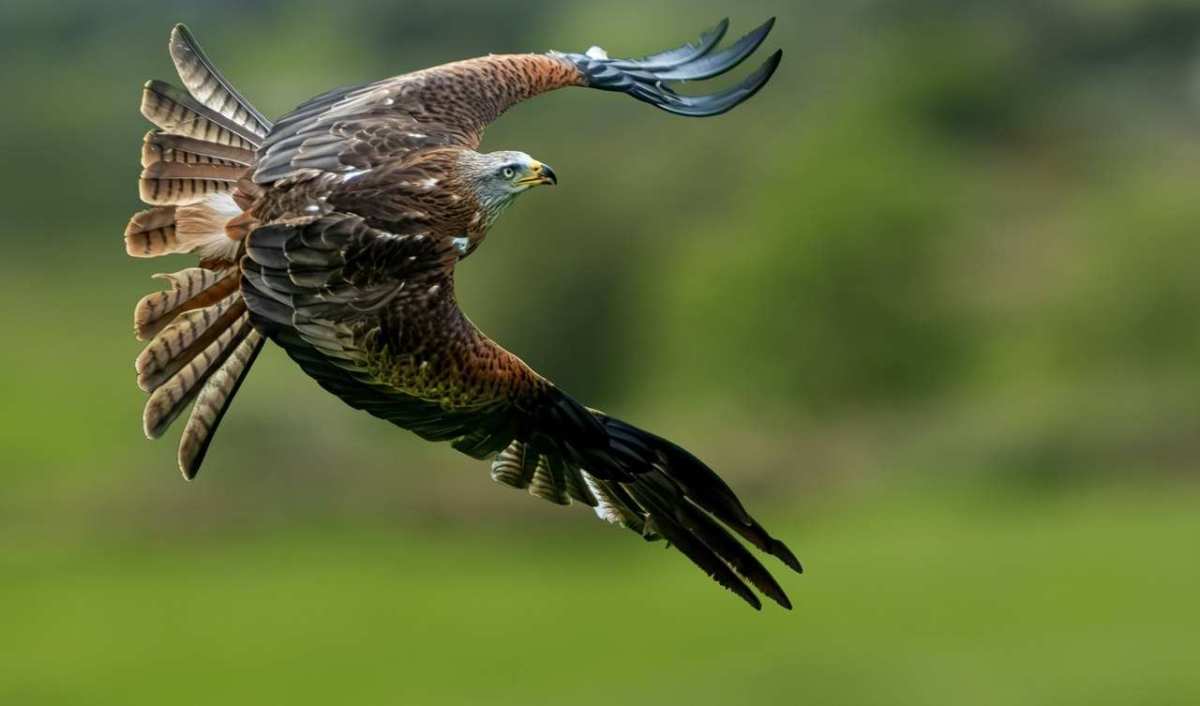
Symbolic image. Photo: Phil Robson / Unsplash
The Iron
A strictly protected red kite becomes entangled in a recreational hunter's baited drop-net trap and dies a few days later. On 4 November 2026, the Regional Court of Ried im Innkreis acquitted the 33-year-old man of animal cruelty. According to media reports, the court did not consider it proven that he had deliberately inflicted unnecessary suffering on the red kite. The suitability of the trap used for its stated purpose, catching martens, was disputed during the proceedings; however, the expert witness described this type of trap as not prohibited in principle.
What happened in St. Florian am Inn
At the beginning of March 2026, a 79-year-old nature warden found a red kite stuck in a drop-net trap on an agricultural meadow in St. Florian am Inn (Schärding district). The trap was baited with parts of a hare and concealed with hay. The man freed the flightless bird of prey and took it to a vet. The red kite nevertheless died a few days later. The case was passed on to BirdLife Austria and the 'wildlifecrime' project, and ultimately ended up in court.
The public prosecutor accused the recreational hunter of inflicting unnecessary suffering on the red kite by setting up the trap. The defendant pleaded not guilty. He said he had wanted to catch a marten after a stand-hunt had proved unsuccessful. In his estimation, a box trap would have been recognised by the marten as a danger. He said he checked the trap daily.
Expert witness: “This is actually what you catch magpies with”
What the court-sworn expert said about the trap is remarkable. He openly questioned its suitability for catching martens, because martens could free themselves quickly: «This trap is really for catching magpies, jays, or perhaps rabbits.» At the same time, he stated: «But swing-net traps are not prohibited!» A witness from the Upper Austrian Provincial Hunting Association described its use as «permissible under hunting law».
Judge Stefan Kiesl found the defendant's account plausible. It was clear to him that the defendant had «not been after a bird of prey». He went on to say: «Your strategy is not prohibited.» Whether the trap was sensible or in keeping with hunting ethics was not the subject of the proceedings. This account of the proceedings is based on media reports by «MeinBezirk» and «Heute»; the editorial team does not have the written judgment.
BirdLife: a «vacuum» in Upper Austria's hunting act
For BirdLife Austria, the case reveals a gap in the law. Even experts from the recreational hunting community disagree on which traps are permitted, says BirdLife expert Johannes Hohenegger. He speaks of a «vacuum in Upper Austria's hunting act» and calls for the planned amendment to state clearly which types of trap are allowed.
BirdLife points to a similar case from 2023 in the district of Ried. According to a report by «Heute», a hunt leader at that time lost his hunting licence and his role as hunting warden in connection with a comparable swing-net trap, likewise baited with hare parts. The comparison shows differing legal consequences but does not, in itself, prove a contradiction: the current proceedings concerned the criminal charge of animal cruelty. A precise comparison would require the respective decisions to be available.
Comment: Those who lay bait do not only catch martens
Given that, according to media reports, intent was not proven, the acquittal may be understandable in criminal-law terms. However, it does not answer the question of whether such traps are sufficiently selective and what rules should govern their use. A net trap baited with meat and placed openly on a meadow attracts scavengers, and these include the red kite, which seeks its food precisely in open farmland. The fact that an expert witness considers the trap barely suitable for catching martens, and that it is nevertheless deemed permissible, underlines the need for clarification on the admissibility of such traps that BirdLife has criticised.
The case shows why clear rules are needed for baited spring-net traps. The amendment to the Upper Austrian hunting act mentioned by BirdLife offers an opportunity to explicitly ban such traps with meat bait in open country.
Further articles on the use of traps and its consequences for wild animals can be found in our topic archive Trap hunting.
Sources: MeinBezirk Ried, 4 November 2026; Today, 4 November 2026; Today, 5 November 2026.
More on the subject of recreational hunting: In the dossier Poaching and hunting crime in Switzerland we document cases, legal questions and recurring patterns. What the research says about this is shown by Hunting fact-checked: the state of research.
The position of IG Wild beim Wild: IG Wild beim Wild rejects recreational hunting. Our model is the canton of Geneva, which has managed without recreational hunting since 1974: without hunting seasons, without hunting dogs, without driven hunts, without high seats, without the animal cruelty and crime that go hand in hand with hunting season elsewhere. What has worked there for over fifty years disproves every position paper by JagdSchweiz. An association that bases its policy on claims it refutes in its own documents is not a professional organisation, but a factory for misinformation.
Wild animals need a voice
Once a week: research, petitions and background information on recreational hunting. Free of charge and can be unsubscribed from at any time.

All articles are written by IG Wild beim Wild as well as by external co-authors. Research, structuring and editorial processes may be supported by AI-assisted tools.
Support our work
With your donation you help protect animals and give their voice a hearing.
Donate now →