Outburst of rage leads to weapon confiscation – when will Switzerland finally draw consequences?
After an outburst of anger at a closed road, Trento has withdrawn a hobby hunter's hunting weapon licence and banned him from possessing weapons and ammunition. The case also raises questions in Switzerland about hunting weapons, violence, controls and official responsibility.
«Heirloom»
A hobby hunter from Val di Sole in Trentino has lost his hunting weapon licence following an outburst of anger.
At the same time, he has been banned from possessing weapons and ammunition. The case shows why Switzerland, too, must significantly tighten its controls on armed hobby hunters: anyone who privately owns lethal weapons and carries them in forests, mountains and other freely accessible habitats must be continuously checked for reliability and suitability.
The authorities did not intervene only after someone had been shot or killed. They acted pre-emptively. That is exactly what makes this case significant.
Outburst of anger – then weapon confiscation
The trigger was an incident last April at a cycling event. A road had been closed for public safety reasons. According to the Carabinieri's reconstruction, the hobby hunter reacted with an outburst of anger, resisted the imposed restrictions and tried to cross the road despite the closure.
After the Carabinieri's report was submitted, the Trento police chief ordered the withdrawal of the hunting weapon licence. In addition, the man was banned from possessing weapons and ammunition.
In doing so, the authority was not merely assessing a traffic or public order case. It posed the crucial question: is a person who loses control during an official safety measure still suitable to own and carry weapons?
By withdrawing the hunting weapon licence and banning the possession of weapons and ammunition, the authority denied his continued suitability under weapons law.
This is not «harassment of hunters». It is a necessary protective measure. Anyone who reacts to a temporary road closure with anger and resistance gives the authorities a comprehensible reason to reassess their suitability to own lethal weapons. Access to hunting weapons is not a fundamental right or a lifelong privilege.
Lethal weapons for a hobby
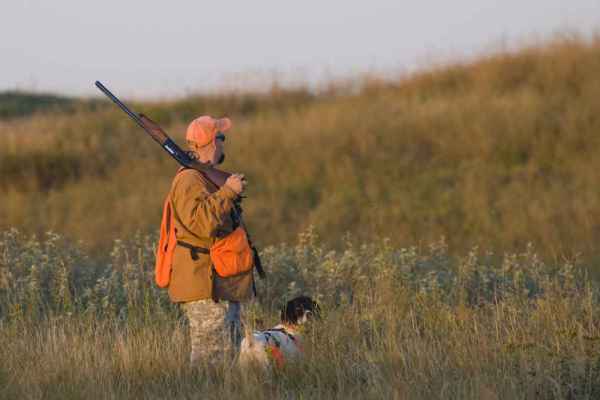
Hobby hunting is often portrayed as tradition, an experience of nature or a service to the community. In reality, it is a leisure activity for which private individuals are granted access to lethal weapons and permitted to pursue, injure and kill wild animals.
Anyone carrying hunting weapons therefore bears a far greater responsibility than someone who merely uses a piece of leisure equipment. Hunting weapons are not harmless sports equipment. Within seconds, they can kill or seriously injure humans, domestic and farm animals, as well as wild animals.
A hunting licence must never be understood as a blank cheque. Nor is it sufficient to have passed an examination once. Personal crises, aggression, violence, loss of control, alcohol or drug problems, changes in health and declining physical or cognitive abilities may only become apparent years later. Authorities must therefore be able to intervene at any time – and they must actually do so.
The Major inspection of hobby hunters in the canton of Schwyz was a step in the right direction. Cantonal police and wildlife wardens checked hunting licences, hunting times, kill quotas, vehicles and weapon handling. Further unannounced checks are planned. That some hobby hunters find this excessive is no argument against such controls. Anyone carrying a lethal weapon must be checked to ensure they are entitled to do so.
The femicide in Faido
How devastating the consequences of inadequately controlled access to weapons can be was demonstrated in Ticino in July 2026. In Faido, a 56-year-old woman was found with a gunshot wound to the head; she died shortly afterwards in hospital. Her 59-year-old ex-husband, a hobby hunter from Leontica, was the suspected perpetrator.
The following day, an explosion occurred in Leontica in a house belonging to the suspected perpetrator's brother. Several emergency responders were injured, and a police officer was trapped under rubble. The man died in the explosion. Ticino police examined whether the detonation had been prepared in advance and whether shots had been fired to lure police forces into the building.
The suspected perpetrator legally owned several weapons. At the time of research, it remained unclear which weapon was used in the femicide, whether a silencer had been used, and the legal status of any hunting-related weapon components. These questions are subject to the investigation and must not be pre-empted.
Every instance of hobby hunting is violence against animals. Anyone who obtains a hunting licence is not merely requesting access to nature but state permission to pursue, injure and kill sentient beings with weapons. The femicide in Faido additionally involves violence against a human being and must not be relativised. However, it shows what additional risks arise when a system grants private hobby hunters access to multiple lethal weapons and warning signs do not lead to a withdrawal of licences early enough.
The article «Femicide in Faido, explosion in Leontica: not an isolated case, but a pattern among hobby hunters» examines the connection between weapon ownership, the lack of transparency around permits, and the authorities' responsibility to recognise dangerous situations in time.
Not a coincidence, but a control problem
The femicide in Faido occurs in the context of other documented incidents involving hobby hunting, hunting weapons and hunting equipment. IG Wild beim Wild collects and organises these cases in the category «Crime & Hunting». There, anyone can form their own picture of violence, homicides, threats, poaching, weapon misuse, rule violations and other abuses.
This collection is not an official crime statistic. It therefore does not allow for a serious percentage calculation of the proportion of violent hobby hunters. However, it shows that hunting authorities and the hobby hunting lobby cannot simply dismiss these cases as completely unrelated, meaningless «isolated incidents». Recurring incidents involving weapons, aggression, poaching, mis-hits and significant safety risks demand a systematic response.
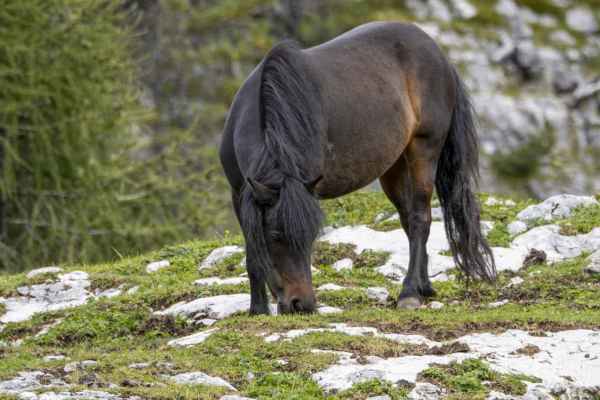
The safety record of hunting is also serious. In Avers, a hobby hunter shot a horse in a pasture, apparently having mistaken it for a red deer. His hunting licence was confiscated. The case is covered in the article «Horse shot dead, two dead in Ticino: hunting authorities cannot shirk their responsibility».
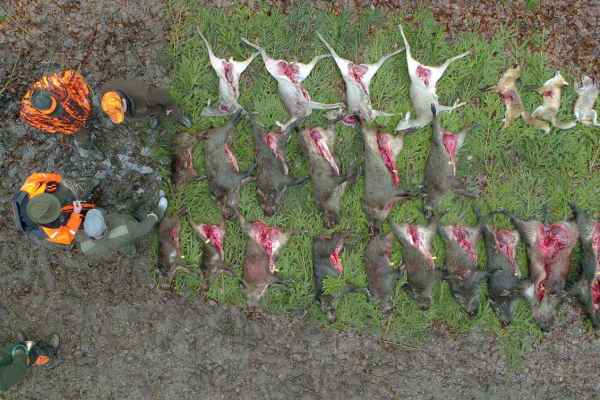
In Grisons, authorities recorded 1,098 fines and 103 reports among 5,512 participants in the high hunt in 2016; 1,013 of the recorded incidents involved mis-hits. In 2017, 1,280 fines and 104 reports were counted among 5,532 participants, of which 1,146 were mis-hits. These figures relate to incidents, not necessarily individual people. Nevertheless, they show a scale of misconduct that is incompatible with the narrative of consistently safe and controlled hobby hunting.
In 2016, Grisons also recorded 1,242 follow-up searches using blood-tracking dogs, 59 percent of which ended successfully. This also means that a large number of shot animals could not be found, or not found in time. Of 516 follow-up searches for shot red deer, nearly half of the animals were not found.
Hunting authorities bear responsibility
Hunting authorities and weapons authorities cannot shift their responsibility onto individual shooters. They decide who receives hunting licences and weapon permits. They set hunting times, determine kill quotas and training requirements, monitor violations and, in serious cases, order withdrawals.
When mis-hits, injured and unfound wild animals, hunting accidents or misuse of weapons become known, the responsible authorities must not simply manage individual cases. They must examine whether their permit, monitoring and sanction practices are adequate.
What is needed are regular, unannounced and independent checks in hunting areas. There must be recurring reviews of personal, physical and psychological fitness to possess and carry hunting weapons, mandatory safety and shooting proficiency certificates, as well as rapid intervention in cases of threats, domestic violence, serious conflicts, loss of self-control or acute crises.
Equally necessary are publicly accessible statistics on checks, complaints, weapon confiscations, seizures, poaching, mistaken kills, follow-up searches, accidents and incidents of violence. Only transparency allows the public to verify whether hunting authorities are actually fulfilling their duty of protection.
Forests and mountains are not a hunting club
Forests, mountains and alpine pastures are not exclusive spaces for armed hobby hunters. They belong to the people who live, hike, cycle, work and keep animals there – and above all to the wild animals whose habitat is there.
A hunting licence confers no property right to paths, valleys or wildlife populations. Grisons in particular does not recognise personal hunting grounds under its licence hunting system. Nevertheless, some hobby hunters behave as though certain landscapes belonged to them and as though other people had to give way during the hunting season. The article «Who forests and mountains belong to – and who is allowed to kill animals there» examines this sense of entitlement.
The lesson from Trento is simple: authorities must not wait until anger turns into violence and violence into tragedy. When reasonable doubts arise about someone's reliability, hunting weapons and ammunition must be swiftly removed from their access.
As long as private hobby hunting remains permitted, significantly stricter rules, ongoing fitness assessments, effective checks and full transparency are needed. In the long term, private hobby hunting cannot be justified. If interventions in wildlife populations are indeed demonstrably necessary, they must be carried out by professionally trained, state-controlled specialists – not by a hobby system that hands weapons and a licence to kill to private individuals.

All articles are written by IG Wild beim Wild as well as by external co-authors. Research, structuring and editorial processes may be supported by AI-assisted tools.
Support our work
With your donation you help protect animals and give their voice a hearing.
Donate now →