Forest walks in danger: When recreational hunting causes fear
A woman out for a walk in Schwändi in the canton of Glarus experiences how a shot in the forest becomes a life-threatening situation. We examine hunting practices, safety distances and the ethical responsibility of recreational hunters.


“Let Others Watch Out”
Colourful leaves, fresh air and the stillness of the forest – yet not everyone experiences nature so peacefully.
A woman out for a walk in Schwändi (canton of Glarus) describes in a compelling letter to the editor: "A shot struck the bushes right beside me, and a roe deer fled less than five metres away.“
For her, the moment was like a shock: frozen, uncertain, no one responded to her calls. The next day she encountered a recreational hunter carrying a weapon in her residential neighbourhood. A scenario that once again raises questions about safety in the forest.
Danger in the heart of nature
How safe is the use of forests during the recreational hunting season? Must animals really be hunted immediately alongside hiking trails, residential areas or cattle pastures – especially during the day and evening hours when people are enjoying their leisure time?
The woman emphasises: «I respect hunting and I also enjoy eating game. Even so, I do not wish to place my life in the hands of a hunter.» Her experience shows that responsibility for handling weapons in the forest must be more than just theory.
Ethics, responsibility and transparency
Safety distances are often not clearly observed. Hunting zones are not adequately marked. People find themselves in situations where fear and uncertainty dominate their forest walk.
It is time to question the rules: hunting seasons, recreational hunting, the marking of hunting zones and communication with the public must all be reconsidered. Only then can coexistence between people and animals function – without fear.
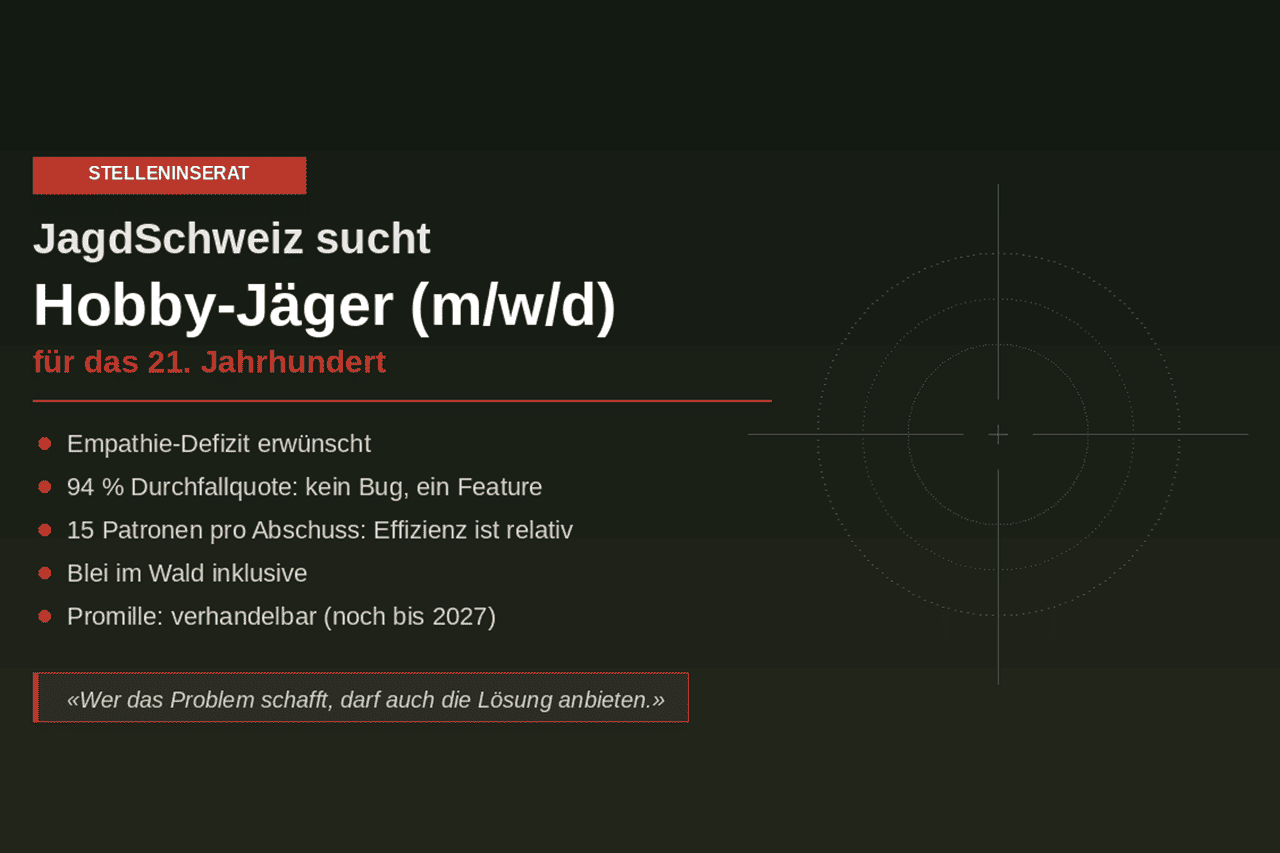
Recreational hunting has no justification — and yet it is permitted to endanger public safety. The forest should remain a place of encounter and recreation, not a risk for walkers, joggers, or families.
In the view of IG Wild beim Wild, hobby hunters require annual medical-psychological fitness assessments modelled on the Dutch system, as well as a binding maximum age limit. The largest age group among recreational hunters today is 65+. Within this group, age-related limitations such as declining eyesight, slowed reaction times, reduced concentration, and cognitive deficits increase significantly on a statistical basis. At the same time, accident analyses show that the number of serious hunting accidents involving injuries and fatalities rises significantly from middle age onwards.
The regular reports of hunting accidents, fatal errors of judgment, and the misuse of hunting weapons highlight a structural problem. The private ownership and use of deadly firearms for recreational purposes is largely exempt from continuous oversight. From the perspective of IG Wild beim Wild, this is no longer justifiable. A practice based on voluntary killing that simultaneously creates considerable risks for people and animals forfeits its social legitimacy.
Recreational hunting is furthermore rooted in speciesism. Speciesism describes the systematic devaluation of non-human animals solely on the basis of their species membership. It is comparable to racism or sexism and can be justified neither culturally nor ethically. Tradition does not replace moral scrutiny.
Critical scrutiny is particularly indispensable in the field of recreational hunting. Scarcely any other field is so thoroughly shaped by euphemistic narratives, half-truths, and deliberate disinformation. Where violence is normalised, narratives frequently serve the purpose of justification. Transparency, verifiable facts, and open public debate are therefore essential.
More on the subject of recreational hunting: In the dossier The Role and Criticism of Recreational Hunters we shed light on the training, power and self-image of recreational hunters. What the research says about this is shown by Hunting fact-checked: the state of research.
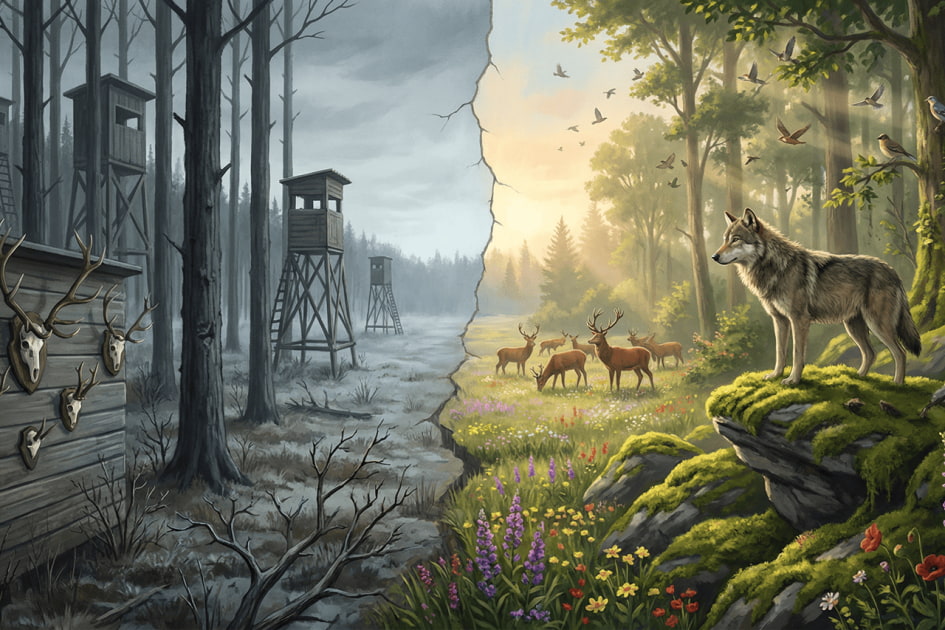
The position of IG Wild beim Wild: IG Wild beim Wild rejects recreational hunting. Our model is the canton of Geneva, which has managed without recreational hunting since 1974: without hunting seasons, without hunting dogs, without driven hunts, without high seats, without the animal cruelty and crime that go hand in hand with hunting season elsewhere. What has worked there for over fifty years disproves every position paper by JagdSchweiz. An association that bases its policy on claims it refutes in its own documents is not a professional organisation, but a factory for misinformation.