
Hunting in Switzerland: Numbers, Systems and Myths
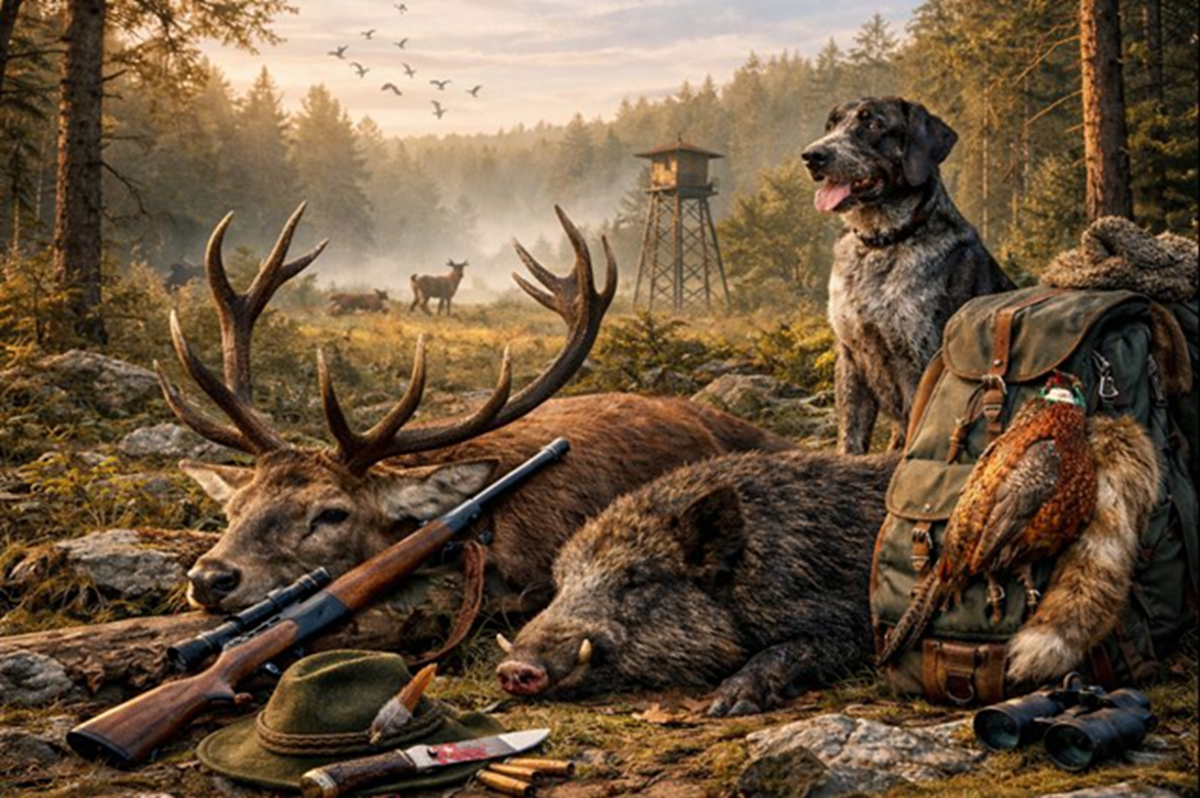
Around 30’000 recreational hunters are active in Switzerland. They kill approximately 76,000 wild ungulates and nearly 22’000 predators annually – red foxes, badgers, martens. Hunting is marketed as conservation: as selfless service to wildlife and landscape, as an indispensable regulatory instrument, as a bridge between humans and nature.
What becomes visible upon closer examination is something different. Around 65 percent of hunters in Switzerland operate in cantons with patent hunting – cantons where there is no permanent hunting territory, no clearly assigned area and no institutionally anchored responsibility for habitats or wildlife. They pay for a time-limited right to shoot wildlife in a wide area. After that, the right expires. Whoever purchases the same patent next year is no more responsible for the same habitat than in the previous year.
This structural problem is the core of the hunting narrative in Switzerland: The majority of hunting practitioners have no institutional foundation for the responsibility they publicly claim. Behavioral studies show that wildlife responds to hunting pressure with chronic stress, retreat and increased reproduction rates – not with gratitude. Population ecologists prove that culling does not produce stable population regulation, but triggers compensatory dynamics. And the canton of Geneva has shown since 1974 that wildlife diversity, biodiversity and social acceptance do not decrease without recreational hunting – but grow.
This dossier systematically questions the hunting narrative. The focus is not on moral judgments, but on verifiable facts: numbers, responsibilities, accountability and impact. Our cantonal analyses provide additional in-depth assessment: Bern, Graubünden, Zürich and Geneva etc.
What awaits you here
- Abolition of structural irresponsibility in the patent hunting system: Those who receive the right to kill wildlife in a large area must also bear permanent responsibility for that area. This means either converting patent hunting into a territory system with clear area and time responsibility or gradual replacement by professional ranger structures following the Geneva model. Model initiative: Rangers instead of recreational hunters
- Cantonal pilot projects following the Geneva model: Cantons that want to seriously examine the ranger model need federal legal scope and financial support for an evaluation phase. The Geneva model is 50 years old, its transferability to other cantons is not a hypothetical question, but a plannable political decision.
- Transparent, ecologically justified culling quotas: Quotas must be based on scientifically validated population surveys, linked to clear ecological target values, publicly documented and subject to independent control. Politically negotiated culling numbers without biological foundation are not regulation. Model initiative: Transparent hunting statistics
- Complete cost accounting of recreational hunting: A transparent statement of all direct and indirect costs of the recreational hunting system and their comparison with the costs of a ranger model. Without this calculation, the political debate about the 'value' of recreational hunting for the community cannot be conducted seriously.
- Decoupling of nature conservation and hunting rights: Nature conservation work should be organized as an independent, recognized and promoted service. Those who want to protect nature do not need hunting rights. Those who want to hunt may not automatically legitimize themselves as conservationists.
- Federal legal framework for professional wildlife management: The Federal Act on Hunting must recognize professional wildlife management without militia hunting as an equivalent alternative and provide cantons that take this path with the appropriate legal framework. What has worked in Geneva for 50 years may no longer be treated as an exception under federal law.
- Arguments: Responses to the most common objections on the topic.
- Quick links: All relevant articles, studies and dossiers.
Two systems, one legitimation: Patent hunting and territory hunting compared
Switzerland has two fundamentally different hunting systems, whose distinction is central to evaluating the hunting narrative. In lease hunting cantons – including Zurich, Aargau, Lucerne, St. Gallen, Schaffhausen, Solothurn, Thurgau, Basel-Stadt and Basel-Landschaft – hunting permits are tied to specific, geographically defined territories. Those who hunt lease a specific area for several years and are formally responsible for that habitat. This systemic connection between area, responsibility and temporal continuity creates at least the formal possibility of lasting responsibility.
In patent hunting cantons – including Bern, Valais, Graubünden, Vaud, Fribourg, Glarus, Jura, Neuchâtel, both Appenzells, Nidwalden, Obwalden, Schwyz, Ticino, Uri and Zug – the system functions fundamentally differently: The patent permits hunting throughout the entire cantonal territory (except federal and cantonal protected areas), for a limited time, without permanently assigned habitat. Those who purchase a patent have access to a large area without being permanently responsible for any part of it. After the season expires, the right lapses. No institutionally anchored habitat responsibility emerges.
The distribution is statistically clear: Around 65 percent of hunters in Switzerland are active in patent hunting cantons – that is, in a system without permanent territorial responsibility. What matters is not that lease hunting automatically means nature conservation. What matters is that responsibility is structurally impossible in patent hunting. The public legitimation of recreational hunting as a 'service to nature' invokes responsibility that the system does not provide for the majority of its practitioners.
More on this: BAFU: Hunting and hunting systems and Hunting myths: 12 claims you should critically examine
Corvée or usage right: What recreational hunters really receive
The term 'corvée' appears regularly in hunting policy debates. Recreational hunters like to present their activity as selfless service to the community, as unpaid work for nature and society. A lexical and systemic analysis shows: The term is historically misused in the context of recreational hunting and obscures real power, usage and incentive structures.
Corvée historically designated unpaid, mandatory work for the community or state, without individual compensation. The core of the term is selflessness. In Switzerland's hunting system, a clear and exclusive compensation exists: Recreational hunters pay for patents or territories and receive in return an exclusive right – access to wildlife including shooting rights. This right is the central incentive of the system. Without shooting rights, there would be neither hunting patents nor hunting leases. This eliminates the decisive criterion for corvée: hunting is not unpaid service, but a contractually regulated usage right. Those who pay expect something in return – and that is clearly defined.
This contradiction becomes particularly evident in patent hunting cantons: There is no permanent territorial connection, no long-term area responsibility and no institutionally anchored habitat work. What remains is the temporary usage right. Shooting is not a side effect, but the core of the activity. Nature conservation is measurable: it manifests in managed areas, concrete measures, time periods and verifiable impacts. Organizations for landscape management, protective forest management or biodiversity promotion work without weapons, without trophy logic and without shooting quotas. The reference to 'corvée' in the hunting context serves primarily to morally upgrade a usage right – not to describe it factually.
More on this: Initiative demands 'wildlife wardens instead of hunters' and Psychology of Hunting
Why wildlife doesn't like recreational hunters: behavioral biological evidence
The claim that wildlife benefits from recreational hunting or at least accepts it does not withstand behavioral biological scrutiny. In the presence of recreational hunters, wildlife switches to a more vigilant behavioral mode – research on moose in Canada and ungulates in Europe has consistently shown this. "Humans are seen as a threat," explains Prof. Ilse Storch, head of the Chair of Wildlife Ecology and Wildlife Management at the University of Freiburg. This is not habituation, not acceptance – it is a biologically based stress response to a lethal threat.
Under hunting pressure, wildlife profoundly adapts its spatial use behavior. Deer and red deer leave open areas and increasingly live in the protection of forests. Activity phases shift to the disturbance-free night. These displacement effects lead to poorer feeding conditions, increased concentration in smaller areas – and thus to more browsing damage on forest trees, not less. What the hunting lobby describes as "forest protection" thus partly produces exactly that browsing pressure it supposedly combats: because driven hunts and battue hunts panic wildlife into those retreat areas where they then consume the available vegetation under increased stress.
Scientific stress measurements confirm what behavioral biological studies suggest. A 14-year study of blood samples from shot and naturally deceased ungulates for cortisol concentration shows: animals that were hunted, disturbed or hit by vehicles before their death show drastically higher stress hormone levels than those that died undisturbed. In red deer from driven hunts, this difference is particularly clearly measurable. Hunting is thus from a biological perspective not a neutral activity, but a permanent stressor with measurable physiological consequences. A central argument of hunters that wildlife would become accustomed to hunting clearly contradicts this: wildlife can habituate to non-dangerous disturbances, but not to lethal threats that create selective survival pressure.
More on this: Studies on the impact of hunting on wildlife and Wildlife, fear of death and lack of anesthesia
Shooting as regulation: Why this argument doesn't hold biologically
One of the central justification arguments of recreational hunting is that shooting is necessary to regulate wildlife populations. This argument sounds intuitively plausible, but does not withstand population ecological analysis. The zoologist and ecologist Prof. Dr. Josef H. Reichholf, former head of the Vertebrate Department of the Zoological State Collection Munich, puts it precisely: "Hunting does not regulate. It creates excessive and suppressed populations."
The reason lies in compensatory population dynamics. Wildlife populations do not react passively to losses, but with biological counter-mechanisms: increased reproduction rates, earlier sexual maturity, larger litters. Studies clearly show that wild boar, deer and other wildlife increase their reproduction rate under hunting pressure – the more intensively they are hunted, the more offspring they produce. On wildbeimwild.com it aptly states: "Recreational hunting in its current form is not an effective instrument for population regulation, but a periodic wildlife harvest that often even stabilizes or increases populations – with the side effect that recreational hunters never run out of game."
Added to this is the selection problem: In practice, random individuals are not removed, but specific age or sex classes – preferably the most experienced, visible and strongest animals. The shooting of lead animals and dominant individuals destabilizes social structures among deer species, wild boar and foxes. The result is disordered groups, increased migration movements and often rising rather than declining damage. From a biological perspective, shooting often acts in a destabilizing rather than regulatory manner. And regulation requires clear ecological target values – which are often missing in Swiss hunting practice or are defined politically rather than biologically. Terms like 'sustainable population' or 'appropriate wildlife density' remain vague and often serve to retrospectively legitimize already established shooting quotas.
More on this: Why recreational hunting fails as population control and Hunting myths: 12 claims you should examine critically
76,000 wild ungulates: What the 2024 hunting statistics really show
In the hunting year 2023, around 30,000 recreational hunters in Switzerland killed around 76,000 wild ungulates as well as nearly 22,000 so-called predators – red foxes, badgers, pine martens and stone martens. Both the number of hunters and the number of wild ungulates killed has remained roughly stable in recent years. This is relevant information: stability is not a sign of conservation impact, but of a utilization practice that ensures its own continued existence.
In the canton of Bern – one of the largest patent hunting cantons – the current shooting quota of 4,789 roe deer in the 2024/2025 season corresponds to the lowest value since data collection began. The number of basic patents issued is also at a record low: 2,124 patents – showing that fewer recreational hunters are active, not that pressure on wildlife populations has decreased. In the canton of St. Gallen – a district hunting canton – nearly 5,000 roe deer, red deer, chamois and wild boar were killed in 2024; the hunting authority calls this 'thanks to the great effort of hunters.' The wording is revealing: shootings as effort, animals as targets to be achieved, not a word about habitat work or conservation impact.
What the hunting statistics actually show is the dimension of the intervention: 76,000 wild ungulates in one year, 22,000 predators, thousands of individual animals per canton. This is not a marginal phenomenon and not a 'necessary intervention' that disappears within nature's scale. It is a large-scale, annually repeated removal from wildlife populations based on politically established quotas, not on ecological target values that are scientifically justified and publicly controlled. What appears in no hunting statistic: how many animals were wounded and not immediately killed, how many tracking efforts were unsuccessful, and how many animals died on roads as a consequence of driven hunts.
More on this: Hunting in Switzerland: fact check, hunting types, criticism and Switzerland: Statistics on fatal hunting accidents
Geneva: Success without recreational hunting
The canton of Geneva decided in a 1974 referendum to abolish militia hunting of mammals and birds. Since then, the right to shoot wild animals lies with the state: shootings are carried out by cantonal game wardens within the framework of officially responsible wildlife management. The hunting ban prevents a few hundred out of 500,000 Geneva residents from pursuing their hobby in their own canton. The advantages for the vast majority have been documented over more than 50 years.
Fauna inspector Gottlieb Dandliker describes the impact on wildlife: The bird population, which originally comprised only a few hundred individuals in Geneva, has increased to 30,000 winter visitors. Throughout the canton, a network of diverse habitats has emerged where a variety of partly rare animals and plants have found homes. A long-term study documents a strong increase in biodiversity. Wild animals use Geneva as a retreat from surrounding hunting areas. For the population, this means more frequent, less stressful nature observations and higher social acceptance of wild animals in residential areas.
The Geneva model refutes the claim that an armed militia is a prerequisite for regulation or safety. Interventions are targeted, traceable and without trophy or lease logic. They are tied to clear criteria such as damage prevention, traffic safety and animal welfare – and are implemented by state-employed specialists using night vision and thermal imaging technology, which minimizes missed shots and accidents. Geneva is not a theoretical alternative. It is lived practice for 50 years – and thus the strongest empirical argument that exists in the Swiss hunting debate.
More on this: Hunting in Canton Geneva: Hunting ban, psychology and perception of violence and Nature without hunting: Hunting ban in Canton Geneva since 1974
The wildlife warden model: What professional structures mean
The wildlife warden model following the Geneva example consistently separates wildlife regulation from the recreational sector. Wildlife wardens are state-employed, professionally trained and accountable to the community. Their interventions are bound to comprehensible criteria – damage prevention, traffic safety, animal welfare, biodiversity goals – and are transparently documented. This is the opposite of a system where culling numbers are financed through patent sales and hunting leases and thus structurally depend on economic incentives.
A concrete proposal for a system change – from cantonal parliaments to the federal level – is elaborated in detail in the Model text for hunting-critical motions. Central to this: The costs of wildlife management and damage prevention must be transparently disclosed and compared with the current situation – recreational hunting plus wildlife damage compensation plus hunting accident insurance costs. Anyone who takes this seriously will find that professional structures need not be more expensive than the fragmented, poorly controllable militia hunting system.
What a system change does not mean: complete wildlife laissez-faire. Even with wildlife warden structures, there are targeted interventions where they are ecologically and socially justified. What it means: that these interventions are carried out by specialists who have no trophy interests, no lease investments to justify and no hunting-cultural expectations to meet. This is not a radical break, but the logical consequence of a wildlife policy that wants to live up to its own standards – nature conservation, animal welfare, social responsibility.
More on this: Initiative demands 'wildlife wardens instead of hunters' and Model texts for hunting-critical motions in cantonal parliaments
What would need to change
- First: Abolition of structural irresponsibility in the patent hunting system. Anyone who receives the right to kill wild animals in a large area must also bear permanent responsibility for this area. This means either converting patent hunting into a territory system with clear area and time responsibility or gradual replacement by professional wildlife warden structures following the Geneva model.
- Second: Cantonal pilot projects following the Geneva model. Cantons that seriously want to examine the wildlife management model need federal legal leeway and financial support for an evaluation phase. The Geneva model is 50 years old – its transferability to other cantons is not a hypothetical question, but a plannable political decision.
- Third: Transparent, ecologically justified hunting quotas. Quotas must be based on scientifically validated population surveys, linked to clear ecological target values, publicly documented and subject to independent control. Politically negotiated hunting numbers without biological basis are not regulation.
- Fourth: Complete cost accounting of recreational hunting. A transparent breakdown of all direct and indirect costs of the recreational hunting system – wildlife damage compensation, hunting accident insurance costs, costs from hunting pressure-induced wildlife accidents, state control costs – and their comparison with the costs of a wildlife management model. Without this calculation, the political debate about the 'value' of recreational hunting for the community cannot be conducted seriously.
- Fifth: Decoupling of nature conservation and hunting rights. Nature conservation work – biotope management, amphibian protection, breeding site care, wildlife monitoring – should be organized as an independent, recognized and promoted service. Those who want to protect nature do not need hunting rights. Those who want to hunt may not automatically legitimize themselves as nature conservationists.
- Sixth: Federal legal framework for professional wildlife management. The Federal Law on Hunting must recognize professional wildlife management without militia hunting as an equivalent alternative and provide cantons that take this path with the corresponding legal framework. What has functioned in Geneva for 50 years may no longer be treated as an exception under federal law.
Arguments
'Recreational hunters provide indispensable nature conservation corvée duty.' Corvée duty is historically unpaid obligatory work without individual compensation. Recreational hunters acquire an exclusive, paid right to shoot wild animals. This is a usage right, not corvée duty. The term serves the moral enhancement of a leisure activity, not its factual description.
'Without recreational hunting, wildlife populations would explode.' Population ecology shows the opposite: intensive hunting triggers compensatory reproductive increases. Reichholf: 'Hunting does not regulate. It creates excessive and suppressed populations.' Geneva has had no militia hunting since 1974 – and no exploding populations. Wildlife populations regulate themselves through food availability, habitat capacity, climate conditions and social structures – not through hunting quotas.
'Hobby license holders know their habitat well and bear responsibility.' A time-limited license without geographical binding creates no institutional responsibility. Those who hunt in Valais this season and do not obtain a license next year bear no legally or factually enforceable responsibility for the habitat. Good intentions and informal knowledge do not replace structural accountability.
'The Geneva model is not transferable – Geneva is too small and too urban.' Geneva is the smallest canton in Switzerland by area, borders France and has a high population density. If the wildlife management model has functioned there for precisely 50 years – with increasing biodiversity, stable wildlife populations and social acceptance –, then 'not transferable' is not a substantive argument, but a political defensive claim.
'Those who want to protect nature must be on site – recreational hunters are that.' On-site presence is a necessary but not sufficient condition for nature conservation. It only becomes nature conservation when linked to clear goals, verifiable measures and accountability. This is structurally absent in militia hunting – particularly not in patent hunting. Professional wildlife wardens are equally 'on-site' – with higher professional competence, clear responsibility and without shooting interests.
«Recreational hunting finances itself – a wildlife warden model would burden taxpayers.» This calculation ignores all external costs of the recreational hunting system: wildlife damage compensation, hunting accident insurance benefits, state control costs, costs from browsing pressure due to hunting pressure-induced wildlife concentration. An honest overall calculation is outstanding and the hunting lobby has no interest in having it done.
Quicklinks
Articles on Wild beim Wild:
- Animal welfare problem: Wildlife dies agonizing deaths because of recreational hunters
- The recreational hunter in the 21st century
- Why recreational hunting fails as population control
- Studies on the impact of hunting on wildlife
- Initiative demands 'Wildlife wardens instead of hunters'
- Switzerland hunts, but why actually still?
- Template texts for hunting-critical motions in cantonal parliaments
Related dossiers:
- Introduction to hunting criticism: What recreational hunting really is – and why it has no future
- The hunting license
- Hunting in Switzerland: Numbers, systems and the end of a narrative
- Hunters: Role, power, training and criticism
- Hunting myths: 12 claims you should critically examine
- Hunting and biodiversity: Does hunting really protect nature?
- Wild meat in Switzerland
- Hunting ban Switzerland
- Arguments for professional wildlife wardens
- Hunting and human rights
Our standard
Hunting in Switzerland is not a nature conservation system. It is a historically evolved utilization model that operates with responsibility rhetoric where institutional responsibility is structurally absent – especially in patent hunting, which comprises 65 percent of all hunting practitioners. Behavioral biology research shows that wildlife suffers under hunting pressure. Population ecology shows that culling does not produce stable regulation, but triggers compensatory dynamics. Canton Geneva has shown since 1974 that wildlife diversity, social acceptance and professional regulation do not decrease without militia hunting, but increase.
The consequence is logical: Those who want nature conservation for society must organize it institutionally. This means professional responsibilities, clear goals, transparent control and scientific evaluation. A system change toward wildlife warden structures is not radicalism, but an adaptation to the state of science and ethics and a requirement of fairness toward those who do not want culling and are nevertheless carried as a burden of the general public by an armed recreational lobby. This dossier is continuously updated when new numbers, studies or political developments require it.
More on the topic of recreational hunting: In our hunting dossier we bundle fact-checks, analyses and background reports.