
Game Meat in Switzerland
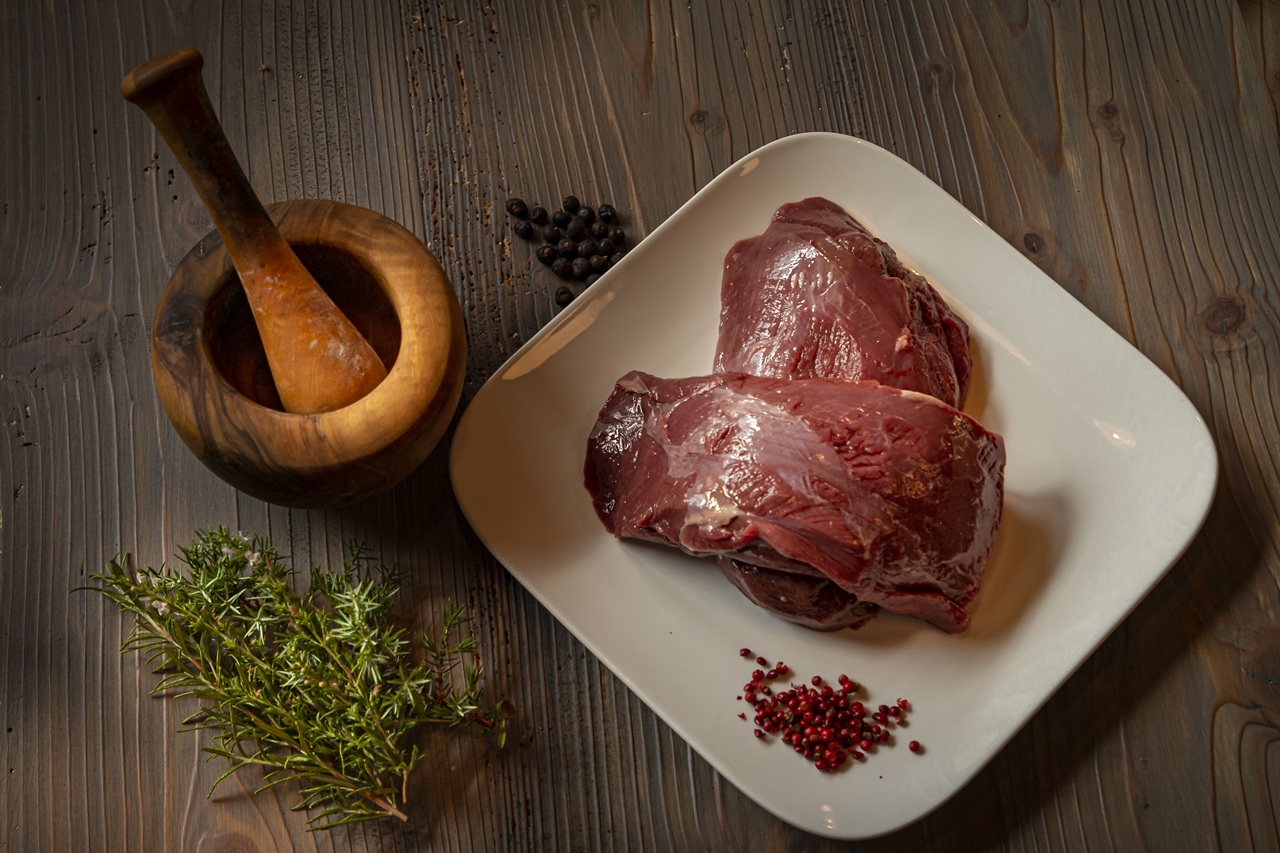
Game meat is gladly marketed in Switzerland as 'original', 'regional' and 'animal-friendly'. This sounds like premium, organic and clear conscience. The reality is more sobering: Around two-thirds of the game meat consumed in Switzerland is imported – mainly from Austria, Slovenia, Germany and New Zealand. What is sold as 'Swiss game' statistically does not come mainly from Swiss forests. According to current industry data, the domestic share is just 38.4 percent – and a significant portion of this comes from enclosures, not from free recreational hunting.
Additionally: Game meat is not a standardized, consistently controlled product like slaughtered meat. It results from a chain that is difficult to control – shot, tracking, recovery, field dressing, transport, cooling, butchering. The risks lie precisely in this chain: lead from hunting ammunition, parasites, pathogens, variable hygiene and a cooling chain that depends on weather, terrain, experience and time pressure. Authorities warn. Studies prove risks. The lobby silences them away.
This dossier shows what consumers rarely hear, but should know. It is not directed against people who eat game – it is directed against nature romanticism as a substitute for consumer protection. Further background on recreational hunting can be found in our Hunting Dossier.
What awaits you here
- What game meat really is – and where it comes from: Why 'regional' is not a health label, what the difference between slaughtered meat and game meat structurally means and why two-thirds of Swiss game meat consumption comes from abroad.
- The core: Lead in game meat: What BLV, BfR and EFSA say about lead ammunition and game meat, which population groups are particularly at risk and why the problem is systemic and cannot be solved through 'clean kitchen' practices.
- The processing chain: Where risks arise: What happens after the shot, why field dressing, recovery, cooling and butchering influence food safety more than with slaughtered meat, and which factors are particularly critical.
- Parasites and pathogens: Wild is not automatically clean: What trichinosis in wild boar means, which legal control obligations exist, and why they have gaps in practice.
- 'Organic wild' is a marketing myth: Why biological doesn't mean the same as controlled, and what lacking certification means concretely for consumers.
- Animal welfare: Why 'free-living' doesn't solve the problem: What missed shots, stress, tracking wounded animals and orphaned young mean for the argument 'better than factory farming'.
- Hunting method and meat quality: Why driven hunts measurably affect meat quality, what stress hormones in muscle tissue mean and how shot placement determines processing hygiene.
- Canada as comparison: Why wild game from hobby hunting may not be sold in large parts of Canada – and what this says about consumer protection standards.
- What consumers should ask: The crucial questions before purchasing or consuming wild game meat.
- What would need to change: Concrete political demands.
- Arguments: Answers to the most common justifications from the wild game lobby.
- Quick links: All relevant articles, studies and dossiers.
What wild game meat really is – and where it comes from
'Wild game' refers to meat from wild-living animals: deer, stag, chamois, wild boar, hare, wild birds. What's crucial is what distinguishes this term from slaughterhouse meat: The animal is not killed in a standardized, state-controlled slaughterhouse. It is shot outdoors – under real conditions that vary greatly. Weather, time pressure, experience, equipment and terrain determine how quickly and cleanly processing proceeds.
This has direct consequences for consumer protection and food safety. With slaughterhouse meat, killing, initial treatment, hygiene, cooling and documentation are standardized and controlled. With wild game, the variation in each of these points is greater. This isn't fear-mongering – it's the structural reality of a food whose production chain begins in the forest and whose quality depends on the decision of a single hobby hunter on a single evening.
Additionally: Those who buy 'Swiss wild game' are usually not buying from Swiss forests. Around two-thirds of wild game meat consumed in Switzerland is imported – according to current industry data from Swiss agricultural media: Main supplier countries are Austria, Germany, Slovenia and New Zealand. The domestic share in 2022/2023 was around 38.4 percent – a record value after years of increase, showing how dominant imports have remained to this day. Swiss wild game is a rare commodity marketed as 'regional' in seasonal communications – but it doesn't fill retail shelves. 'Regional' is not a hygiene or health label. It's a marketing promise.
More on this: Hunting in Switzerland: Numbers, systems and the end of a narrative and Hunting myths: 12 claims you should critically examine
Lead in wild game meat: The officially known problem
The Federal Food Safety and Veterinary Office (FSVO) clearly recommends: Children up to seven years old, pregnant women, nursing mothers and women wanting children should avoid eating wild game shot with lead ammunition as much as possible. This isn't a recommendation from a hunting-critical organization. It's an official recommendation based on measurable findings.
The German Federal Institute for Risk Assessment (BfR) shares this assessment and supports it with studies showing: Lead projectiles can fragment, particles can remain in meat, and they are sometimes not visible. A PLOS-ONE study concludes that people consuming wild game shot with lead-containing ammunition can demonstrably ingest lead from fragments – with measurable influence on blood lead levels, especially in heavy consumers, children and pregnant women. The European Food Safety Authority (EFSA) confirmed in a comprehensive 2025 report on lead exposure in the European population that wild game meat is a relevant exposure source, especially for hobby hunter families. Lead is toxic to the human organism in any amount: It damages blood formation, liver, kidneys and the central nervous system, with proven effects on brain development in children.
The core problem is systemic: It arises from hunting technique, not from faulty cooking. Lead-containing projectiles fragment on impact. Particles spread throughout meat in a radius around the wound channel that cannot be completely detected with the naked eye. Generous cutting around the shot channel reduces contamination – it doesn't eliminate it. And: Switzerland has only introduced a ban on lead-containing bullet ammunition from 6mm caliber starting January 1, 2030 at the federal level. In Canton Bern, the ban already applies from August 1, 2027. Until then, lead-containing ammunition in hobby hunting is legal nationwide – and the risk for consumers is real.
More on this: Lead ammunition and environmental toxins from hobby hunting and Lead residues in wild game products
The processing chain: Where risks arise
After death, autolysis begins: The body's own enzymes break down tissue. Simultaneously, germs multiply. The warmer it is and the longer it takes until the animal is properly treated and cooled, the stronger these processes become. With slaughterhouse meat, this period is limited to minutes under controlled conditions. With wild game, it often lasts hours – outdoors, at variable temperatures, with variable hygiene conditions.
Typical risk factors in hunting practice: Recovery in difficult terrain takes longer than planned. Contact with flies, dirt, fur, ground and equipment increases contamination risks. With abdominal hits, intestinal contents can leak – then the speed and care of field dressing determines germ load and eating quality. Stomach-intestinal hits, late recovery, warm autumn weather, unsanitary field dressing and transport without functioning cold chain are not rare exceptions – they are typical hunting-practical risk factors that regularly occur in the everyday practice of hobby hunting without fixed standards. A study in the journal Meat Science examined surface germ counts on wild carcasses after field preparation and found considerable variance – depending on field dressing hygiene, weather conditions and the hobby hunter's experience.
What this means for consumers: Food safety with wild game meat depends more on individual practice than with standardized slaughter. This is structurally unavoidable – as long as the processing chain begins in the forest and functions without uniform, independently controlled standards.
More on this: Wild game meat from hunters is carrion and Warning: Caution against wild game meat from hobby hunters
Parasites and germs: Wild game is not automatically clean
With wild boar, the trichinella risk plays a special role. Trichinella is a roundworm that nests in muscle tissue and can cause severe illnesses in humans. The European Center for Disease Prevention and Control (ECDC) documents trichinellosis cases in Europe annually – with wild boar meat as the most common infection source.
In Switzerland, all shot wild boar intended for market must be examined for trichinella according to the Animal Disease Ordinance and the Ordinance on Food and Consumer Items. Excluded is only wild game meat intended exclusively for personal consumption and not brought to market. This means: Anyone receiving wild boar meat from a hobby hunter as a 'gift' – without trichinella inspection –, is eating uncontrolled meat. This practice is widespread in Switzerland and difficult to control. For wild game generally, STEC bacteria (Shiga toxin-producing Escherichia coli) are detectable in wild game meat. Food Standards Scotland examined the risk of STEC contamination in wild game meat in 2020 and classified it as relevant, especially with poor hygiene in the field dressing process.
More on this: Wild game meat makes you sick and According to studies, health risks exist when consuming wild game meat
'Organic wild game' is a marketing myth
'Organic' means defined standards, documented operational controls and certified production chains. Wild game meat fulfills none of these requirements – by definition. The animal lived freely: That's correct. But free living is not a quality certificate. Lebensmittelklarheit.de states unambiguously: 'Meat from wild-living animals is not organic wild game.' An animal living in the forest also absorbs pollutants there – through soils, waters and food plants contaminated with pesticides, heavy metals and other environmental contaminants. Wild boar accumulate pollutants particularly because they feed close to the ground and omnivorously.
«Regional» is also not a food quality term. It describes origin – not hygiene, not contamination levels, not processing quality. The equation of «regional» with «safe» and «healthy» is a rhetorical shift that serves marketing interests, not consumer protection. Anyone who wants to communicate seriously about game meat speaks about verifiable criteria: ammunition type, cooling time, hygiene documentation, trichinosis examination, contamination levels. The recreational hunting lobby structurally does not do this.
More on this: Game meat cannot be organic and Media and hunting topics: How language, images and «experts» shape the debate
Animal welfare: Why «lived free» doesn't solve the problem
The strongest argument of the game meat lobby is: «Better than factory farming.» This comparison shifts the moral question but does not solve it. Because even with game meat: Death is not automatically immediate and not automatically painless.
Wounding shots – hits that do not kill immediately – are structurally unavoidable. There are no reliable Swiss statistics on how many animals are shot without being found. What exists are estimates from practice and the fact that tracking dog work – the follow-up search with scent dogs – is an integral part of the Swiss hunting system because it is regularly needed. Wild animals may die after minutes or hours in pain and stress – in the forest, alone, without a human accompanying them. Measurable stress hormones in the meat of killed animals prove that this dying process is physiologically anything but neutral. The killing does not become «animal-friendly» just because it happens in the forest. It merely becomes more unpredictable.
More on this: Wild animals, mortal fear and lack of anaesthesia: Why animal welfare law ends at the forest border and Hunting and animal welfare: What practice does to wild animals
Hunting method and meat quality: What research shows
The hunting method is not a detail – it is an essential factor for meat quality. Research on quality parameters in killed game shows measurable differences depending on the hunting method.
In driven hunts – battues, drives – wild animals are exposed to considerable stress before the shot: flight, dog pressure, long movement. Stress influences muscle metabolism: the pH value in the meat drops differently, water retention capacity changes, oxidation processes accelerate. This has measurable effects on tenderness, shelf life and hygiene risk. A study on surface bacterial counts on game carcasses after field preparation confirms: hit location and contamination patterns are directly linked – abdominal hits significantly increase the risk of bacterial contamination from intestinal contents.
The time between shot and death is also not just an animal welfare issue, but a quality factor. Studies show correlations between long dying phases and elevated stress hormone levels in tissue. This means: game meat from driven hunts statistically has a higher probability of poorer meat quality parameters than game from quiet stand hunting. Anyone selling game meat should communicate this transparently, but as a rule does not.
More on this: Driven hunting in Switzerland and Psychology of hunting
Canada as comparison: Why hobby hunter game often may not be sold
In many Canadian provinces, the commercial sale of game meat from recreational hunting is severely restricted or prohibited. In Ontario, wild-killed meat may generally not be sold or served in restaurants – which explains why «game» on Canadian menus often actually means farmed game.
The reasoning is clear: game meat from recreational hunting structurally does not meet the requirements for control, traceability and state inspection. Uninspected, unstandardised meat is considered too risky for public sale. Added to this is poaching protection: if game could be sold commercially, incentives for illegal taking would arise. Canada has chosen strict control – for consumer protection and nature conservation reasons simultaneously. Swiss consumers do not have this protection. In Switzerland, a hobby hunter may sell game meat directly to private individuals and to a limited extent to catering and trade – with little transparency, little documentation and without state inspection of the processing procedure.
More on this: Hunting laws and control: Why self-supervision is not enough and Hunting ban Switzerland: Possibilities, models and limits
What consumers should ask
If you are offered or served game meat, these are the crucial questions:
- Ammunition: Lead-free or lead-containing ammunition? Without this information, lead contamination cannot be assessed.
- Time to cooling: How long after the shot until cooling? More than two hours at temperatures above ten degrees is critical.
- Butchering: Who butchered? Under what hygienic conditions? With what documentation?
- Animal species: Wild boar is to be assessed differently than roe deer. Trichinosis inspection verifiable?
- For whom: Children up to seven years, pregnant women, nursing mothers, women wanting children: observe BLV recommendation, especially with unknown ammunition type.
- Origin: Imported or from Swiss recreational hunting? From enclosure or from the wild?
Anyone who does not receive clear answers to these questions is buying an unknown and not a nature experience.
More on this: Game meat: Natural, healthy – or dangerous? and Dementia: How harmful is game meat?
What would need to change
- Mandatory declaration requirement for ammunition type: Anyone selling game meat or offering it in catering must mandatorily declare whether the animal was killed with lead-free or lead-containing ammunition. This information is vital for BLV risk groups – and is systematically missing today.
- Immediate lead ban throughout Switzerland, not only in 2030: Canton Bern has shown that 2027 is possible. Lead-free ammunition is available and tested. Postponing the ban to 2030 protects lobby interests, not consumers.
- Uniform hygiene documentation for game meat: Time of field dressing, recovery conditions, cooling temperature and butchering standards must be uniformly documented and supplied with every transfer – analogous to slaughter meat documentation.
- Extension of mandatory trichinella testing: Wild boar meat from recreational hunting that is passed on as a 'gift' or 'direct sale' must without exception be subject to trichinella inspection – even if it is not officially 'placed on the market'.
- Transparency regarding imported game meat: Game meat in Swiss retail and gastronomy must clearly declare country of origin, game species and husbandry form (enclosure or wild). 'Game' as a label without further information does not meet modern consumer protection standards.
- Independent quality controls of game meat: Spot checks by state food inspectors for lead, contaminants and pathogens in game meat that is placed on the market must be institutionalized and published.
- Sample motions: Sample texts for hunting-critical motions and Sample letter: Appeal for change in Switzerland
Arguments
'Game meat is healthier than supermarket meat.' The FOPH explicitly recommends certain population groups not to eat game. Lead residues are detectable in the majority of tested game meat sausages. Stress hormones in meat from hunted animals are measurably higher than in animals that died peacefully. Game meat is not a natural remedy. It is an emotionally marketed food product with real, officially recognized risks.
'Game meat is sustainable.' Two-thirds of game meat consumed in Switzerland is imported – partly from enclosure farming in New Zealand. Sustainability requires transparency, traceability and controlled production chains. This structurally does not apply to the game meat market.
'The animal lived freely – that is animal welfare.' Freedom before the shot does not mean animal welfare-oriented killing. Wounding shots, long tracking searches, stress-induced kills and orphaned young animals are structurally unavoidable components of recreational hunting. The argument 'lived freely' shifts the animal welfare question, it does not answer it.
'Lead-free ammunition is not yet widely available.' Lead-free calibers have been on the market for years. The Hunters' Association Bern has long since internally communicated the ban from 2027. The argument that lead-free ammunition is not available is technically outdated and serves to delay, not to protect consumers.
'Game meat is controlled here.' Game meat from recreational hunting is not systematically controlled for lead, contaminants or pathogens in Switzerland before it is placed on the market. Trichinella testing for wild boar is the only legally mandated minimum control. Everything else is at the discretion of the hobby hunter.
Quick links
Articles on Wild beim Wild:
- Game meat: Natural, healthy – or dangerous?
- Game meat from hunters is carrion
- Game meat cannot be organic
- Lead residues in game meat products
- Hobby hunters poison birds of prey
- Game meat makes you sick
- Dementia: How harmful is game meat?
- Hunters also lie when selling meat
- Warning: Caution with game meat from hobby hunters
- According to studies, health risks exist when consuming game meat
Related dossiers:
- Introduction to hunting criticism: What recreational hunting really is – and why it has no future
- The hunting license
- Hunting in Switzerland: Numbers, systems and the end of a narrative
- Hunters: Role, power, training and criticism
- Hunting myths: 12 claims you should critically examine
- Hunting and biodiversity: Does hunting really protect nature?
- Game meat in Switzerland
- Hunting ban Switzerland
- Arguments for professional game wardens
- Hunting and human rights
Our claim
Game meat is not a harmless natural product. It is an emotionally marketed food product with real, officially recognized risks – lead, parasites, variable hygiene, incomplete transparency. The recreational hunting lobby sells nature romanticism where consumer protection would be needed. The FOPH warns. EFSA documents lead exposure. Food Standards Scotland classifies STEC contamination as relevant. And two-thirds of game meat consumed in Switzerland does not come from Swiss forests, but from imports – partly from enclosure farming in New Zealand.
IG Wild beim Wild documents this reality because consumers have a right to complete information. Not to hunting romanticism. Not to marketing promises. To facts. To official recommendations. To transparency about what lands on their plate and under what conditions it got there.
More on the topic of recreational hunting: In our Hunting Dossier we compile fact-checks, analyses and background reports.