Sadism: understanding recreational hunters better
Sadism is defined as a person experiencing pleasure or gratification through humiliating, oppressing or inflicting pain on others.

«The pleasure hunt»
There is undoubtedly a scientific link between violence against animals and violence against humans.
From an ethical standpoint, there is now a societal duty to act preventively against sadism.
The aggression shown by recreational hunters towards animals is an expression of a behavioural disorder. Violence against animals – violence against humans: this thesis is increasingly supported by scientific Studies.
Differences between recreational hunters and serial killers?
Both experience hunting fever and a strong desire for power and control. Hunting can be an early symptom of a dangerous psychopathy that is not limited to animals alone. Many studies show that acts of violence against animals demand our full attention!
Both the serial killer and the recreational hunter believe they are taking part in something important. Brain anomalies are strikingly common findings in perpetrators of violence. Violence leaves traces in the brain after only a short time. Neuropsychologists confirm: the amygdala, a core region of the brain, is noticeably reduced or disturbed in perpetrators of violence. If this central part of the brain is impaired, the feeling of disgust, among other things, is switched off.
When killing, both experience something similar to the effects of taking illegal drugs. A temporary relief and calm passes through their body and mind – until they must set out again in search of a victim. It cannot be denied that in the recreational hunting world, other illegal activities, such as poaching, arms smuggling, crime, alcohol abuse, and so on, are also practised, fostering sociopathy.
Hunting weapons lead to abuse in our social life. Time and again there are firearm suicides, threats and fatal tragedies. Year after year, countless people are killed and injured by recreational hunters and their weapons, sometimes so severely that they end up in a wheelchair or have limbs amputated.
Animals play an important role in our existence, just as humans do. They also show us how important it is to share, since we humans are not the only living beings on the planet.
Recreational hunting is the dark shadow that torments the Wild animals. Recreational hunting is like prostitution. Territorial and licence hunters pay a sum of money so they can indulge their passion and live out their urge to kill. In Switzerland, the authorities even organise especially attractive hunts so that people can boast about them.
According to experts, pornography is a decisive factor in stimulating the fantasies of serial killers, especially bondage play and sadomasochism, in which victims can be dominated and controlled.
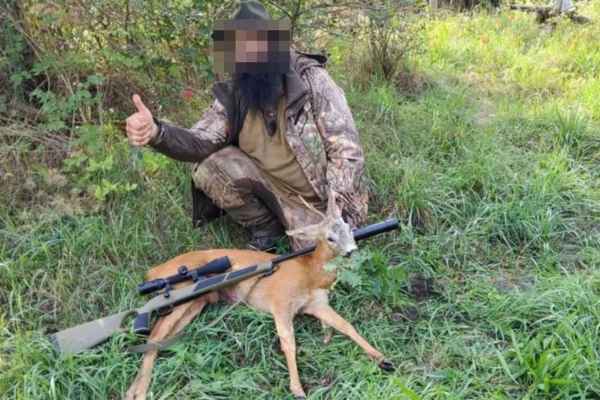
Relevant militant recreational hunting magazines are full of images of recreational hunters holding a weapon and posing in a dominating position over their victims. Such magazines stimulate the fantasy of recreational hunters to want to hunt more and more, in all corners of the world. Hobby-hunters need such photographs and films to feel important.
Recreational hunters have a great desire to do something heroic, to satisfy their sense of self-worth through the act of killing. Recreational hunters do not shy away from going into schools with missionary zeal to abuse children. Sectarian, with their hunter's tall tales, they advertise their violent passion. Children and young people have a great love for animals, and yet recreational hunters place weapons and misdeeds in their hands, which contradicts the UN Committee on the Rights of the Child.
What also connects recreational hunters and serial killers is the desire to collect trophies from their victims. Both love to go stalking, on the lookout for victims for the next violent act.
I do not mean to suggest that most hunters are weak people, but in my experience, weak people often enough use hunting or playing around with weapons and knives as an opportunity to compensate for their flaws.
Quote from the non-fiction book “Mindhunter” by FBI profiler John Douglas.
Recreational hunters have been subjected to psychological and sociological studies both in Europe and in the USA and compared with non-hunters on various aspects. The results clearly show that recreational hunters do not display a stronger connection to nature than non-hunters, tend to have a more negative attitude towards issues of animal welfare, environmental protection and nature conservation, and generally show a higher tendency towards aggressive behaviour – a typical trait among meat-eaters. The hunter's love of animals and nature does not take pleasure in the mere existence of the beloved object; rather, it aims to possess the beloved creature entirely, culminating in turning it into prey through the act of killing. Nowhere is this more evident than in hunting stories – found in practically every issue of the common hunting magazines.
Even though people who hunt have different personality traits, what ultimately unites all recreational hunters is the same act: a violent treatment of peace-loving animals and nature, often merely for fun, as a leisure pursuit or even as a sport, as well as the poisoning of nature with lead-based ammunition. Psychologists, psychiatrists and psychoanalysts speak of psychological defects among recreational hunters in the context of recreational hunting. Recreational hunters want to kill!
“With a hunting licence, one acquires a license to kill. The popular belief that someone who holds a hunting licence is not entirely of sound mind probably has – like most popular wisdom – a kernel of truth. And indeed, we know neither how many psychopaths, gun enthusiasts or addicts are among the holders of hunting licences who are legally permitted to handle firearms, nor do we know which of the candidates for a hunting licence merely want to pass the hunting examination in order to legally obtain firearms. We don't know, the authorities don't know, the hunting associations don't know – and would rather not know either”, as K.H. explains.
Christian Lüdke is a psychotherapist who trains special police units and focuses primarily on the psychology of perpetrators.
Lüdke: «Such people lead a double life. Deep down, they feel like absolute failures – in family life, at work and sexually – and are driven by extreme desires for power. Because they cannot act this out in everyday life, they have to express it through an act of violence and seek out the weakest victims.»
How can one recognise such a person?
Lüdke: «Outwardly, they are usually very inconspicuous. But in the life stories of these perpetrators, three symptoms often appear around the age of eleven: bedwetting, playing with fire and, above all, tormenting animals.»
Are these isolated cases?
Lüdke: «Unfortunately not. There are very many people among us who possess such a high level of sexual, criminal energy that they are, so to speak, ticking time bombs.»
Recreational hunter Frank Gust
Frank Gust is a German serial killer sentenced to life imprisonment followed by preventive detention. As we learn from an interview conducted by criminologist Petra Klages, animal cruelty and animal killing were present right at the start of his development. It should be noted that Frank Gust was trained as a recreational hunter by none other than his own mother, a former recreational hunter herself, and thereby also legally obtained firearms. And just as he had learned from his mother how to gut animal carcasses, he later followed the same procedure when killing people. In hindsight, the mother regretted this hunting training and speaks of a mistake she made:
«…they should have arrested me, because I failed so badly. I used to be a hunter myself and I also trained Frank as a hunter. That includes field-dressing the game. And since he, let's say, dismembered the bodies in a professional manner, I thought: well, I did teach him that.»
In the interview with Petra Klages, hunting licence holder Frank Gust spoke about his personal experiences with the hunting craft and openly criticised the claim that recreational hunters are always also conservationists:
Some of them certainly are. But most of the people I got to know there were a mixture of class arrogance and hypocrisy.
Frank Gust
When asked whether the goal was not to protect nature and animals, Gust continued that, in his experience, it was more about «building a wonderful disguise for other desires under the cloak of such supposedly noble hunting».
When asked by the interviewer whether she had examples of this, Frank Gust described two incidents that cannot be reproduced here in full length. However, to give an impression, let us briefly mention the incident during a rabbit hunt that Gust recalled:
There was a supposedly experienced and highly respected hunter. He shot at a rabbit … could have taken a safe shot from a few metres away, but waited until it had run a little further, so that the shotgun pellets would no longer hit so precisely, because then it would struggle for longer. It wasn't about getting a good roast or protecting the population, it was simply about making it hurt nicely. Of course, nobody says that officially.
Frank Gust
The clinical picture of sadism in recreational hunters
If we could look into the subconscious in the collective pool of recreational hunting, we would find Pandora's box of suppressed problems.

The renowned psychiatrist Dr. Karl Menninger (1893-1990), who received the Presidential Medal of Freedom from President Jimmy Carter in 1981 and after whom the Menninger School of Psychiatry is named, wrote extensively about the erotic sadistic motivational theory in recreational hunting. «Sadism can take a socially acceptable form (such as deer hunting and deer watching) and other kinds of so-called hunting practices,» he writes. «These all represent the destructive and cruel energies of men directed at helpless creatures.»
The symptoms of recreational hunters only allow for pleasure-driven experiences and emotional stability up to a certain point. To bring about the desired stimulation, the fantasies are expanded, for example, through trophy hunts abroad. At times they escalate to such an extent that recreational hunters even kill people. Time and again, Media report on homicides or other criminal activities within the problem group of “recreational hunters”, as most recently illustrated by the attack (carried out by a recreational hunter) outside the UBS branch in Zurich in February 2018.
Animal welfare always also means the protection of humans. Those who fail to understand this, through their lack of understanding, ensure that we shoot ourselves in the foot.
Volker Mariak
German studies and specialist publications on the topic of “Violence against humans – violence against animals”:
| Year | Authors | Study / specialist publication |
| 1988 | Wochner, M. and Klosinski G. | «Children and adolescents with psychiatric disorders who abuse animals» |
| 1998 | Berg, C. | «Horse slashing – A form of brutal animal cruelty» |
| 1998 | Füllgrabe, U. | «On the motivation of horse rippers» |
| 2003 | Kaplan, Astrid | «On the psychological connection between violence towards animals and violence towards humans, with particular consideration of the relevant intra- and interpersonal psychodynamics.» |
| 2003 | Vitt-Mugg. V. | «Sexually sadistic serial offenders» |
| 2004 | Harbort, Stephan | «The morbid world of imagination and experience of sadistic serial killers» |
| 2005 | Stupperich, A. | «From fantasy to deed – animal cruelty» |
| 2006 | Harbort, Stephan | «The serial killer principle. What drives people to evil» |
| 2007 | Heubrock Dietmar, Parildayan-Metz, Dorothee | «Who on earth does such a thing?» |
| 2009 | Sevecke, Kathrin, Krischer, Maya | «Animal cruelty and personality pathology in delinquent boys and girls. Findings from the Cologne study.» |
| n.d. | Faust, Volker | «Animal cruelty – what kind of people are young offenders?» |
| 2010 | Kaplan, Astrid | «As long as there are slaughterhouses, there will be battlefields. On the necessity of a quantum leap in compassion.» |
| 2017 | Klages, Petra | «The Rhine-Ruhr Ripper Frank Gust interviews» |
Find out more in the dossier: The psychology of hunting
| You can help all animals and our planet with compassion. Choose compassion on your plate and in your glass. Go vegan. |
More on the subject of recreational hunting: In the dossier Psychology of recreational hunting we put research, motives and social consequences into perspective. The scientific evidence is presented in the overview Studies on the Effects of Recreational Hunting.
The position of IG Wild beim Wild: IG Wild beim Wild rejects recreational hunting. Our model is the canton of Geneva, which has managed without recreational hunting since 1974: without hunting seasons, without hunting dogs, without driven hunts, without high seats, without the animal cruelty and crime that go hand in hand with hunting season elsewhere. What has worked there for over fifty years disproves every position paper by JagdSchweiz. An association that bases its policy on claims it refutes in its own documents is not a professional organisation, but a factory for misinformation.

All articles are written by IG Wild beim Wild as well as by external co-authors. Research, structuring and editorial processes may be supported by AI-assisted tools.
Support our work
With your donation you help protect animals and give their voice a hearing.
Donate now →