
Eagle owl: fact file, way of life and eagle owls in Switzerland
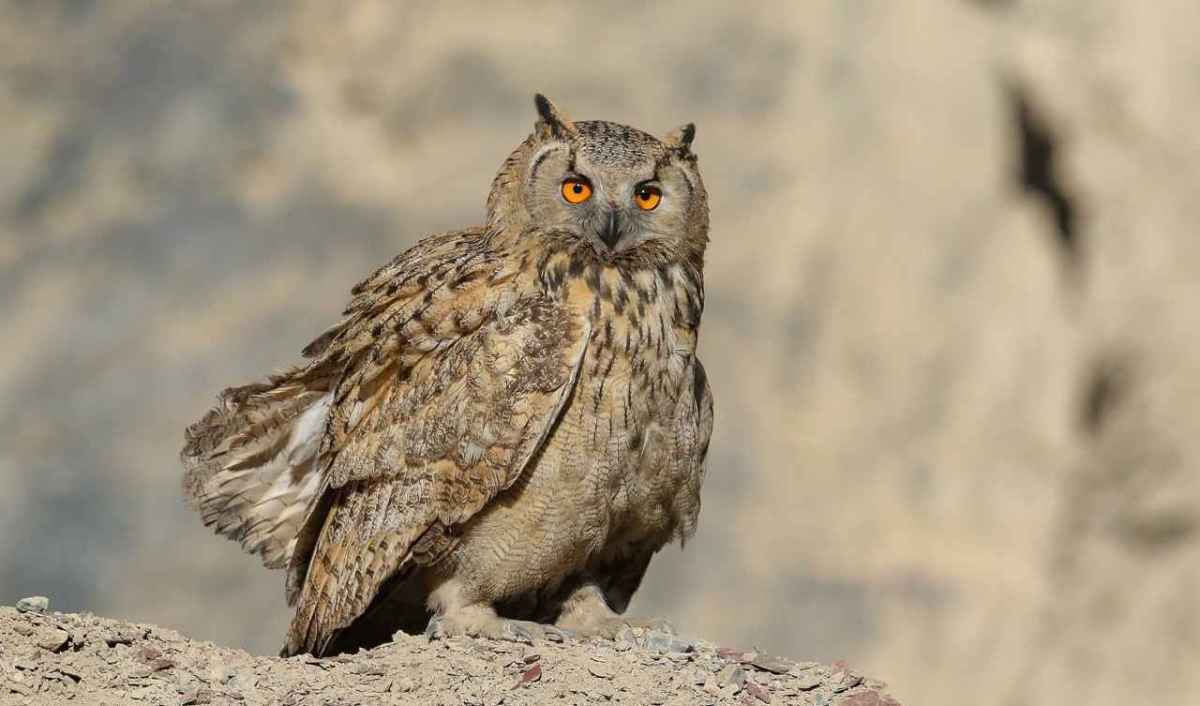
The eagle owl (Bubo bubo) is Europe's largest owl. By day it rests well camouflaged in rock faces; at night it moves silently. It was persecuted for a long time, and its population in Switzerland has recovered somewhat. Its greatest danger today is electrocution on power pylons.
Profile
- Family: Owls (Strigidae)
- Size: 60 to 75 cm
- Wingspan: 160 to 188 cm
- Weight: 1.5 to 3 kg
- Features: orange eyes, long ear tufts, powerful talons
- Diet: mammals and birds
- Breeding: rock niches, 2 to 4 eggs, incubation 34 to 36 days
- Population in Switzerland: 300 to 400 pairs (Swiss Ornithological Institute, 2025)
- Status in Switzerland: protected, Red List «vulnerable»
Silent through the night
The eagle owl is a resident bird and stays in its territory all year round. It occurs from the lowlands to above the treeline and is undemanding as long as there is enough prey and undisturbed rock faces. By day it sits in a niche or close against a tree trunk, becoming active only at dusk.
Eagle owls in Switzerland
In the 20th century, persecution by humans brought the eagle owl in Switzerland to the brink of disappearing. According to the Swiss Ornithological Institute, it has since resettled some regions in the Jura and the Alps more densely and reclaimed parts of the Central Plateau. Losses remain high, above all from power lines, cables and traffic. In Grisons there would be room for twice as many territories as the current 25 to 35.
What research shows about the eagle owl
According to the Ornithological Institute, electrocution is the most common cause of death for the eagle owl. A study by the University of Bern showed that electrocution accounts for half of all human-caused deaths of young eagle owls. Without the losses at medium-voltage pylons, the population in Valais could triple within eight years. Old pylon types in particular are dangerous, and they can be made safe by simple means. More on this in the article Electric shocks are the number one cause of death for eagle owls.
Frequently asked questions about the eagle owl
How big is an eagle owl?
60 to 75 cm, with a wingspan of 160 to 188 cm. It is Europe's largest owl.
What does the eagle owl eat?
Mammals and birds, from mice and rats to hedgehogs and crows.
How many eagle owls are there in Switzerland?
The Swiss Ornithological Institute estimates the population at 300 to 400 pairs.
How long does an eagle owl live?
The oldest ringed eagle owl recorded in Switzerland lived to almost 24 years of age.
Is the eagle owl protected?
Yes. Like all owls, it is protected in Switzerland.
Awareness day and related animal profiles
4 August is International Owl Day. What the IG Wild beim Wild is calling for on this day can be found in the press release for Owl Day 2027.
Related animal profiles: Golden eagle, Bearded vulture, Red kite and Woodcock. All profiles can be found in the overview of animal profiles.
What is Wild beim Wild doing for eagle owls?
We are working to ensure that populations and their habitats are preserved and connected with one another. For the eagle owl, we are calling for a binding deadline for making all dangerous electricity pylons safe, and for undisturbed nesting cliffs.