Electrocution is the number one cause of death for eagle owls
The eagle owl is acutely threatened with extinction in Switzerland, as many birds are killed by electrocution on power line pylons.


After 22 years, an eagle owl pair had settled in the St-Léonard region for the first time again. But at the end of January, the male was found dead beneath a power line on the railway between Sierre and Sion. It had been struck by an electric shock. Nature conservationists are now demanding that the canton, electricity companies, and Swiss Federal Railways promptly make all dangerous power pylons safe.
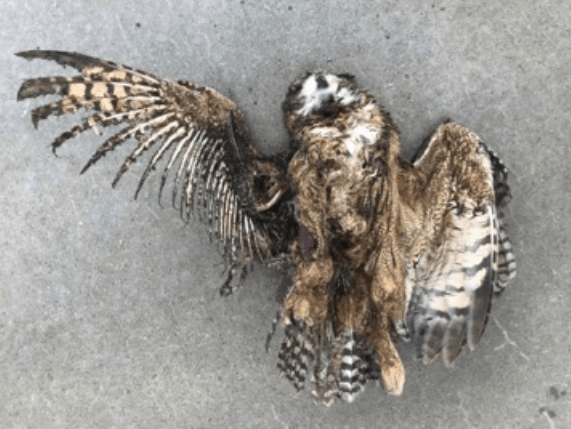
The eagle owl has become very rare in Valais. While the nocturnal bird of prey had virtually died out in the canton during the 1960s and 1970s, fewer than ten breeding pairs are found there today. A pair had settled in the St-Léonard region in the 1980s, but both birds were killed in 1996 by electrocution on a power line. Since then there had been no signs of eagle owls in the area — until last autumn.
I have been waiting 22 years for the eagle owls to return to this area! Last year there were first signs of their presence, and at the beginning of January it was confirmed that a pair had settled in a nearby gorge. And now the male of the new pair (born in 2017, as can be recognised from its plumage markings) has been found dead! It was struck by an electric shock next to St-Léonard station. I checked the spot the pair had chosen in the gorge on Sunday morning, but the owls were gone! It is very sad, but unfortunately many eagle owls are killed by electrocution in the Rhône valley, so I have become somewhat fatalistic.
Raphaël Arlettaz, Professor at the University of Bern
Since the 1990s, the eagle owl population in Valais and the Vaudois Chablais has consistently remained at a low level. To better understand the causes, the University of Bern, under the direction of Raphaël Arlettaz, launched a major research project in 2000. Several dozen young eagle owls were fitted with satellite transmitters. The results were unequivocal: electrocution is the number one cause of death for eagle owls, far ahead of collisions with cables, vehicles, and trains. The study made clear how important it is to make dangerous electricity pylons safe for the survival of these large predatory birds in the Rhône valley!
Based on the study results, the team at the Valais branch of the Swiss Ornithological Institute in Sempach compiled an inventory of problematic electricity pylons. More than 1,500 pylons posing an electrocution risk to birds were documented and made available to public services and electricity companies on a dedicated website. Thanks to the ornithologists' efforts, the first safety upgrades were carried out, with plans to continue these throughout the entire canton. A good example can be found in the Martigny region, where devices have been installed on several problematic pylons to prevent large birds from causing a fatal short circuit. Several medium-voltage lines, which are by far the most dangerous, have been buried underground by the local electricity distributor. Since then, the eagle owl population in this region appears to have been recovering.
Dangerous Electricity Pylons
The St-Léonard case shows that not only the pylons belonging to regional electricity distributors contribute to increased eagle owl mortality, but that old Swiss Federal Railways (SBB) pylons also pose a problem — a new finding for ornithologists. An inspection carried out by Raphaël Arlettaz following the discovery of the eagle owl revealed that, of the hundreds of pylons along the railway line between Sierre and Sion, only 13 are problematic. These are old pylons near St-Léonard station that are now rarely seen elsewhere.
Switzerland's 2017 Biodiversity Action Plan for the conservation of biological diversity stipulates that all power grids throughout Switzerland are to be upgraded in accordance with wildlife protection laws. The Federal Offices of Transport and Energy, Swiss Federal Railways (SBB), and the Swiss Ornithological Institute in Sempach are currently working to address this task. For fauna.vs, however, it would be highly desirable if SBB were to take immediate action to upgrade the problematic pylons, such as those in St-Léonard. In general, it can be said that at a time when we are continually building new infrastructure in the landscape that poses a potential threat to birds and bats — such as wind turbines — it is all the more important to upgrade existing infrastructure. Otherwise, the sources of mortality that are problematic for biodiversity may accumulate over time.

fauna.vs has launched a petition demanding that measures to upgrade the cantonal power grids proceed more quickly than before. The benefits of such an upgrade are twofold:On the one hand, we protect biodiversity, and on the other, companies can avoid costs by eliminating the need for repairs to power lines that become necessary following electrocution of birds of prey.
More on the subject of recreational hunting: In our dossiers on recreational hunting gather fact-checks, analyses and background reports. The scientific evidence is presented in the overview Studies on the Effects of Recreational Hunting.
The position of IG Wild beim Wild: IG Wild beim Wild rejects recreational hunting. Our model is the canton of Geneva, which has managed without recreational hunting since 1974: without hunting seasons, without hunting dogs, without driven hunts, without high seats, without the animal cruelty and crime that go hand in hand with hunting season elsewhere. What has worked there for over fifty years disproves every position paper by JagdSchweiz. An association that bases its policy on claims it refutes in its own documents is not a professional organisation, but a factory for misinformation.