
Woodcock: profile, way of life and woodcocks in Switzerland
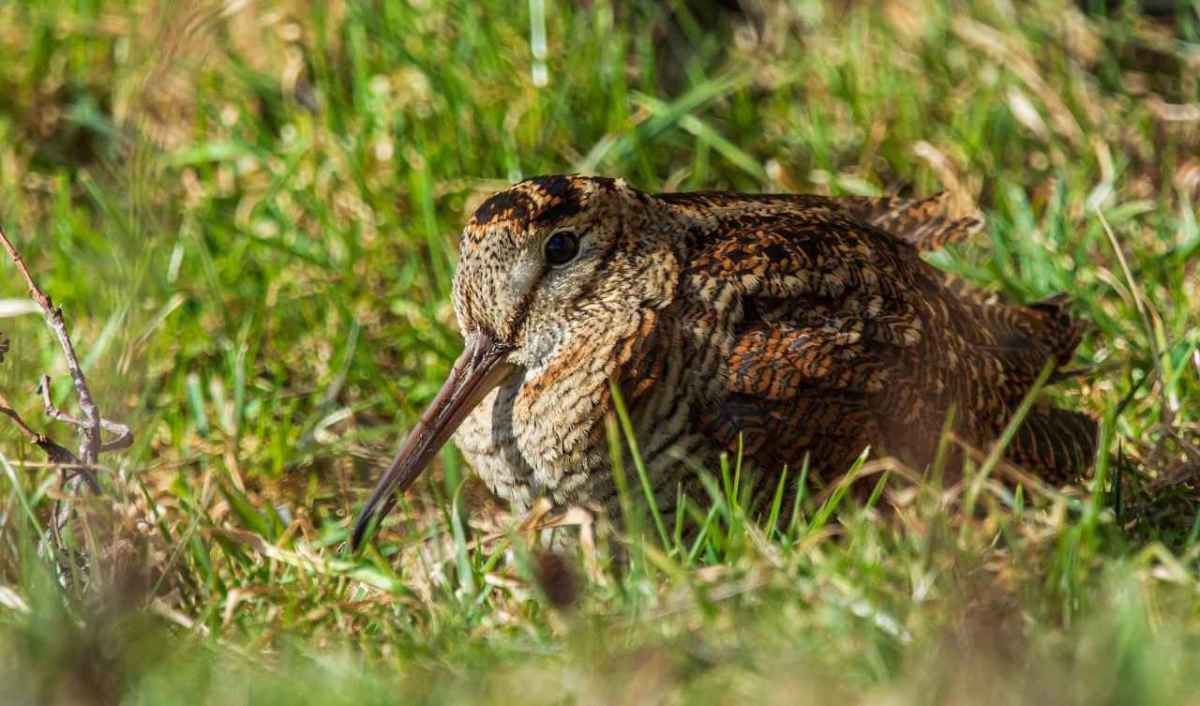
The woodcock (Scolopax rusticola) is a secretive woodland bird, about the size of a domestic pigeon. By day it sits perfectly camouflaged on the forest floor, becoming active only at dusk. In Switzerland it is classed as "vulnerable" and is nevertheless shot in the hundreds every year.
Profile
- Family: Sandpiper family (Scolopacidae)
- Size: 33 to 38 cm
- Weight: 250 to 420 g
- Features: long, straight bill, bark-coloured camouflage plumage, large eyes set far back on the head
- Diet: mainly earthworms, plus insects and larvae
- Breeding: hollow in the leaf litter, 4 eggs, the female incubates alone
- Population in Switzerland: 1,000 to 4,000 displaying males (Swiss Ornithological Institute)
- Status in Switzerland: may be hunted, Red List "vulnerable"
A master of camouflage
With its plumage, the woodcock blends in with the leaf litter on the forest floor. Its large eyes sit so far back on its head that it can see almost all the way round. With its long bill it probes the soft ground for earthworms. In spring, the males fly their courtship circuits above the treetops at dusk.
Why the woodcock is disappearing
The woodcock needs damp, structurally rich forests. According to the Swiss Ornithological Institute, it has "almost completely disappeared" as a breeding bird below 900 metres since the mid-1990s. It is still found along the northern edge of the Alps, in the central Alps of Grisons and in the Jura. Increasingly dense forests, drying soils, light pollution and recreational hunting are considered causes of the decline.
Woodcocks in Switzerland
In 2025, according to Swiss Hunting Statistics 2025 1,400 woodcocks were shot, 1,172 of them in Ticino. Over ten years the total was 16,935. The kills take place in autumn, when migratory birds from the north pass through and the resident breeding birds are still in the country. All the facts and demands can be found in the dossier "The Woodcock in Switzerland".
What research shows about the woodcock
A study commissioned by the Federal Office for the Environment (Bohnenstengel et al. 2020) has shown that Swiss breeding birds remain in the country well into the recreational hunting season. Depending on the method, 14 to 33 per cent of the woodcock shot are native birds. The claim that only migrants from the north are shot is therefore refuted.
Frequently asked questions about the woodcock
Is the woodcock protected?
No. It may be hunted in Switzerland, even though it is listed as “vulnerable” on the Red List.
How many woodcock are shot in Switzerland?
In 2025 the figure was 1,400, of which 1,172 were in Ticino.
Where does the woodcock live?
In damp, structurally rich woodland. In Switzerland it breeds mainly along the northern edge of the Alps, in Grisons and in the Jura.
Is the woodcock a migratory bird?
Many woodcock from northern and eastern Europe pass through Switzerland in autumn. The native breeding birds stay in the country well into autumn.
Awareness day and related animal profiles
9 October is the autumn World Migratory Bird Day. What IG Wild beim Wild is calling for on this day can be found in the Press release “Migratory birds in autumn 2027: stop the woodcock hunt”.
Related animal profiles: Rock ptarmigan, Black grouse, Eagle owl and Red kite. All profiles can be found in the overview of animal profiles.
What is Wild beim Wild doing for woodcock?
We are working to ensure that populations and their habitats are preserved and connected with one another. For the woodcock, we demand that it be removed from the list of huntable species.