The Red Kite
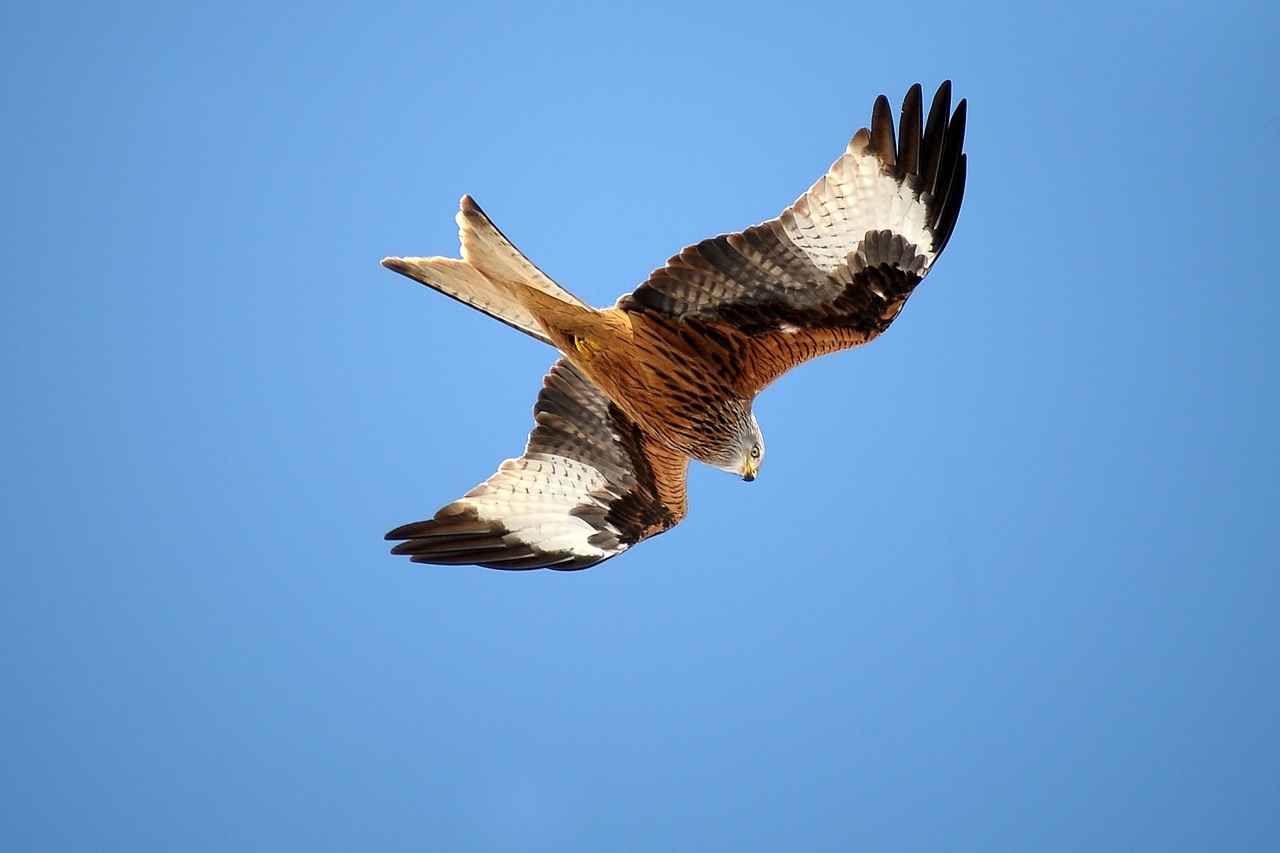
The Red Kite (Milvus milvus), also called Red Milan, Fork-tailed Kite or Royal Kite, is a bird of prey species from the accipiter family (Accipitridae).
This bird of prey, about the size of a Common Buzzard with long, narrow wings, has its distribution center in Europe. Only a few Red Kites also breed in Northwest Africa.
Characteristic features of this elegant flier are the forked tail (reminiscent of an M = Milan) and the distinctive white wing patches in front of the deeply fingered black primary feathers.
Red Kites are partial migrants. Most birds in Central Europe leave their breeding areas in late autumn and migrate southwest. They usually remain in Southwest Europe, with very few migrating further to the Sahel regions of Africa. Increasing numbers of Red Kites are also attempting to overwinter in their Central European breeding areas.
Red Kites feed predominantly on small mammals, invertebrates, amphibians, smaller birds and carrion.


After very severe population losses towards the end of the 20th century, populations have been increasing significantly again since around 2010, allowing the species to establish itself anew or more strongly in some areas.
In contrast to the closely related, slightly smaller Black Kite, the distribution of the Red Kite is essentially restricted to Europe. It breeds mainly in open landscapes interspersed with small forests or woodlands. It is significantly less water-dependent than the Black Kite. Most Red Kites of central Central Europe as well as those breeding in Northern and Eastern Europe are migratory birds, while a varying percentage of breeding birds from western and southwestern Central Europe remain as residents in their breeding territories for years.
The Red Kite is an easily identifiable raptor species. It can most likely be confused with the Black Kite, but even with this closely related kite species, good distinguishing features are present.
The Red Kite is larger than a Common Buzzard and somewhat larger than the Black Kite; it has distinctly long wings and a long, forked tail. The perched bird appears reddish-brown, with a clearly lighter, usually ochre-colored feather edging, especially of the wing coverts and back plumage, creating a contrasting overall impression. The head, neck and throat plumage of adult Red Kites is brilliantly light, almost white, and shows conspicuous black feather shafts that make these body parts appear black-streaked. The fairly robust bill is yellow at the base, dark grey or black at the hook. The short legs are yellow, the claws black. The iris of adult birds is pale yellow. The clearly black longitudinally streaked belly plumage is somewhat lighter and more luminous reddish-brown than the back plumage; the underwing coverts are similarly colored. The primaries and secondaries are very dark, almost black, at their tips.
In flight, the long, relatively narrow wings and the deeply forked, rust-red tail stand out particularly, which is always in motion and shows a notch even when fully fanned. From above, the black primaries and secondaries contrast strongly with the remaining reddish-brown plumage. Even more contrasting is the flight silhouette from below, as the primaries are white at the base and form an extensive white wing panel, while a black patch can usually be seen in the wing bend. The outermost, deeply fingered primaries are black in their final third. In soaring flight, the secondaries are slightly raised above the horizontal, but the primaries are straight or slightly lowered, creating a recognizably angled wing profile. The wings are distinctly angled at the carpal joint in almost every flight position.
The sexes do not differ in coloration, and the juvenile plumage also closely resembles the adult plumage. The best distinguishing feature of juvenile individuals, also useful for field identification in very good light, is the more sand-colored, not light grey-white head and the rather speckled (not longitudinally streaked) appearing, more pale reddish-brown belly plumage. In very young fledgling Red Kites, the tail may still show a slight rounding at the outermost edge, as the outermost tail feathers have not yet reached their full length.
The reverse sexual dimorphism in the Red Kite is similar to that in the Black Kite regarding body size and not very pronounced, but somewhat more distinct regarding body weight. The heaviest males weigh 1.1 kilograms; on average, the weight is slightly under one kilogram (0.93 kg). The heaviest females weigh 1.4 kilograms, with an average of 1.06 kilograms. Body length varies between 60 and 73 centimeters, of which 31 to 39 centimeters account for the tail. The wingspan measures 150 to 180 centimeters.
Adult birds undergo a complete annual molt of their entire plumage. This complete molt begins with the body plumage already during the breeding period and is completed with the replacement of flight feathers and tail feathers (usually in wintering regions). Some juvenile birds replace parts of their body plumage soon after fledging; a complete molt begins in all juvenile birds in the spring of their second year and is completed by late summer/early autumn. From then on, young Red Kites display the appearance of fully colored, older individuals.
Red Kites are acoustically less conspicuous than Black Kites. Especially outside the courtship period and at greater distances from the nest, they remain largely silent, except for food disputes with other birds such as crows, buzzards or other kites, which are usually very loud affairs. The most distinctive call is a high, strongly variable in tone but usually shrill, drawn-out Wiiieeh, to which further elements are added in ascending and descending tonal curves. The first element is drawn-out, often plaintive, with subsequent elements joining in a wave-like pattern, becoming progressively shorter and often stumbling toward the end.
The Red Kite is a bird of prey of open landscapes interspersed with small and larger woodlands. It is significantly less water-dependent than the nominate form of the Black Kite, with which it frequently breeds in close proximity. Preferred habitats are agricultural landscapes with field copses, often also parklands and structured forest edges bordering open land, less frequently heathland and moorland areas, as long as trees are available as nesting sites. It frequently utilizes favorable updraft conditions in narrow river valleys or on mountain slopes.
For hunting it requires open cultivated land, grasslands and livestock pastures. Additionally, wetlands can also serve as foraging territories. It includes harvested or freshly plowed grain fields in its food search as well as highways and garbage dumps, though the latter not to the same extent as the Black Kite.
Generally, the Red Kite is an inhabitant of lowlands and hilly regions up to about 800 m. In the Swiss Jura, individual breeding sites are located at almost 1200 m. In the Pyrenees, populations are known in the subalpine zone. Historical breeding sites in the Caucasus and High Atlas were located at elevations of almost 2500 m.
Like the Black Kite, the Red Kite is also largely a food generalist, but unlike the former, it is a more capable, active hunter. While it also consumes fish and carrion, it does so less frequently than the Black Kite. Individual feeding and hunting habits vary considerably. During the breeding season, the main diet consists of small mammals and birds. In terms of quantity and weight, field voles (Microtus sp.) and moles (Talpidae) predominate among mammals, while starlings are very conspicuous among birds. Various pigeons (Columbidae), corvids (Corvidae) and larger thrushes (Turdidae), such as blackbirds (Turdus merula), fieldfares (Turdus pilaris) and mistle thrushes (Turdus viscivorus), are also taken relatively frequently. Where the common hamster (Cricetus cricetus) is still comparatively abundant, for example in eastern Poland, it can become the main prey. Often the captured birds are injured or sick individuals or juveniles. In water-rich areas, fish, particularly white fish such as roach (Rutilus rutilus) and common bream (Abramis brama), can dominate by weight. The Red Kite captures both living fish and dead or dying fish floating on the water surface or washed ashore. The amount of invertebrates that the Red Kite takes both in flight and on the ground is not inconsiderable. Especially in spring, various beetles (Coleoptera) and earthworms (Lumbricidae) can be an important dietary component. The proportion of reptiles and amphibians in the overall diet varies greatly by region, generally being somewhat higher in southern populations than in Central or Northern Europe.
The Red Kite is a search-flight hunter of open landscapes that systematically searches large areas of its foraging territory for prey in relatively low and slow gliding and soaring flight. It is an ambush predator that typically moves on after unsuccessful attacks and does not pursue missed prey further. It can also frequently be seen walking on the ground, where it searches primarily for insects and earthworms. The Red Kite picks up spotted prey from the ground while flying over without landing. It also snatches fish from the water surface in the manner of sea eagles and carries them away. It can occasionally surprise and strike birds in flight or on branches, but usually captures them on the ground. It typically kills prey not with its talons, but through powerful beak strikes.
Red Kites also rob other birds, particularly Black Kites, crows and gulls. They harass them as kleptoparasites to steal their prey or pester them until they regurgitate already swallowed food. Especially in winter, this method of food acquisition appears to cover a not inconsiderable portion of their nutritional needs.
Overall, the Red Kite is very flexible in its food acquisition strategies and skillfully exploits favorable opportunities. Where mowing and harvesting activities expose previously inaccessible prey, Red Kites quickly appear on the scene. Until they are plowed, harvested fields also provide good food resources that Red Kites can quickly adapt to.
With sufficient food supply and outside the breeding season, the Red Kite begins its first hunting flights only some time after sunrise and can end its hunting flights several hours before sunset. During the day, it takes longer rest periods, usually near the nest, which it also uses for intensive feather care.
The size of the area used for foraging depends on the respective availability of prey animals. Various studies have shown that foraging flights rarely extend more than two kilometers from the nest. Usually the foraging bird remains within sight of the nest.
Activity time is remarkably short when prey is abundant, but can begin as early as dawn and end only with nightfall, particularly during breeding season. However, red kites regularly take extensive rest periods between hunting flights, even when nestlings nearby are begging energetically.
Outside the breeding season, red kites are very social and show no territorial behavior. The species almost always roosts in large communal roosts and also hunts collectively. These roosting communities can comprise several hundred individuals. Frequently, 'playful' behavior such as mutual teasing and synchronous flight games by some birds can be observed in these kite gatherings. Occasionally, red kites break off conifer cones in flight simply to drop them.
Even during breeding season, territorial behavior is not very pronounced, but both partners defend the nest and its immediate surroundings (up to about 100 meters) as well as the airspace above against conspecifics and foreign intruders. The kites rise high and attack the intruder quite energetically from above. Usually the male in particular pursues it for a certain time, while the female returns to the nest fairly quickly. Red kites generally do not claim their own feeding territory; only when food availability is very low do solitary breeding pairs show territorial behavior in this regard as well. Red and black kites can breed very close to each other. In disputes over a favorable nesting site or an already established nest, the red kite is usually the subordinate party.
The migratory strategies of this species are not uniform. Overall, a shortening of migration routes and increased persistence of the species in previously winter-vacated breeding areas has been observed in the last two decades. Less snowy winters and greater, constantly available food supplies at garbage dumps and along heavily frequented roads make it possible for many central and some northern European populations to remain in their breeding areas during winter. The largest winter populations in Central and Northern Europe are found in the northern Harz foreland, in Switzerland (for example near Neerach), in Baden-Württemberg, and in southern Sweden. In some overwintering areas in Switzerland and southern Sweden, the overwintering birds were (and are) supported through supplemental feeding. In Baden-Württemberg, the number of overwintering red kites declined continuously with the closure of several landfills.
However, the majority of northern and central European red kites leave their breeding areas in autumn and migrate southwest, particularly to Spain. The breeding birds of southwestern Central Europe, Italy, France and Spain, as well as the few red kites of southeastern Europe and North Africa, are predominantly sedentary, with varying degrees of wide-ranging foraging flights within the overwintering area. In Spain, the overwintering regions overlap with the breeding areas of the red kites resident there. These are located primarily in the northern and southern Meseta, in the Ebro basin, in Extremadura, and in parts of southern Andalusia.
Red kites migrate during the day and mostly individually or in small flocks. During autumn migration, the migratory groups are generally larger in number than during spring migration. Due to the relatively short migration distances, red kites leave their breeding areas late, rarely before mid-September, with most departing in the first half of October. Females migrate about one to two weeks before males. Conversely, the first migrating red kites appear very early in the breeding areas, as early as mid-February, with the majority following in late February and the first decade of March. A large proportion of one-year-old and many two-year-old red kites do not return to breeding areas on their first spring migrations, but instead spend the summer either in wintering areas or wander in smaller groups in southern and central France, partly also in Switzerland.
Red kites exceptionally become capable of reproduction in their first year of life, but usually breed for the first time only in their third year. The nature and duration of pair bonding varies. Largely monogamous breeding season partnerships are the rule, but multi-year lasting bonds have been observed as well as partner changes during the breeding period. In sedentary birds, pair bonding appears to be more stable than in migratory birds, where higher mortality rates due to migration also force more frequent partner changes. The species shows strong breeding site fidelity. Even sexually mature young birds usually attempt to settle in the vicinity of their birthplace, even when suitable breeding sites would be available in the wider area. According to Walz, this leads to an increase in breeding entry age in densely populated red kite habitats due to lack of suitable breeding sites.
In birds overwintering in Central and Eastern Europe, courtship behavior was observed throughout the entire wintering period. In breeding areas, future partners often arrive with temporal delays, frequently up to twelve days (in exceptional cases up to four weeks), with either the female or male appearing first. Some arrive already loosely paired in the breeding area. There, sedentary birds begin main courtship as early as mid to late February, while migratory birds start on average about two to three weeks later.
The courtship of the red kite is not very conspicuous. Essentially it consists of nest building, joint flights over the nest site, and frequent copulations that continue into the nestling period. For copulation, the female solicits with quiet trill calls, horizontal crouched posture, and lowered head. Usually the male then flies directly to his partner and lands on her back. Spectacular steep dives over the nest territory, where two adults interlock their talons, occur in red kites as in many other raptors. According to evaluation of various studies on this topic, this behavior termed 'cartwheeling' is now mostly interpreted as defense against rivals. It is also conceivable that this behavior occurs both in defense against rivals and – in modified form – as a courtship ritual. Already during the nest-building phase, the female largely ceases her own foraging flights and is provisioned by the male from this time until she participates again in food procurement about two to three weeks after hatching.
Nest construction or the restoration of an old nest begins immediately after the partners arrive in their breeding territory. Nest sites and nest trees vary greatly, but in Central Europe these are mainly oaks, beeches or pines. Cliff nesting occurs in populations in the Balearics and North African red kites. Very rarely, nest sites have also been found on transmission towers. Most nests are located relatively high up in strong trees, but very low-lying nests in weak trees have also been recorded. Red kites like to choose nesting trees along steep slopes or above rock cliffs, preferably in edge locations, or in heavily thinned stands. The nesting base is usually a strong trunk fork, less often a fork in a strong side branch. Both partners participate in nest construction. The basic framework consists of strong twigs and branches that they pick up from the ground or tear from trees with their beaks or talons. The birds line the nest with various soft, organic material, but also with cultural waste such as foils, plastic bags or binding twine. The latter often leads later to strangulation of a nestling. Plastic materials prevent balanced air circulation and can lead to soaking and hypothermia of the young.
The size of red kite nests is highly variable. They can be conspicuously small and rather carelessly assembled, with diameters between only 45 and 60 centimetres. However, nests used for multiple years are massive constructions with a diameter of one metre or more, at a height of over 40 centimetres.
The clutch usually consists of three eggs, less often one, two or four eggs. Clutches with five eggs have also been found. The eggs weigh about 60 grams and measure on average 57 × 45 millimetres. They correspond in size and shape to a medium-sized chicken egg. On a dull white background, they show differently pronounced reddish-brown spots and blackish garlands. Laying begins in Central Europe at the earliest at the end of March, but usually not until early to mid-April. Fresh clutches can be found well into May. In Southern Europe, laying begins about two weeks earlier, in the northernmost distribution areas not before the end of April, early May. Red kites breed only once a year; only in case of early clutch loss does a replacement clutch occur, usually in a different nest.
The eggs are incubated almost exclusively by the female for about 32 to 33 days, starting intensively after the first egg, so that the young are raised with distinct developmental differences. Only for short periods does the male take over the brooding duties. In the first two to three weeks, the female remains almost constantly at the nest, guarding and shading the nestlings and feeding them the food brought by the male, which consists mainly of small mammals and birds. The nestling period lasts between 48 and 54 days, depending on weather and food availability. In extreme cases, the young do not fledge until after 70 days.
The main threat to nestlings lies – apart from lack of food – in predation by the goshawk. The guidance period is quite short compared to that of young black kites and rarely exceeds three weeks. After that, the young birds disperse, and usually the adult birds also leave the immediate nest area.
In the wild, mixed breeds between Red Kite and Black Kite have occasionally been documented. The Black Kite was usually the female bird. Successful breeding between a Black Kite male and a hybrid female has also been recorded. Such mixed breeds occur more frequently in captivity. In the Aukrug Nature Park in central Holstein, a mixed pair bred successfully for 6 years. After the Red Kite failed to appear, apparently a hybrid from a previous brood took its place.
The Red Kite is one of three species in the genus Milvus. In addition to the nominate form Milvus milvus milvus, the subspecies M. milvus fasciicauda, endemic to the western and southwestern islands of Cape Verde, has been described. This subspecies was last documented in 1999 with two individuals. All kites subsequently captured and analyzed from Cape Verde were Black Kites of the nominate form Milvus migrans migrans. M. milvus fasciicauda thus appears to be extinct. The taxonomic status of the Cape Verde Kite remains unclear: it could have been a relict species that existed before the separation of the two species Red Kite and Black Kite, or a largely stabilized hybrid between these two species. However, molecular genetic studies on museum specimens from the late 19th century showed that birds with the typical fasciicauda characteristics belong to the Red Kite clade.
Significant declines in the main breeding areas led the International Union for Conservation of Nature (IUCN) to upgrade the population status in the Red List to NT (= near threatened) at the beginning of the millennium. Due to growing population, the IUCN changed the classification to LC (= least concern) in 2021.
Reasons for the population declines suffered between 1990 and 1996 lie primarily in the intensification and conversion of agriculture. This had a particularly negative impact on Red Kite populations in eastern Germany after reunification, where regional losses of more than 50 percent and a clear decline in reproduction numbers were recorded. Essential factors were the deterioration of food availability through changes in mowing schedules due to increased cultivation of winter cereals and rapeseed, as well as a decline in cattle farming – with simultaneously less pasture management and forage cultivation with regular mowing. Furthermore, traffic, secondary poisoning through consumption of poisoned prey animals, persecution through deliberate poisoning, shooting, as well as accident losses at power lines and wind turbines contribute to the decline. Losses through illegal shooting are also severe, predominantly during bird migration and in wintering areas. As a result, many animals do not return in spring. In breeding areas, breeding losses occur due to forestry work during breeding season near nesting sites. Despite strict prohibitions and regulations according to the EU Birds Directive, enormous deficits still exist regarding control.
The Life-Eurokite research project, which investigated the causes of death of 556 dead red kites equipped with GPS transmitters until early 2022, reached the interim conclusion that the greatest threat to red kites in Europe was poisoned bait. The red kites die after consuming poisoned small mammals such as rats and mice. This was followed by road traffic, illegal shooting, electrocution on power lines, accidents with rail vehicles, and wind turbines in seventh place. According to study leader Rainer Raab, a collision between a red kite and a wind turbine is an 'extremely rare event' that occurs mainly when a red kite is exhausted after a long flight or visibility is poor. In a press release, the Life-Eurokite research project clarified after the Frontal report aired: 'These results are not per se transferable to the current debate about causes of death of red kites in Germany (even though this was presented as such in the report), since the causes of death are unevenly distributed across Europe. For example, poisoning and illegal shooting as well as electrocution on power lines occur much less frequently in Germany than in other European countries,' and concluded: 'At the current stage of the project, it cannot be ruled out that there will be shifts in the frequency of causes of death in the future.' A statement published by the 'Red Kite Specialist Group' shortly after the Frontal report drew different conclusions for Germany from this and older data material and criticized the methodology of the Life-Eurokite study. The researchers emphasized that collisions with wind turbines had been one of the most frequent causes of death at 15% for both first-year and older birds over the past 15 years and had increased significantly compared to previous decades.
Information about collision victims found in wind farms is provided by a collision statistics database maintained by the Brandenburg state ornithological station since 2002. For red kites, this number stood at a total of 629 in Germany between 2002 and May 2021; only common buzzards were more frequently affected with 683 collision victims. These figures do not allow conclusions about how collisions affect the population. Even the most comprehensive study on this topic to date (PROGRESS study, 2016) could not answer this question. A 2019 comparison of red kite population development by the German Association of Avifaunists from 2005 to 2014 with wind turbine density in 2015 showed regional differences. There were clear population increases in southwestern and western Germany, exclusively in areas where virtually no wind turbines existed, while clear population declines occurred in counties with high wind turbine density, for example in Saxony-Anhalt and East Westphalia. On average, there was a highly significant negative correlation between red kite population change and wind turbine density at the county level, meaning that as wind turbine density increases, the number of red kites decreases. However, based on the latest data, IUCN and BirdLife International have classified the red kite as no longer endangered.
Red kites can live to a very old age. A red kite found in the wild was almost thirty years old. However, the actual life expectancy of free-living birds is significantly lower. In a 2009 study, 2/3 of 44 red kites captured in Thuringia were between three and seven years old. Only 16% were older than 10 years.
The first migration period in particular ends fatally for many red kites. By the end of the first year of life, approximately 60–65 percent of a birth cohort survive. With growing experience, the mortality rate slows, so that after three years approximately 35–45 percent of a cohort are still alive and able to breed. However, these figures depend on many factors, so they should only be viewed as approximate values. Food shortage, shooting, collisions with obstacles and power lines, as well as poisoning are the most common early causes of death.
What does Wild beim Wild undertake for the protection of red kites?
We are committed to ensuring that populations and their habitats are preserved and connected with each other. Natural corridors enable genetic exchange between individual populations. Not only the protection of predators, but also of their prey is an essential component of our work. This is achieved by defending wildlife from unnecessary hunting and poaching wherever possible.
Animal Portraits