Switzerland Sells Massacre of Wolves as a Success
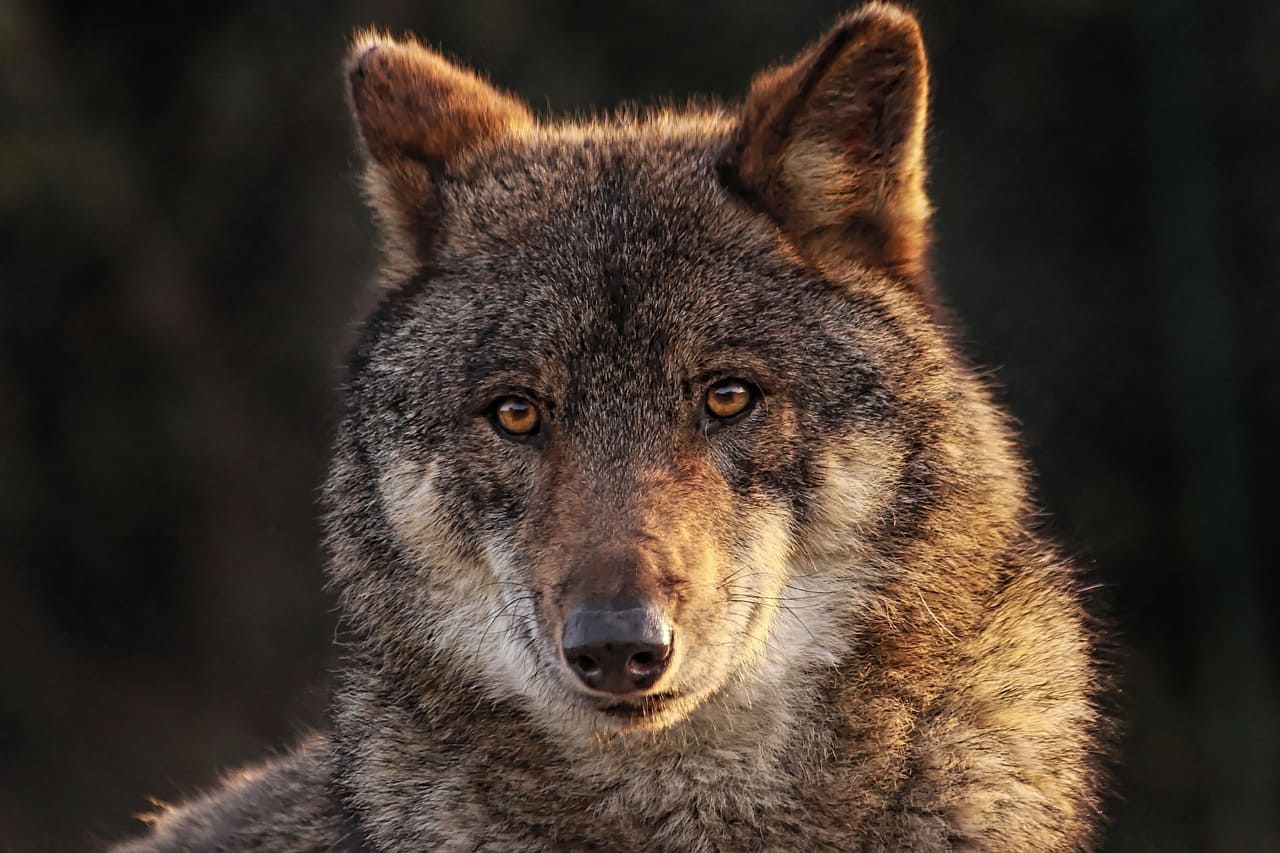
From 1 September 2024 to 31 January 2025, cantons terrorised the wolf population in Switzerland for the second time and staged a massacre, orchestrated by Federal Councillor Albert Rösti (SVP).


Right-wing Federal Councillor Albert Rösti (SVP) and fan of American President Donald Trump has absolutely no sympathy for the wolf.
«The wolf has no place in Switzerland«, he trumpeted into a private broadcaster's television camera as early as 2021. A former Federal Councillor from the same party is campaigning for the demonstrably far-right AfD and is on first-name terms with Alice Weidel.
Since his election to the Federal Council, Albert Rösti has abused his power and manipulated policy as well as authorities.
Laws were broken, democratic referendums bypassed, and illegal hunting methods implemented. The whole affair resembles a ghost train ride at a funfair.
Over 145 wolves have since been massacred in Switzerland during hunts — including parent animals and young, individuals not cleared for culling, and even protected species such as lynx and a livestock guardian dog, overwhelmingly without proof of damage.
This, despite the fact that a decline in wolf attacks on livestock had already begun before right-wing conservatives organised the massacres of wolves. The cause of the decline in livestock attacks is and remains improved herd protection — not the rifle. A similar situation can currently be observed in Brandenburg.
Not only in the canton of Valais were the wrong wild animals shot by hobby hunters during the 2024/25 massacre. There, 11 of the wolves shot are said to have not belonged to the packs that had been cleared for culling. This emerges from genetic kinship analyses conducted by a laboratory at the University of Lausanne.
The cantons have repeatedly provided false information, violated hunting laws, communicated erroneous data transmissions, and misjudged situations. The responsible cantonal authorities are not equal to the challenges, and their diligence also leaves much to be desired, as confirmed by the numerous complaints before the courts. Through legal trickery, many complaints are preemptively blocked as if in a law-free zone.
Now the responsible federal authority (FOEN) has processed the massacres — criticized, among others, by the Bern Convention and over 200 nature conservation organizations on six continents — in a «Report».
This war report from the office of Katrin Schneeberger is a hodgepodge of contradictions, distortions, misinterpretations, disregard for national and international laws, and fabrications. It is a shame that taxpayers' money is wasted on such sloppiness.
Even the introduction is a distortion. It is precisely the opposite. Livestock kills declined before the massacres, and wolf populations had begun to stabilize.
The wolf population regulates itself — as do foxes — beyond a certain number in a given area and no longer continues to grow, but instead expands across national borders. The regulatory mechanisms include increased territorial conflicts, higher mortality rates among young animals, and a limited food supply.
The number of kills is not dependent on the wolf population, but on livestock protection measures. In the past, there were years with particularly high levels of damage despite low wolf populations. The vast majority of killed livestock are taken from unprotected alpine pastures.
Livestock owners destroy and encroach upon wildlife habitats all the way up into the mountains.
Upon close analysis, there is virtually no section of the FOEN report that is meaningfully insightful. The massacres regulate nothing at all — they merely decimate temporarily. What is sustainable about wasting dozens of millions in taxpayers' money on this every year? The Bern Convention explicitly calls for greater livestock protection and non-lethal methods in dealing with predators.
Furthermore, Switzerland has set the number of twelve packs entirely arbitrarily as the permissible figure. According to experts, at least twenty would constitute a scientific basis.
By point 5.5 at the latest, one has had enough of the bargain-bin level, fiction, and superstition of the report from Katrin Schneeberger's office. «Although Switzerland cannot look back on a centuries-long herding tradition …» On this, science states: As early as 5’000 BC, shepherds in the southwest of the country began driving their herds up to the alpine pastures. Shepherds tending their herds thus have a long tradition in Switzerland.
Katrin Schneeberger and her team are completely out of their depth. The pseudo-science at the Federal Office is the real damage in itself, with its reality-detached whitewashing of the massacres, and apparently also lacks the backbone and ethics to stand up against misguided policy.
One can only hope that even more charges, complaints, resignations, impeachment proceedings, and the like will rain down.
Since the wolf returned to Switzerland in 1995, there have never been any attacks on humans. In comparison, hobby hunting has claimed dozens of human lives, with hundreds of additional injuries each year. On top of that, cantonal authorities issue thousands of charges and fines annually within the cult-like milieu of hobby hunters, because these hobby hunters are not up to the responsibility — and are now also going after wolf hunting.
The wolf is not included in hunting law, just like the ibex, wildcat, lynx, golden jackal, bear, European otter, etc. All are considered protected, as stated on the website of the FOEN. Therefore, hobby hunters are also not permitted to intervene. This is reserved exclusively for wildlife wardens. The wolf is and remains a protected animal, and a hobby hunter does not have the right to target it, just as with all other protected animals. Even the hunting association president Charles-Henri de Luze in the canton of Vaud has stated clearly that this, if at all, is the task of the wildlife wardens. Everything else is a distortion by those who themselves repeatedly cause great harm. In the federal hunting statistics, no data on wolf culls are collected either.
At the FOEN and the cantonal wildlife management authorities, the focus is not on science but on the presentation of shooting-gallery targets, as if at a fairground. Hunting-free areas such as the National Park, where chamois and ibex populations have been stable for decades, as well as entire countries with hunting bans prove this unequivocally. In Luxembourg, fox hunting has been banned for over 10 years because common sense and science have prevailed. The canton of Valais recently re-authorized trophy hunting of ibex for wealthy foreigners. In these offices, hobby hunters are at the controls, seeking to institutionalize suffering at the legislative level as well.
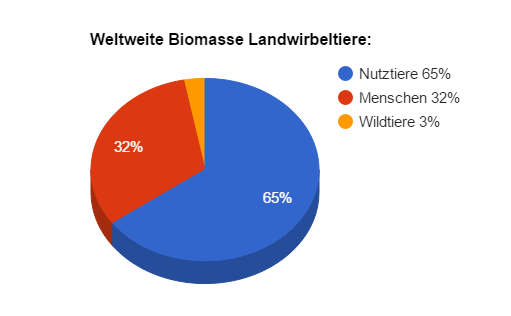
Biomass
The biomass of all wild animals (from the elephant to the hazel dormouse) today amounts to only 3%. This means that humans and their livestock — mostly raised under conditions of animal cruelty — stand in a ratio of 97% to 3% relative to all wild animals on the continents. A disproportionality without equal, which should give us pause.
Swiss agriculture is extremely over-subsidized and has taken on dangerous industrial dimensions. In 2023 alone, over 80 million animals were slaughtered.
In addition, in 2023 approximately 56’500 sheep died due to inadequate herding practices — yet only around 1’000 of these were killed by wolves due to insufficient herd protection. That is less than 2% of deaths! Furthermore, around 1’023 cattle died — but only 6 of them were killed by wolves. That is less than 0.6% of deaths during alpine summer grazing!
The proportion of threatened species is, according to the United Nations, greater in Switzerland than in any other country in the world.
Yet the relevant lobby groups and right-wing conservatives portray the wolf as a scapegoat. In 2024, all applications for a wolf massacre were justified on the grounds of preventing damage to livestock — what an outrage, when those same circles cart 80 million animals off to the slaughterhouse.
Retrograde hunting policy is damaging the ecological balance, harming forests, protective woodlands, and Switzerland’s international reputation. The standing of a country that proudly claims to have the best animal protection law in the world has suffered enormous damage since the appointment of Albert Rösti to the Federal Council.
It cannot be said often enough: The wolf is not the problem. The problem is those who make it an enemy image to distract from their own psychological, political, or moral failures.
Dossier: Wolf Switzerland: Facts, Politics, and the Limits of Hunting
Further Articles
- Swiss meadows are losing biodiversity at an alarming rate
- When sheep, cattle, and others occupy wildlife habitat
- Swiss animal protection organization criticizes planned wolf culls as a threat to pack structures and livestock protection
- In Graubünden, wolf incompetence runs rampant
- Val Fex: When the livestock protection concept has more holes than the fence
- Culling instead of protection – Switzerland on the path to silent wolf extermination
- Communication failure at the Office for Hunting and Fishing Graubünden
- Illegal wolf hunting in Switzerland
- Wolf pups in Switzerland in the crossfire
- Switzerland sells wolf massacre as success
- Negligence in the office of Katrin Schneeberger
- Grazing by livestock alters soil, plants, and insect populations
- The senseless hunt for wolves in Switzerland
- The truth about sheep mortality in Switzerland: causes and statistics
- Wolf culls in Switzerland: concerns about party politician Albert Rösti
- Let us stop the destructive fury of the SVP
- Participatory campaign: An appeal for change in Switzerland
- 200 environmental organizations from 6 continents call on the Swiss government: Stop the wolf cull
- Federal Council faces sharp criticism from wolf experts
- The consequences of controversial wolf management in Switzerland
- Wolf: Federal Councillor Rösti (SVP) circumvents law and order
- Es Burebüebli mahn i nit
- Are BAFU and the hunting administrations still operating with due diligence?
- Federal Councillor Albert Rösti tramples the will of the people
- The consequences of controversial wolf management in Switzerland
- Too many sheep harm biodiversity
- Agricultural use destroys alpine meadows
- Livestock kills despite herd protection – how is that possible?
- The rotten apple in the St. Gallen hunting administration
- Pro Natura calls for a comprehensive strategy for summer sheep grazing
- According to Agridea study, livestock protection with dogs works well
- Thanks to herd protection, wolves kill fewer livestock in Switzerland
- Farmers treat fields as disposal sites
- Biomass of wildlife
- On sheep farmers and vague authorities
- The double standards of wolf opponents