Red deer in Germany: Shot into illness instead of managed
Hesse has an inbreeding problem. The subject is the red deer, which still lives in comparatively large numbers in the forests of the Brothers Grimm. Yet behind this supposedly idyllic wildlife fairytale world, the situation today is even more dramatic than in 2019: wildlife biologists from Justus Liebig University Giessen have shown that the isolated populations are becoming genetically impoverished and that the first visible signs of inbreeding depression are accumulating.

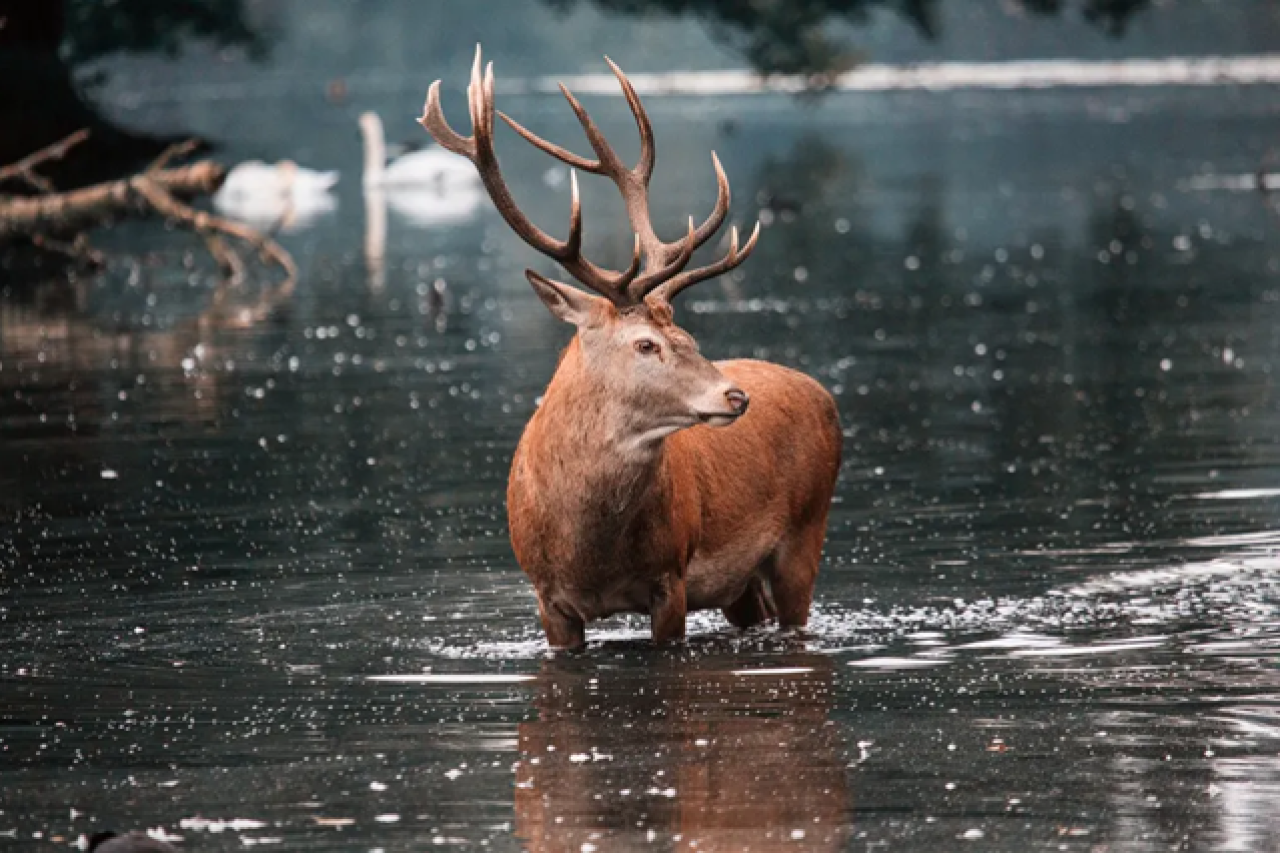
As early as 2019, the genetic study by Gerald Reiner and Heiko Willems concluded that not a single red deer population in Hesse possesses sufficient genetic diversity to adapt the species Cervus elaphus to future environmental changes.
The long-term survival of the red deer as a healthy wild animal species is therefore at stake.
What a few years ago sounded like an alarm call from individual researchers is today a bitter reality in the forest. In Hesse, several red deer calves with severely shortened lower jaws have already been documented — a malformation that typically occurs in cases of inbreeding. At least six such cases have now been officially recorded.
In June 2023, a severely ill calf was found in the Burgwald-Kellerwald red deer area; it could barely walk and had virtually no hoof capsules. Examination by the Wildlife Biology Working Group at the University of Giessen revealed that the animal had inherited defective genes from closely related parents, and that the high degree of inbreeding directly caused the deformities and severe suffering.
These extreme individual cases are merely the tip of the iceberg. The actual consequences of inbreeding depression affect the animals' fertility, vitality, adaptability and immune defences, and usually remain invisible in the wild.
Red deer zones: island populations mandated by law
The causes have been known for years. Hesse is one of several German federal states in which red deer are only permitted to live in so-called red deer zones. Outside these areas, they must by law be shot. This policy means that it is no longer only transport infrastructure that fragments red deer habitats, but above all the legislature itself.
According to the assessment of researchers, almost no genetic exchange takes place between the approximately 20 Hessian red deer zones, and in particular migrating stags rarely reach new areas. Motorways, settlements, and the legally mandated extermination outside the designated zones prevent natural migration and enforce small, isolated island populations.
This artificial fragmentation into islands directly contradicts any serious commitment to biodiversity and animal welfare. When the state deliberately drives wildlife into genetic dead ends, deformities, suffering, and a gradual collapse of populations are not an accident, but a calculated consequence of misguided hunting policy.
Baden-Württemberg: Four Percent of Habitat for a Heraldic Animal
But it is not only Hesse that is making the red deer sick. In Baden-Württemberg, the largest native land mammal is to this day only permitted to live in five legally designated red deer zones, together comprising less than four percent of the state’s total area. Across the remaining 96 percent, a de facto extermination order has been in place since 1958: every red deer must be shot.
There too, genetic studies conducted by the Forest Research Institute (FVA) Freiburg show that genetic diversity within the individual red deer zones has by now become too low to sustain permanently healthy populations. The FVA explicitly calls for measures to improve genetic exchange between the isolated sub-populations.
The state government nevertheless continues to adhere to the system of red deer zones. Rather than granting red deer access to more natural habitat and migration corridors, it seeks to address genetic impoverishment primarily through management within the existing boundaries.
At least in March 2025, Agriculture Minister Peter Hauk announced the suspension of the culling order for young stags outside red deer zones. In future, wandering young stags will no longer be killed automatically. Hunting associations and conservationists see this as a long-overdue first step. At the same time, it is clear: as long as 96 percent of the state's land area remains legally declared a no-go zone for red deer, the problem of genetic impoverishment has not been solved.
The beginning of an extinction process
The Deutsche Wildtier Stiftung now openly warns that the genetic isolation of red deer populations must already be regarded as the beginning of an extinction process. It is precisely for this reason that it has chosen the red deer as Animal of the Year 2026 — to draw attention to a species that is widely considered common, but is in reality being marginalised and genetically hollowed out.
This places the red deer at the centre of a symbolic debate: it stands as an example of a wildlife policy that prioritises hunting interests, forestry objectives and transport infrastructure over the needs of migratory wild animals. Anyone who confines red deer to a few percent of the state's land area and responds to every step beyond that with a rifle is not only destroying the genetic foundation of the species, but is making a mockery of every claim to wildlife stewardship and animal welfare.
What must change
The solution has been known for years and is demanded by scientists, animal welfare organisations and even parts of the hunting community:
- Abolition of the rigid red deer districts and an end to the extermination order outside these zones
- Protection of wandering stags instead of culling, particularly in the corridors between existing “islands”
- Reconnection of habitats through wildlife bridges, wildlife corridors and large-scale areas of undisturbed refuge
- Hunting models oriented towards animal welfare, ecology and biodiversity — not the kill counts of recreational hunters
The loss of genetic diversity is irreversible. Every further generation of red deer raised under the conditions of island populations and culling orders drives inbreeding depression further. Politics thus decides in very concrete terms whether the “King of the Forests” has a future in Central Europe as a free-living, healthy wild species — or ends up as a degenerate remnant population in hunting enclosures.
The wrong hunting policy is making the red deer sick. And it violates what a civilized society owes migratory wildlife species like the red deer: respect for their independence, their need for movement, and their role in near-natural ecosystems.
It is long overdue to treat not only the red deer, but the recreational hunting policy itself.