Federal Hunters' Day 2026 in Suhl: fact check on the DJV poster campaign
The DJV is plastering Suhl with three claims about wolves, racoons and the rescue of young wildlife. The figures do not hold up against the sources.
On 3 and 4 July 2026, the German Hunting Association (DJV) will gather around 400 delegates for the Federal Hunters' Day in Suhl, together with the Thuringia State Hunting Association.
As political guests, the association announced on 25 June 2026: Federal Agriculture Minister Alois Rainer, Thuringia's Minister-President Mario Voigt, and the Parliamentary State Secretary at the Federal Ministry of the Interior, Christoph de Vries. On Friday, the delegates are to adopt a position paper on hunting ethics standards. Further agenda items are the future handling of the wolf and the revision of weapons law.
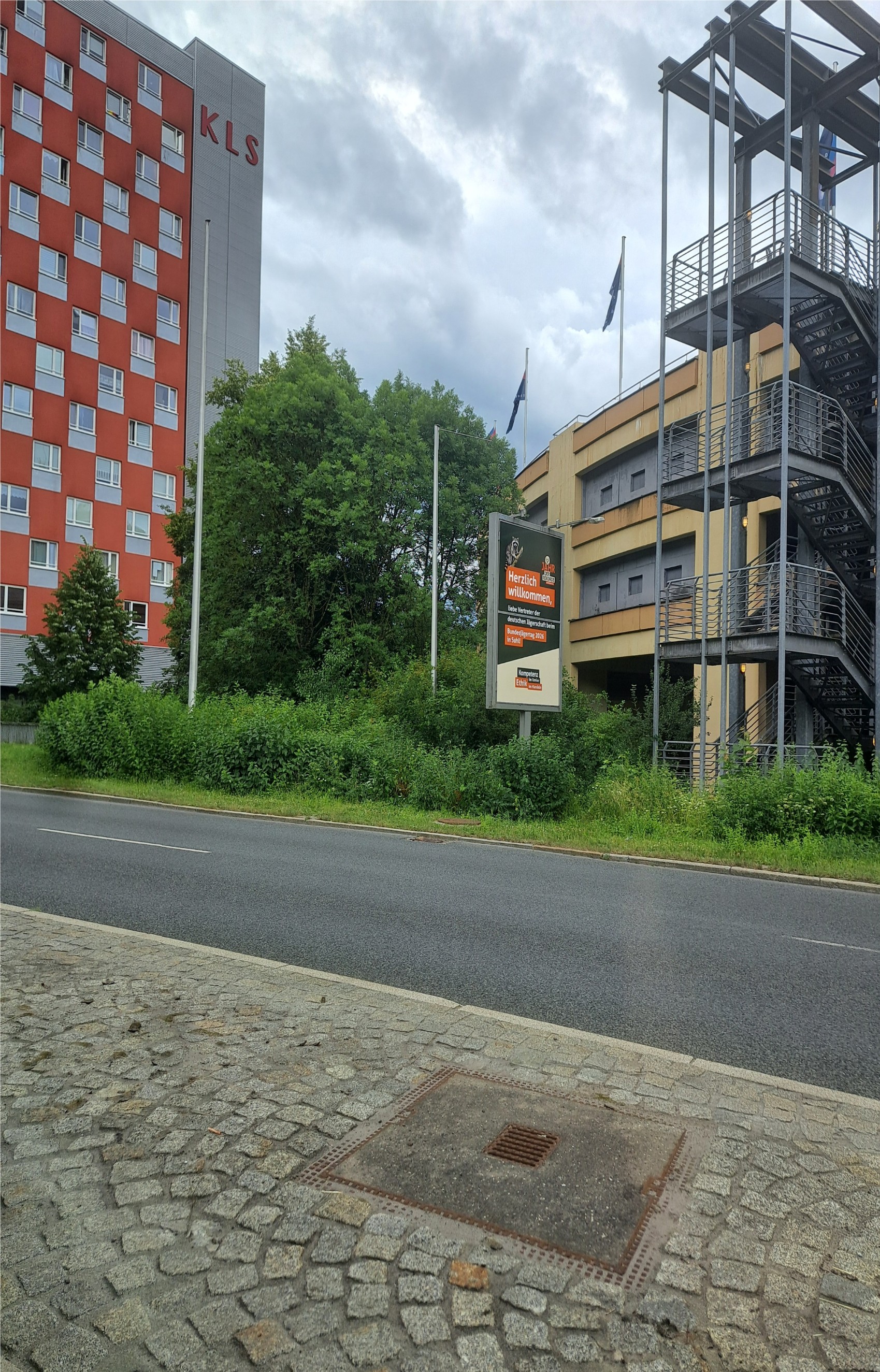
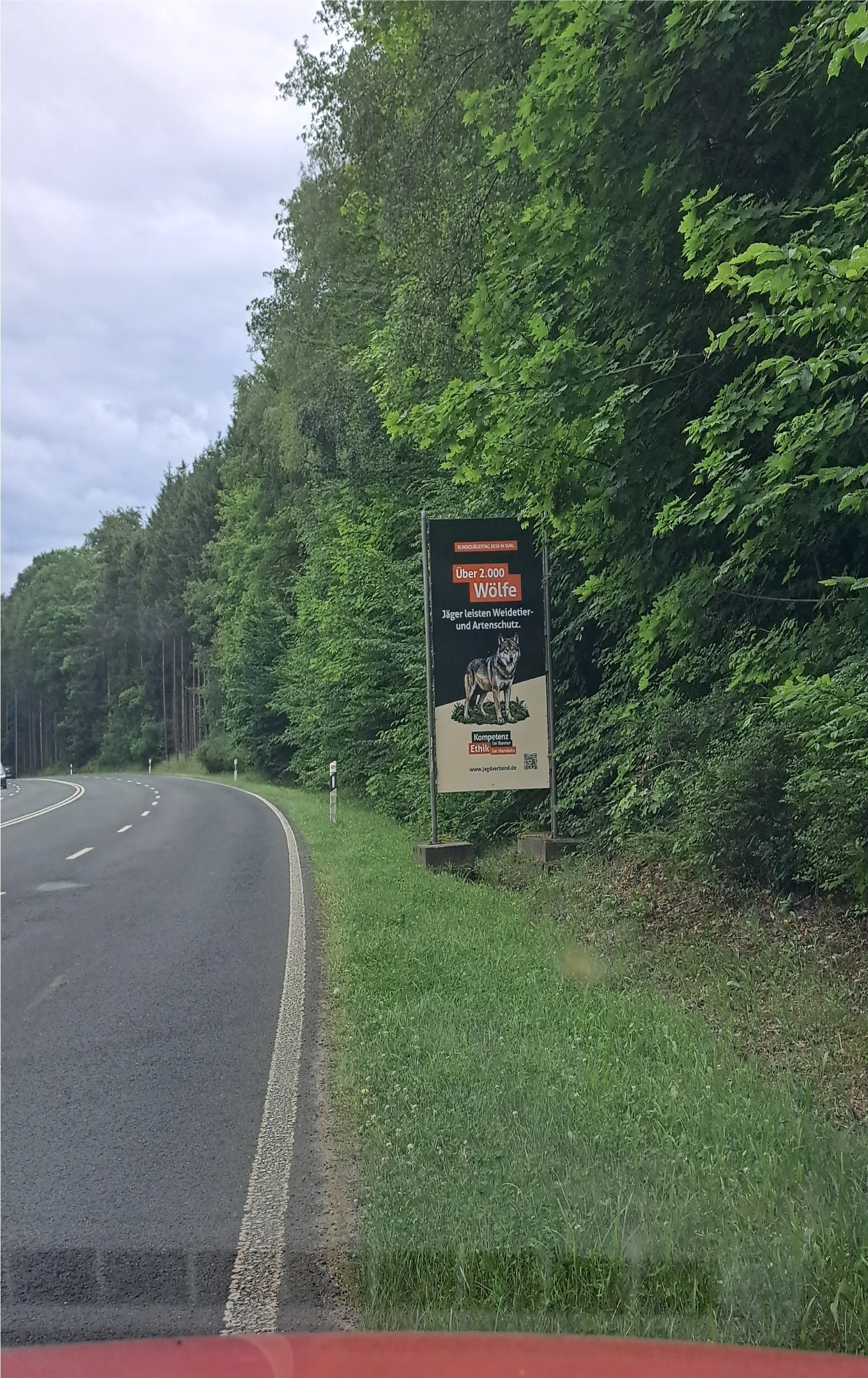
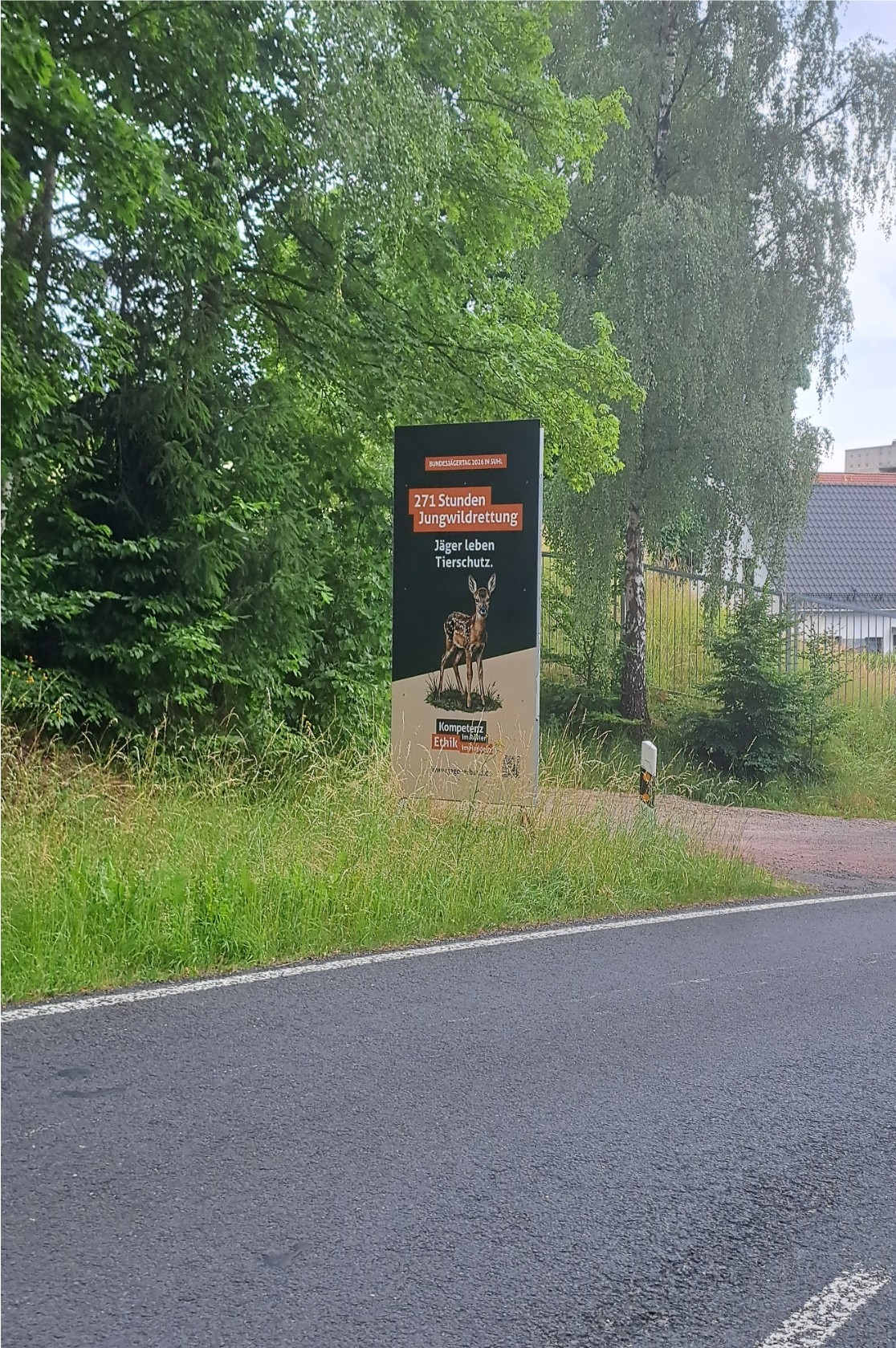
In the run-up, the association has fitted out the city area with large-format posters on recreational hunting. Four locations have been documented so far: on Meininger Strasse (entrance from Mäbendorf), on Ilmenauer Strasse, on Gothaer Strasse (entrance from Zella-Mehlis) and at the car park of the Congress Centrum Suhl on Dr.-Theodor-Neubauer-Strasse.
Under the association's motto «Competence in the hunting ground, ethics in action», the three content posters advertise the following messages: «Over 2’000 wolves. Hunters provide protection for grazing animals and species», «271 hours of young wildlife rescue. Hunters live animal welfare» and «284’000 racoons killed. Endangered species say thank you». A fourth, image-based poster welcomes the delegates at the event car park. Alongside the poster campaign, the association's announcement points to a representative survey according to which «three quarters of Germans» consider hunting necessary.
The campaign coincides with the inclusion of the wolf in the Federal Hunting Act, which has been in force since April 2026, and with the DJV's demand for year-round hunting of so-called invasive species without closed seasons.

Wolf figures: extrapolated, not counted
The Federal documentation and advisory office on the wolf (DBBW) reports a total of 219 wolf packs, 43 pairs and 14 resident lone wolves for the 2024/25 monitoring year, that is 276 territories. A conservative extrapolation with seven animals per pack, two animals per pair and one animal per lone wolf yields around 1,633 wolves, well below the poster's claim of “over 2,000”. The DBBW itself stresses that a reliable total figure for living wolves (cubs, yearlings, adults) cannot be determined at federal-state level. It is precisely this uncertainty that is the real point: a poster figure that cannot be scientifically pinned down exactly is of no use as a reliable basis for an animal welfare claim.
With 276 territories compared to 274 the previous year, the current DBBW figures show first signs of saturation. Statistically, one year is not yet enough for a trend, but for the core areas of Brandenburg, Lower Saxony and Saxony, NABU already speaks of markedly slowed growth.
Scientifically, the second half of the slogan is even more delicate. BfN, NABU and several European wildlife research institutions agree in concluding that hunting demonstrably does not replace herd protection and shows no consistent effect on kill numbers in the available studies. According to the current state of research, electrified fixed fences and livestock guardian dogs are effective. Living wolves learn to avoid protected herds and pass this behaviour on within the pack. This capacity to learn can be disrupted by killings.
Saving young wildlife: 271 hours, divided by eight
The 271 hours come from a survey published in 2024 by the DJV together with Deutsche Wildtierrettung and Deutsche Wildtier Stiftung of 490 rescue teams. The figure is arithmetically correct. But it is explicitly an average per team for the period from March to July, that is five months, and not an achievement per recreational hunter. According to the DJV, on average two drone pilots and six helpers were deployed per team, of whom only 70 percent were recreational hunters and 30 percent farmers.
Broken down to the individual person, this amounts to around 34 hours per helper over an entire spring. In its own survey, the DJV deliberately speaks of a team effort. The poster in Suhl, however, places the same figure in a different context: anyone reading «271 hours of young wildlife rescue. Hunters live animal welfare» while driving past perceives the number as an individual commitment. This shift from the team level to the personal level is the actual point of criticism, not the number itself.
In addition, there is the broader context missing from the poster: the rescue is only necessary in the first place because binding mowing windows and late first cuts are still lacking in Germany to this day. In autumn, more than one million roe deer and several hundred thousand further animals are killed in the very same hunting grounds. The DJV's 2024/25 bag statistics record 1’097’000 roe deer killed alone.
Anyone who labels the drone deployment in May with the term animal welfare would, to be consistent, also have to place the bag figures from November alongside it. The poster does not do this.
284’000 raccoons: record high without effect
The DJV statistics report 282’499 raccoons killed for 2024/25; the poster rounds up generously. The claim that endangered species benefit from this is scientifically disputed and not clearly proven by the available evidence. The methodologically cleanest field study in Europe, the dissertation by Dr Berit Michler in the Müritz National Park spanning twelve years (2006 to 2017), concludes that the raccoon is not a species killer. Its main diet consists of earthworms, insects, windfall fruit and carrion.
The Frankfurt wildlife biologist Dr Frank-Uwe Michler has calculated that, for mere population stabilisation, at least 300’000 animals per year would have to be killed. More shots lead, through compensatory reproduction, to more offspring. The population continues to grow despite record bags; the population is estimated at 1.6 to two million animals. The wildlife biologist Dr Ulf Hohmann sums it up as follows: «I do not know a single scientist or hunting expert who seriously believes that these animals can be brought under control by hunting means.»
Habitat protection and sterilisation are being discussed as alternative approaches. The pilot project of the city of Kassel trialled castration instead of culling for the first time in Europe in 2025 and was halted after five days due to a change of jurisdiction at state level. The legal challenge came from the Hessen state hunting association. Whether the procedure would prove successful on a large scale has not yet been conclusively demonstrated; the Kassel attempt remains for now an isolated case that illustrates the dispute over the choice of method.
We have already examined the methodological and political background in several articles, including «282’499 dead raccoons: Why recreational hunting fails miserably», «ZOWIAC and the recreational hunting lobby: raccoon study under scrutiny» as well as «Removal of the raccoon from the EU list of invasive species».
77 per cent in favour of hunting: One survey, three reservations
Accompanying the poster campaign, the DJV cites in its association statement of 25 June 2026 a representative Civey survey, according to which 77 per cent of Germans consider hunting «necessary» and 64 per cent see it as an «important contribution to society». At first glance the figure seems impressive, but it does not withstand three reservations.
Firstly, the survey is not current. Civey originally published it for the Federal Hunters' Day 2025 in Bonn; the DJV is now recycling it for Suhl. It was moreover conducted on behalf of the DJV, so it is not independent social research but association communication.
Secondly, Civey's methodology is contested in market research. Civey recruits its participants via embedded widgets on news websites (so-called river sampling) and statistically adjusts the result to the population using respondents' self-reported data. Classic survey institutes with random sampling criticise this procedure as self-selective. In 2022 the Cologne Regional Court issued a legally binding ban prohibiting Civey from advertising that it was «more reliable than the competition». The Civey figures are usable as an indication of mood, but not as a population-accurate measurement.
Thirdly, and this is the most important point: the survey does not distinguish between state-functional wildlife regulation and private recreational hunting. Anyone who answers the question «Is hunting necessary in this day and age?» with yes may be thinking of wildlife warden services in Switzerland, of ASF control of wild boar, of reducing populations of cloven-hoofed game critical to road traffic, or of controlling invasive species. All of this enjoys broad social acceptance. The specific question of whether private recreational hunting with over 400’000 recreational hunters, drive hunts, trap hunting and trophy hunting is necessary in this day and age is one the survey does not ask. Yet this very question is the actual political dispute. The 77% are an endorsement of a concept, not of a practice.
One campaign, four gaps
The three posters and the accompanying survey share a pattern. They take a real or slightly rounded-up figure, cut away the context, and place the result next to the word «animal welfare» or «necessary». The wolf figure stands without the note that it is an extrapolation with considerable uncertainty and that the population is showing first signs of saturation. The 271 hours stand without the note that it is a team average over five months. The 284’000 raccoons stand without the note that science assesses their hunting as a failure. The 77 per cent stand without the note that the survey lumps recreational hunting and state-functional wildlife regulation together.
The posters are not aimed at the recreational hunters themselves, who know these figures. They are aimed at motorists, walkers and commuters, that is, at the non-hunting public, who are meant to absorb a supposed fact as they drive past. That is the classic function of lobby advertising in public space, not science communication.
Support our work
With your donation you help to protect animals and give their voice a hearing.
Donate now →