Extremists terrorize wildlife: recreational hunters as a threat
Particularly when it comes to recreational hunters, it is absolutely essential to look very closely. Nowhere else is there so much manipulation through falsehoods, hunters' tales, and fake news. Violence and lies are two sides of the same coin!

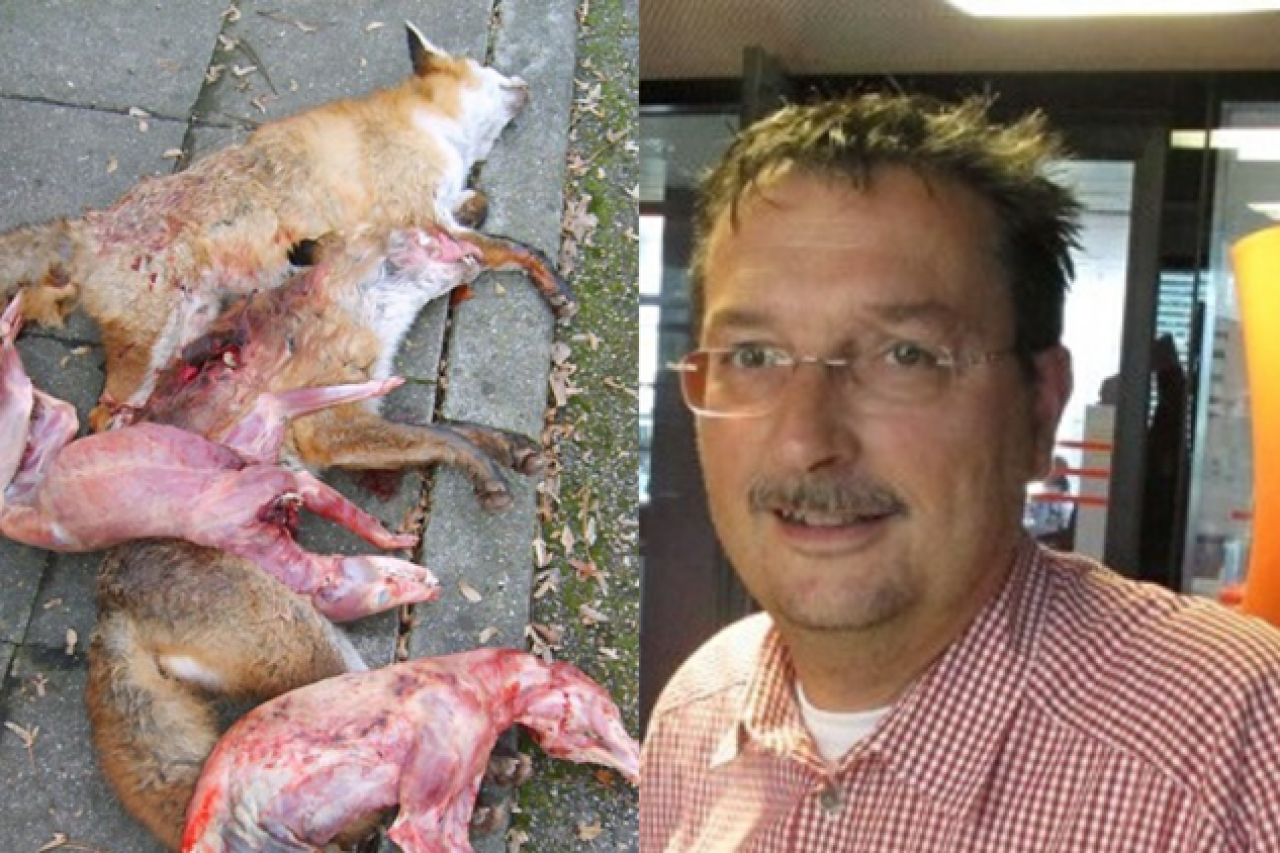
In autumn, cruel driven hunts are carried out in countless hunting grounds.
Journalists are repeatedly invited to these tiresome events, and the media is instrumentalized in service of the violence-glorifying ideology of recreational hunters.
On 7 November, the online edition of the Winterthur newspaper published an article by Michael Hotz about driven hunts in the Rickenbach hunting ground near Winterthur, featuring Urs Philipp.

The first of two autumn hunts last Tuesday got off to quite a spectacular start. Just minutes after Urs Philipp, one of three leaseholders with supervisory responsibility in the Rickenbach hunting ground, sounded the horn to open the hunt, a young roe deer darted through the undergrowth. The eleven beaters relayed instructions on where the fawn was heading. The four dogs brought along pursued the fleeing animal. None of the 13 recreational hunters managed to shoot it. Shortly afterwards, the first shot rang out nonetheless. Two horn blasts announced which animal had been taken: a fox had been shot.
Michael Hotz, journalist, Winterthur newspaper
Violations of animal welfare legislation
These acts are in direct contradiction to several Swiss animal welfare laws, including Art. 26 and Art. 4.
No one may inflict pain, suffering, or harm on an animal without justification, cause it fear, or otherwise disregard its dignity. Mistreating, neglecting, or unnecessarily overexerting animals is prohibited.
The fact that driven hunts cause significantly more animal suffering through the many missed shots than targeted culling through stalking was not worth a single line to Michael Hotz.
Or that, looking across all cantons and over several years, the number of found casualties with gunshot wounds among roe deer and foxes in the canton of Zurich consistently accounts for the largest share of all such finds, according to the Swiss Animal Protection organization. Journalist Michael Hotz fails to report on this as well.
Fox hunting is pointless from a wildlife biology perspective
Hotz also appears to be unaware that for more than 30 years there have been at least 18 wildlife biology studies proving that fox hunting does not regulate populations and is useless for disease control as well. Quite the opposite! There is no culling plan for foxes — they are simply shot indiscriminately by extremists for no reason.
Even without hunting, there would not suddenly be too many foxes, hares, or birds. Experience shows that nature can be left to its own devices. From a purely pragmatic standpoint, small game hunting is unnecessary.
Heinrich Haller, former National Park Director of Graubünden and wildlife biologist
The Swiss Rabies Centre warns that reducing fox populations through hunting is not feasible, and that recreational hunting for rabies control is actually counterproductive. As we know today, only animal-friendly vaccine baits were able to defeat terrestrial rabies — it has been considered eradicated in Switzerland since 1998 and across much of Europe. According to one study, the fox tapeworm also spread in intensively hunted areas rather than being brought under control. As other studies have impressively demonstrated, deworming baits can effectively reduce the rate of fox tapeworm infestation in foxes to nearly zero percent. Anyone who fears diseases such as Lyme disease or the so-called fox tapeworm should therefore speak out unequivocally against recreational hunting. Far more people are harmed in hunting accidents.
Further reading: Stop the fox and badger massacre in the canton of Zurich
The Geneva model as an example
We commend the Canton of Geneva for its professional wildlife management without recreational hunters, but with dedicated wildlife wardens. On the shores of Lake Geneva there are vineyards and other cultivated areas, just as in the rest of Switzerland. Evidently, however, they have embraced humane and ethical approaches to dealing with wildlife and intelligent measures to protect crops. In Geneva, foxes, martens, or badgers are not regulated simply because it is hunting season. This is also reflected in the federal hunting statistics. Instead, practical deterrent measures and meaningful education, guidance, and training for the public are carried out together with the game wardens. Safety, animal welfare, and ethics are the guiding principles.
Lowest-Quality Meat from Drive Hunts

Wild animals live in constant fear because of recreational hunters like Urs Philipp. Especially when they are actually being hunted, they produce enormous quantities of toxic hormones, adrenaline, etc., which accumulate in the meat alongside other toxins and waste substances already present. Drive hunts, battue hunts, or moving hunts produce the lowest-quality meat of all, which is not infrequently contaminated with ammunition particles as well. This meat is then passed off to the local population. According to the World Health Organization,WHO processed game meat is carcinogenic — like cigarettes, asbestos, or arsenic.
Things became utterly absurd in Michael Hotz's article when he quoted lease-holder Urs Philipp with the following words:
We recreational hunters love animals and want to make a contribution to nature and to society.
Urs J. Philipp
By the evening, after three drives, the recreational hunters had six foxes and two roe deer on the ground.

Predators Regulate the Roe Deer Population
The contradiction and hypocrisy of recreational hunting could not be more clearly illustrated. The six foxes — that is, the predators — would have been perfectly capable of regulating the roe deer population themselves. Once again, 13 wildlife killers and 11 beaters caused needless terror and panic in a biotope. What would the figures look like if one calculated the total hours that recreational hunters spend in their hunting grounds pursuing all this recreational hunting nonsense?
Studies conducted in various countries and at various points in time have documented the fox's influence not only on roe deer populations: for the Bernese Mittelland, it is estimated that a fox can catch an average of eleven fawns during the months of May to July. This also helps reduce browsing damage.
Lease-holder Philipp is, incidentally, head of department at the cantonal fisheries and hunting administration and is thus the highest-ranking recreational hunter in the canton of Zurich.
In the canton of Zurich, during the 2018 hunting season, 2’463 foxes and 292 badgers were senselessly slaughtered by militant extremists without any scientific basis or wildlife biology expertise. Those who kill needlessly do not protect, and civilized society gains nothing from it.
We have observed that mother foxes give birth to more young in areas where the animals are hunted. While a targeted cull can provide temporary relief, the vacant territories are quickly reoccupied. Nature regulates itself.
Wildlife warden Fabian Kern from Zurich
Many case studies, such as national parks, Luxembourg, or the Canton of Geneva, have shown that there are no sound arguments for these massacres. Freed-up habitat is immediately reoccupied by these animals. It is well established by science that fox populations develop largely independently of hunting intervention attempts, because hunting, on the contrary, actually causes reproduction rates to surge.