
Zurich: Stop the fox and badger massacre
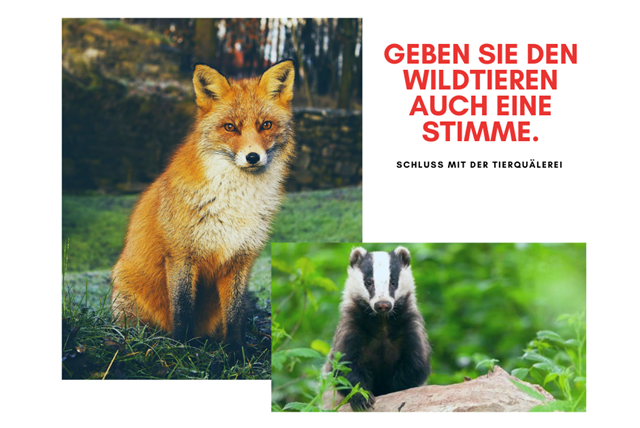
To justify the ruthless persecution of one of our most interesting predators in Zurich, it is simply claimed that fox and badger hunting during the low hunting season is necessary because their populations would otherwise get out of control – an outdated view!
Fundamentally, lightly hunted fox populations also produce fewer offspring. Humans always create conflicts with wildlife that share the same habitat. Humans cause, particularly in wildlife habitat, far more damage than the few grapes a badger enjoys.
Now more and more municipalities in the canton of Zurich are beginning to disturb wildlife habitat at night by allowing fox and badger hunting with special permits.
Recently, in addition to Stäfa and Zollikon, Hombrechtikon and Horgen have also newly issued permits for night hunting for hobby hunters. In some municipalities, such as Küsnacht, Erlenbach and Oetwil, permits were already issued at the beginning of the current lease period in 2017.
Hunting in the canton of Zurich
Urs Philipp is the controversial Head of Fisheries and Hunting for the Canton of Zurich. He repeatedly reveals his mentality – unchristianly striking down the weaker and those under protection with brute and lethal force – devoid of any scientific or wildlife biological knowledge – or disregarding law and order.

Urs Philipp became known nationwide for his inglorious misshot at a wild boar during the closed season. It was also recently revealed that fishing statistics for Zurich lakes and the Linth Canal for the year 2017 were disposed of as waste paper in his office. Transparency at its finest.
In his function as department head, Urs Philipp is a member of the cantonal hunting commission as well as the operating commission of the Embrach shooting range, against which a criminal complaint was recently filed again (The IG Wild beim Wild informed).
Urs Philipp notoriously spreads false claims in the media, such as in the Landboten from October 6, 2017 where he even enlisted Zurich Animal Protection for his militant purposes, although no agreement had been reached. Zurich Animal Protection is against the wild boar enclosure in Elgg.
Zurich Animal Protection rejects the facility because 1. it means stress and risk of injury for wild boars and dogs, and 2. because animal protection fundamentally considers the approach of such facilities wrong: Animal Protection is convinced that drive hunts cause significantly more animal suffering through the many missed shots than targeted shots from stand hunting, 3. such facilities are available in neighboring countries.
In a letter to all municipalities in the canton regarding night hunting of foxes and badgers, Urs Philipp claims that foxes transmit rabies, although the Swiss rabies center warns that a hunting reduction of fox populations is not possible and hunting for rabies control is even counterproductive. As we know today, only animal-friendly vaccination baits could defeat terrestrial rabies – it has been considered eradicated in Switzerland since 1998 and in large parts of Europe! According to a study, fox tapeworm also spread in intensively hunted areas instead of being controlled. As other studies have impressively shown, deworming baits can effectively reduce the infection rate of foxes with fox tapeworm to nearly zero percent. Those who fear diseases like Lyme disease or the so-called fox tapeworm should therefore speak out with complete clarity against recreational hunting. Far more people are harmed in hunting accidents.
Urs Philipp has spent (wasted) much time and energy (tax money) in recent years making the Canton of Zurich into Sodom and Gomorrah for recreational hunters from near and far. Now Freiburg recreational hunters are also frolicking in the canton for their gleeful and recreational wildlife slaughter. What goes on in the Canton of Zurich has long had nothing to do with game management or hunting.
Urs Philipp increasingly allows the shooting of non-huntable red deer and chamois on a population-regulating scale, with the argument of preventive damage limitation. He no longer publishes decrees regarding this chamois and red deer shooting.
Urs Philipp keeps precious few statistics, such as the number of missed shots, etc. Follow-up searches are not even mandatory to report. Although: Across all cantons and several years, findings of fallen game with gunshot wounds in the Canton of Zurich consistently make up the largest share of findings for roe deer and foxes, according to Swiss Animal Protection.
Despite the Freedom of Information Act, Urs Philipp repeatedly fails to provide demonstrable answers, facts, evidence, etc. for his claims.
«Hunting protects. Hunting benefits. Whom exactly? In the private sector, the recreational hunter Urs Philipp would have been dismissed long ago! Those who kill senselessly do not protect, and it serves no purpose for civilized society.«
IG Wild beim Wild
Violence begins in Zurich, where knowledge ends
While this hunting administration of Canton Zurich has now also authorized fox hunting at night with artificial light throughout the entire canton, the approval for nighttime badger hunting still lies with the municipalities.
The hunting supervisor in the Adliswil, Kilchberg and Rüschlikon district also recently stated in the media:
If a hunter sits in wait for roe deer at dusk – waiting at a post – and a badger comes, it too will be shot.
Ulrich von Rickenbach
This demonstrates the disrespectful and abhorrent mindset of hobby hunters. Wherever an opportunity presents itself, they coldly murder.
Repeatedly, claims are made from the hobby hunting milieu that, upon careful analysis, have their origins in hunting literature and such unscientific sources. This is primarily due to the frequently inadequate training in hunter examination courses, which are predominantly conducted by sometimes fanatics with a sect-like ideology who require no formal qualification credentials. After training, the hobby hunter moves only within the echo chamber of hunting press, which continuously repeats its skewed and often false representations.
In hunting associations, they then mutually confirm each other in their worldview. This has created an insular and militant group that is barely accessible to new information. What is fatal is that local press and politics still believe that expertise lies beneath the hunter's hat and gladly consult the local hobby hunter on all nature topics. This way, hobby hunters also contaminate public discourse.
We commend Canton Geneva with its professional wildlife management without hobby hunters, but with dedicated game wardens. At Lake Geneva there are vineyards and other crops, as in the rest of Switzerland. Apparently, however, they have humane and ethical approaches in dealing with wildlife and intelligent measures to protect crops. In Geneva, no foxes, martens or badgers are regulated simply because hunting season is open. This is also reflected in the federal hunting statistics (2). Instead, practical deterrent measures (12) and sensible education and assistance as well as continuing education for the population take place with the game wardens. Safety, animal protection and ethics are the guiding principles.
For foxes, there is no legal shooting plan and population assessment. Fox hunting resembles short-circuit ecology for inadequately trained hunters.
For IG Wild beim Wild, it is counterproductive to give cantons more authority in hunting law – quite the contrary. They cannot handle the responsibility, are overwhelmed, are inadequately trained as hobby hunters and decision-makers, and they lie. Moreover, they already have enough carte blanche. Current examples include the department head for hunting and fishing in Canton Zurich.

According to animal protection law (Art. 26 TSchG), there must be a "reasonable cause" for killing an animal – however, hunting foxes and badgers is usually merely the satisfaction of a bloody hobby. For these wild animals, there is no legal shooting plan. The animals serve hobby hunters as living targets, as there is no reason from either a wildlife biology or health perspective for the mass hunting of healthy predators.
Accordingly, every fox or badger hunt in Zurich is a clear violation of animal protection law, because it lacks reasonable cause. Fox and badger hunting in Canton Zurich is thus primarily organized animal cruelty.
Wild animals also have feelings and emotions. They can suffer, mourn and experience joy. Like us humans, they live in family units and social structures, which hobby hunters usually terrorize and defile for entertainment.
For a full 8 months, foxes are pursued in Canton Zurich – for badgers it is over 6 months, according to the federal hunting statistics. With such stress, one need not wonder why these animals become ill. Throughout Europe, the epicenter of fox tapeworm reports lies in Switzerland, precisely in that region of Switzerland where hunting-enthusiast hobby hunters, like Urs Philipp, have embedded themselves within cantonal authorities. These senseless disturbances and noise emissions caused by hobby hunters' night hunting in wildlife habitats always disrupt entire wildlife populations and residents as well.
Master Grimbart – as the badger is called in fables – is not frequently observed: The largest animal of the marten family is shy and active only at night. Badgers spend the day mainly in their sett, which is usually located at the settlement edge and is often used for generations. Badgers are also harmless to humans and pose no danger to agriculture, forestry, wildlife or domestic animals. Badgers do not attack cats and are mainly active at night. When they must defend themselves against dogs, the dog usually loses. Badgers spend winter or periods of low temperatures predominantly sleeping – they maintain a winter rest. Canton Zurich grants badgers no closed season at the cantonal level and they are huntable from 16.6. – 15.1. – which is animal cruelty without equal. Badgers also do not transmit diseases, which are always brought up by hobby hunters as false arguments.
Science versus hunters' tales
For more than 30 years, there have been at least 18 wildlife biology studies that prove: Fox hunting does not regulate and is also useless for disease control. On the contrary!
Scientific investigations (5) have found that even when three-quarters of a population is shot, the same number of foxes are present again the next year. The more intensively they are hunted, the more offspring there are – any kind of "regulation" of these populations is neither necessary nor even possible through hunting methods.
Fox populations are regulated through a complex social system. Foxes live in family groups where only the highest-ranking vixen produces offspring (like the lead sow among wild boar). Birth control instead of mass misery, biologist Erik Zimen commented on this phenomenon. However, when humans intervene in fox populations with traps and guns, these family communities (3) are destroyed. As a result, nearly all vixens become ready to mate, and the number of cubs per litter also increases significantly.
"Even without hunting, there would not suddenly be too many foxes, hares or birds. Experience shows that nature can be left to itself. From a purely pragmatic perspective, small game hunting is not necessary."
Heinrich Haller, former National Park Director Graubünden and wildlife biologist
Studies in various countries and at different times have also documented the influence of red foxes not only on roe deer populations: For the Bern Mittelland, it is estimated that one fox can prey on an average of eleven fawns in the months from May to July. This also reduces browse damage (1).
Many case studies such as national parks, Luxembourg (10) or for example Canton Geneva have demonstrated that there are no valid arguments for these massacres. Vacated habitat is immediately reoccupied by these animals. It is scientifically well-documented that fox populations develop largely independently of hunting intervention attempts, because hunting actually causes reproduction rates to spike.
In Switzerland, hobby hunters shoot approximately 20,000 healthy foxes annually for the garbage dump or incineration (2). Exactly the number needed so that the risk group of hobby hunters can later spread their sectarian hunter jargon as indispensable regulators. This senseless pile of carcasses at taxpayer expense must be ended. The hobby hunters cause more problems than they allegedly solve. This absurd behavior doesn't help the forests either.
These hunts repeatedly lead to fatal misidentifications and hobby hunters shoot protected species like golden jackals or wolves (8).
Can the enlightened taxpaying woman and the responsible taxpayer in Zurich still reconcile with their conscience supporting such functionaries in the canton, who don't care one bit about ethics, science or animal welfare and lie to the population and endanger them?
End the animal cruelty and waste of tax money in Canton Zurich.
Fox hunting is ecologically, economically and epidemiologically pointless – indeed even counterproductive! – and must therefore be banned in the interests of humans, nature and wildlife as well as from the perspective of ethics, morality and animal welfare. Blind activism and violence help no one.
Food consumption by wild animals in shared habitat is not damage, but a natural process for the survival of these creatures. Tolerance and fairness are required here. We humans build over and destroy the habitat of wild animals on all levels many times more. Wild animals have just as much right to exist as humans. These disrespectful killing actions and bounty premiums are disproportionate to a healthy and heart-forming sense of justice. Against hail and bird damage, for example, one also protects oneself with nets or deterrence.
We demand with this direct submission of the petition to an official body to prohibit the killing of these wonderful creatures as quickly as possible and to publish this in the official gazette.
The protest emails went to the municipal boards of Zollikon, Erlenbach, Oetwil, Küsnacht, Horgen, Hombrechtikon, Zollikon, Stäfa and the Office for Hunting and Fishing in Zurich.
Also voice your opinion by phone to decision-makers in Zurich:
- Municipal Chancellery Zollikon, +41 44 395 31 11
- Municipal Chancellery Oetwil, +41 44 929 60 11
- Municipal Chancellery Erlenbach, + 41 44 913 88 00
- Municipal Chancellery Küsnacht, +41 44 913 11 31
- Municipal Chancellery Horgen, +41 44 728 42 81
- Municipal Chancellery Hombrechtikon, +41 55 254 92 92
- Municipal Chancellery Stäfa, + 41 44 928 71 11
- Urs Philipp, Office for Hunting and Fishing, +41 43 257 97 50
In addition to this, we demand:
- Recognition of scientific studies and expert opinions (not from the hobby hunter milieu), which question or refute the necessity of hunting.
- No spreading of sectarian or refuted hunter lies, such as the alleged necessity of regulating fox populations, as well as fear-mongering about rabies, fox tapeworm and mange, or that the fox is to blame for the decline of small game etc.
- Killing animals as part of a recreational activity has no place in the 21st century and should also be prosecuted under criminal law.
Justification:
In Canton Zurich during the 2018 hunting season, mostly healthy 2’463 foxes and 292 badgers were killed without scientific basis or wildlife biological expertise by militant hobby hunters.
The alleged threat to grassland birds, i.e. ground nesters, can be dismissed as hunter fairy tales, as there are research studies that classify the influence on bird populations as insignificant (3). This is all the more understandable when one considers the main diet of foxes: mice and earthworms. Foxes are distinctly beneficial to agriculture. However, only few people know that foxes are distinctly beneficial to forestry and protect humans from diseases through their diligent consumption of mice (which are considered the main carriers of Lyme disease, for example).
The false arguments of allegedly combating rabies, fox tapeworm or mange through relentless hunting have been scientifically refuted. Mange is much rarer than assumed and foxes with good constitution can heal from mange. These fox populations are then resistant to new infections. Furthermore, mange in foxes poses no danger to humans or domestic animals.
Fox tapeworm
Fewer foxes, less fox tapeworm, thus also less infection risk for humans. At first glance a plausible conclusion, but upon closer analysis merely hunter's tales, as several international studies (6) demonstrate.
Throughout Europe, the epicenter of fox tapeworm reports lies in Switzerland, precisely in that region of Switzerland where hunting-affiliated recreational hunters have entrenched themselves within cantonal authorities. These senseless disruptions and noise emissions during recreational hunters' hunts in the habitat always disturb entire wildlife populations and residents as well..
There are far more zoonoses among pets and livestock. As a rule, only recreational hunters contract a zoonosis like fox tapeworm. About 20 – 30 people in Switzerland become infected with this liver disease (Echinococcus multilocularis) per year. This is no more than before, when fewer foxes were found in cities. Most people's immune systems are strong enough to ward off an infection. Typically, fox tapeworm larvae develop in the livers of mice and some rats. If a fox eats the infected mouse, a tapeworm develops again in its intestine. Cats and dogs that eat mice can also spread the parasite this way, but do not become ill themselves. The fact that the disease frequency in Switzerland is very low, that direct transmission from fox to dogs is not possible, and that neutered animals cannot get fox tapeworm can be seen as somewhat reassuring.
Urban foxes typically have an infection rate under 20%, as their diet consists mainly of food scraps. Rural foxes, however, have a higher infection rate because they feed abundantly on field mice.
The infection risk is minimal for normal forest visitors. Contrary to many rumors, no fox tapeworm patient is known to have been infected through forest berries. Berries that hang high on bushes are ruled out as an infection pathway. It is hard to imagine how fox feces could reach high-hanging berries.
"We have observed that fox mothers give birth to more young where the animals are hunted. One can indeed create relief through targeted shooting, but the free territories are quickly reoccupied. Nature regulates this itself."
Game warden Fabian Kern
Shooting foxes can even have the effect that the freed habitat is newly inhabited by foxes with a much larger proportion of fox tapeworm carriers.
Fox mange
Not every scruffy-looking fox has mange, and dogs are also not highly susceptible to infection. The parasitic mange mite can indeed infect dogs or humans – but this infestation is very treatable in both cases. The locally apparent increased occurrence of said mites is not the result of excessive population density among foxes. Therefore, increased hunting would not prevent the spread of mange either. Scientific evidence shows that hunting foxes is actually counterproductive for containing wildlife diseases. In general, it has been shown that in intensively hunted areas, the fox population does not decline, but rather increases due to enhanced reproduction and immigration of animals.
The main reasons for the spread of fox mange are considered to be intensive hunting. Hunting leads to an artificially rejuvenated and increasing population with weakened immune systems, resulting in an autumn increase in migrating young foxes that spread pathogens they carry.
"Unfortunately, we cannot provide health data for the foxes killed, as this is not recorded in the harvest control. This applies to both hunting and special culls, which are carried out from June 15 to August 31. There is also mange among the animals found dead, but we cannot quantify the number from the 23% due to age, disease, or weakness. Basically, we can assume that in the last 20 years, between 5-10% of foxes were infected with mange. Distemper is very rare."
Rolf Schneeberger, LANAT Office for Agriculture and Nature
In the past, mange and distemper have always flared up locally and then subsided on their own. Especially where mange has spread particularly severely, foxes appear to develop increasing resistance to new infections. However, since hunting negates the natural survival advantage for mange-resistant foxes (a hobby hunter cannot see a fox's mange resistance), killing foxes is likely counterproductive in this regard as well. Incidentally, it has been found that wild animals have already formed antibodies against distemper, making the danger marginal.
Foxes protect us
A new study (7) suggests that the extinction of mouse-hunting predators, particularly foxes, is the cause of the increasing number of tick-borne diseases in humans.
Foxes also have a positive influence in protecting humans and animals from hantavirus, botulism, or leptospirosis (11), for example.
"If not so many foxes were killed, farmers would not have to apply so much poison to fields against mouse plagues – which in turn burdens the entire ecosystem."
IG Wild beim Wild
Foresters must combat mice with chemicals, mechanics, and traps, as mice damage seedlings and trees, while hobby hunters hunt foxes that would actually keep mice under control. Millions of francs in damage and additional effort for forest management due to hunting are the consequences. Farmers and fruit growers must hire mouse hunters because foxes and other predators are missing.
Barbaric folklore or normal hunting method?
Fox hunting involves practices (9) that animal protection laws actually prohibit. The persecution is particularly cruel during den hunting and the training of hunting dogs on live foxes.
At least in the Swiss population, den hunting enjoys hardly any acceptance; this is shown by a representative survey in September 2017 among 1015 people, conducted by the market research company Demoscope on behalf of Swiss Animal Protection (STS). 64 percent support a ban, only 21 percent want to maintain den hunting. The rejection is somewhat more pronounced among women and 15- to 34-year-olds. A Röstigraben does not exist.
The fox is a very vivid (and sad) example of how the hobby hunter, with his ignorance and compulsive need to control nature, creates problems himself and worsens natural regulatory mechanisms. If one examines foxes without prejudice, one quickly recognizes that they are fascinating animals with impressive abilities. They are very caring parents and possess extraordinary capabilities, such as incorporating the earth's magnetic field in food acquisition. Moreover, as mouse hunters they are very important for both agriculture and forestry and have a significant role in containing 'rodent-transmitted pathogens' such as hantaviruses or borrelia. For these reasons, we should see the fox as what it is – namely as an important component of the ecosystem and an enrichment of native fauna.
Actually, all small game hunting should be banned. Those who kill senselessly do not protect, and it benefits civilized society nothing. Recreational hunters thus also do not ensure healthy or natural wildlife populations.
Particularly with hobby hunters, it is extremely essential that one looks very closely. Nowhere is there so much manipulation with untruths, hunters' tales and fake news. Violence and lies belong to the same coin!
Sources:
Further articles
- Fred Kurt: The Roe Deer in the Cultural Landscape. Ecology, Social Behavior, Hunting and Management. Kosmos Verlag, Stuttgart 2002, p. 83.
- Federal Hunting Statistics Link
- Explanations and Source References Link
- Scientific Literature: Red Fox Studies
- Hunters spread diseases: Study
- Hunting promotes diseases: Study
- Hobby hunters in criminality: The List
- Ban on senseless fox hunting is overdue: Article
- Luxembourg extends fox hunting ban: Article
- Small game hunting and wildlife diseases: Article
- Harassment of wild animals: Article
Interest Group Wild beim Wild
The IG Wild beim Wild is a non-profit interest group that advocates for the sustainable and non-violent improvement of human-animal relationships, whereby the IG has also specialized in the legal aspects of wildlife protection. One of our main concerns is to introduce contemporary and serious wildlife management in the cultural landscape following the model of the Canton of Geneva – without hobby hunters but with upright wildlife wardens who deserve the name and act according to a code of honor. The monopoly on violence belongs in the hands of the state. The IG supports scientific methods of immunocontraception for wildlife.