Petition Schliefanlage Schwadernau: Stop Animal Cruelty
A petition demands the closure of the Schliefanlage Schwadernau, where badgers and foxes are abused for the training of hunting dogs.


The Pointer Hunters' Association of the Canton of Bern intends to build an artificial fox den — known as a Schliefanlage — on its grounds near Schwadernau as a training facility for hunting dogs.
In the Canton of Bern, around one fifth of all red foxes in Switzerland are shot, even though experts see no point in it. Hunting protects nothing, hunting achieves nothing! Sign the petition against the Schliefanlage in Schwadernau now sign now!

(Screenshot Facebook)
One of the project's authors, named Mathias Kunz from Meinisberg, even pretends that this animal-cruel project is based on scientific facts: Among other things, he considers hunting the fox to be absolutely necessary — on the one hand to prevent overpopulation and thus the spread of disease, and on the other hand because the fox is also a predator that threatens other species such as ground-nesting birds, hares, and other small animals. Earth hunting, the recreational hunter claims in the Bieler Tagblatt, is therefore a contribution to preserving biodiversity. This hunters' tall tale, however, directly contradicts years of experience in the Canton of Geneva and, for example, in Luxembourg, where fox hunting has been banned for several years!
Facts instead of hunters' tall tales and animal cruelty
According to the Swiss Rabies Centre, it is well established that the activities of recreational hunters have only spread the disease further — and the same holds true for fox mange, and so on. An artificial fox den in Schwadernau will not change any of that. With this petition, we say NO to the Schliefanlage in Schwadernau.
The alleged threat to meadow birds can be dismissed as hunters' tall tales. Research exists that classifies the influence of foxes on bird populations as insignificant, and identifies the intensification of agriculture as the main threat to ground-nesting birds. This is all the more understandable when one considers the fox's primary diet: mice and earthworms. Foxes are genuinely beneficial to agriculture and are even regarded in some places as a “health police.” By contrast, few people are aware that foxes are also highly beneficial to forestry, and that by eagerly consuming mice — which are considered the primary carriers of diseases such as Lyme disease — they also protect humans from illness.
This raises the question of why foxes are still hunted so intensively, given that for years a nationwide campaign by IG Wild beim Wild and allied organizations has been raising awareness about the hunters' tall tales and the animal cruelty practiced by cowardly sharpshooters lying in wait.
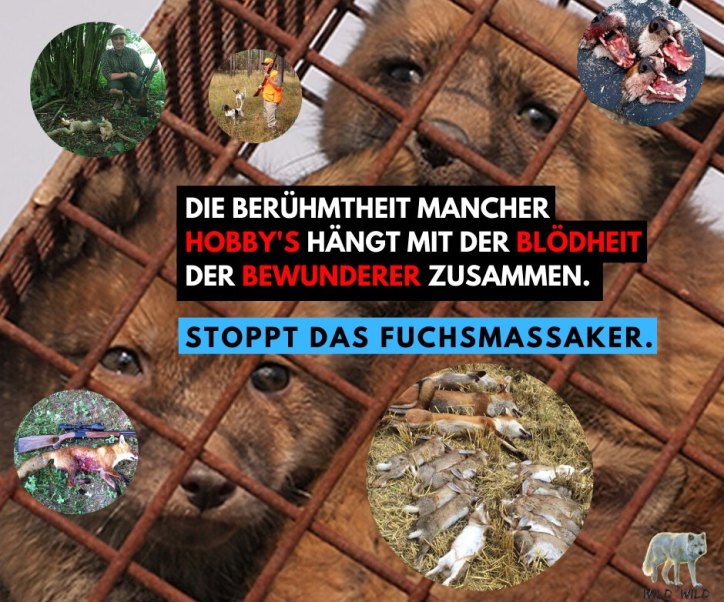
Social density regulation controls fox populations. As we know from hunting-free areas, the social structure of fox populations ensures that foxes do not reproduce excessively. When left undisturbed, foxes live together in stable family groups in which only the highest-ranking vixen produces offspring. The birth rate is relatively low and population density remains constant.
Industrial agriculture is the primary driver of population decline in endangered species, as it destroys animal habitats. New croplands, monocultures, fertilizers, and pesticides are progressively eliminating the natural structures vital to their survival — and over-fertilization also reduces food availability. However, the killing of animals by recreational hunters places additional pressure on already weakened populations and can push them to the brink of extinction. Paradoxically, hunters attempt to attribute the decline of many species — such as the European hare — to predators like the fox. Foxes, however, feed primarily on mice and earthworms and pose no threat to hare populations or ground-nesting birds, except in the case of sick or weak individuals. On one hand, it is a waste of a fox's time to search unsuccessfully for rare and therefore hard-to-find prey; on the other hand, a healthy hare is simply no match for even the fastest fox — with their powerful hind legs, these long-eared animals can launch themselves from a standstill to over 70 km/h. Studies show that the vast majority of hares consumed by foxes are taken as carrion.
Artificial fox den (training earth) in Schwadernau
The training earths in Schwadernau are used to prepare aggressive hunting dogs for the real-world application of the cruel practice of earth hunting for foxes or badgers. A fox is placed inside an artificially constructed den with multiple tunnels and chambers (pockets), and the dog must then track it through the tunnel system. Even though the fox and dog remain separated by a grate throughout the process, this procedure causes considerable stress for the foxes used, which are kept in deplorable conditions. Hunters are now so well equipped with modern technology that serious questions also arise about proportionality and legitimate justification. Both the fox and the dog are inevitably subjected to cruelty. This is what we are fighting against with this petition regarding the training earth in Schwadernau.
Foxes in such artificial earths experience this mortal terror anew with every training session — if they have not already died from the stress the first time around. What is meant by “species-appropriate care and animal welfare” in this context is scarcely worth imagining. Artificial earths are pure animal cruelty. The foxes in the Schwadernau artificial earth will spend their lives in wretched captivity.
Warning: this video shows the full brutality of fox hunting and is not recommended, particularly for people who cannot process such scenes quickly.
In earth hunting, unnaturally hardened hunting dogs are used to drive foxes out of their dens so that they can be shot outside by waiting recreational hunters. Animal is set against animal, resulting in animal fighting, which is prohibited under current Swiss law. Sadistically inclined recreational hunters knowingly accept that their dogs will be mistreated. Underground fights to the death frequently occur, in which dog and fox lock onto each other and sustain serious injuries. Earth hunting violates several elements of the offence of animal cruelty under Art. 26 of the Animal Welfare Act.
For a variety of reasons, it can happen repeatedly that the fox barricades itself rather than fleeing, that it finds itself face to face with the dog in a dead end, or that the dog encounters a badger that will not retreat. During such fights, the animals bite into each other viciously, sustaining severe injuries to the chest, legs, face and ears. If the dog manages to make it back to the surface on its own after a confrontation or fight, it is lucky. Often, however, it must then be put down by a veterinarian due to the most serious of injuries.
Training the dogs, as well as the dogs themselves, represents a significant financial investment. Not least for this reason, dogs today usually carry a transmitter that allows them to be located underground. They sometimes have to be dug out with excavators or shovels, a process that can take hours. Nevertheless, it continues to happen that dogs suffocate or cannot be found and die a miserable death from thirst. Recreational hunters who are critical of earth hunting and sympathetic to dogs say they would never send their dog into a fox den and that it contradicts the principles of ethical hunting to pursue the fox into its last place of refuge.
Nationwide, the sadistic and cruel earth hunting practice continues to torment animals at the hands of a small minority (5–10% of foxes are killed through earth hunting), namely anachronistic recreational hunters pursuing a misguided notion of nature experience. Let us say NO to the artificial earth facility in Schwadernau with this petition!
Reply letter from the municipality of Schwadernau dated 24.4.2020 to IG Wild beim Wild: Link
More on the subject of recreational hunting: In the dossier The Role and Criticism of Recreational Hunters we shed light on the training, power and self-image of recreational hunters. What the research says about this is shown by Hunting fact-checked: the state of research.
The position of IG Wild beim Wild: IG Wild beim Wild rejects recreational hunting. Our model is the canton of Geneva, which has managed without recreational hunting since 1974: without hunting seasons, without hunting dogs, without driven hunts, without high seats, without the animal cruelty and crime that go hand in hand with hunting season elsewhere. What has worked there for over fifty years disproves every position paper by JagdSchweiz. An association that bases its policy on claims it refutes in its own documents is not a professional organisation, but a factory for misinformation.