Right in the Heart of Europe: Wildlife Is Being Systematically Exploited
FOUR PAWS reveals: wildlife tourism in Germany, Spain, France and the Czech Republic.


The unscrupulous exploitation of wild animals for entertainment purposes takes place not only in Asia, but right in the heart of Europe.
This is evidenced by current investigations conducted by the animal welfare organisation «Four Paws». Material obtained by the organisation shows legal tourist attractions in Germany, Spain, France and the Czech Republic that display animals, some of which are endangered. The animal welfare advocates are calling on the countries concerned to permanently ban wild animals from the entertainment industry. Tourists are urged to avoid such attractions.
The animals at the visited attractions are kept in conditions that are inappropriate for their species across several countries and are forced to perform tricks that contradict their natural instincts. To make a wild animal behave in such a way, its will must first be broken. This is often only possible through early separation from the mother and violent training.
Avoid Wildlife Attractions at All Costs
«It is incomprehensible that in 21st-century Europe it is still legal to exploit wild animals for the entertainment industry. These unscrupulous tourist attractions are not only animal cruelty, but also fuel the unregulated breeding and trade of wild animals. We wonder what happens to the animals once they are too old or too sick to perform. We call on the tourism industry to stop exploiting wild animals for entertainment purposes. We urgently ask tourists to avoid such wildlife attractions and to report them to us», says Kieran Harkin, Head of International Wildlife Campaigns at «Four Paws».
Elephant riding in Germany
For just five euros, you can ride an elephant in Germany. Guests willing to spend more can pay 180 euros to spend even more time with an elephant — the animal may then not only be ridden, but also fed, washed, and taken for a walk. When the elephants are not booked, they perform tricks in the arena. They sit on small chairs, play football, stand on one leg, or let an acrobat climb on them. Every year there is also a tug-of-war between the elephants and local villagers. In winter, the animals are made to pull sleds.

«Elephants are extremely sensitive herd animals. To make them compliant, very brutal methods are typically used. In the wild, elephants roam for kilometres, foraging for fresh food, playing, or bathing. The lack of movement in captivity causes joint and back problems», says Harkin.
Walking tiger «Noa» on a leash in Spain
Outside the Spanish capital Madrid, tigress «Noa» lives together with 100 other animals that are hired out for film productions. When the animals are not on a film set, they are made available to guests for animal keeper and photography courses. The main attraction is tigress «Noa». For 150 euros per hour, tourists may walk the big cat on a leash, pet her, and take selfies with her.
«The footage shows the tigress attacking a visitor in play. Fortunately, the man escaped with only a few scratches, but it could have ended very differently. After all, «Noa» is a predator weighing around 300 kilograms, with sharp teeth and razor-sharp claws. Her instincts cannot be suppressed forever. In the wild, only around 3’900 tigers remain. It is alarming that these animals continue to be commercially traded and treated like commodities,» reports Harkin.

Wolves and a bear at a medieval festival in France
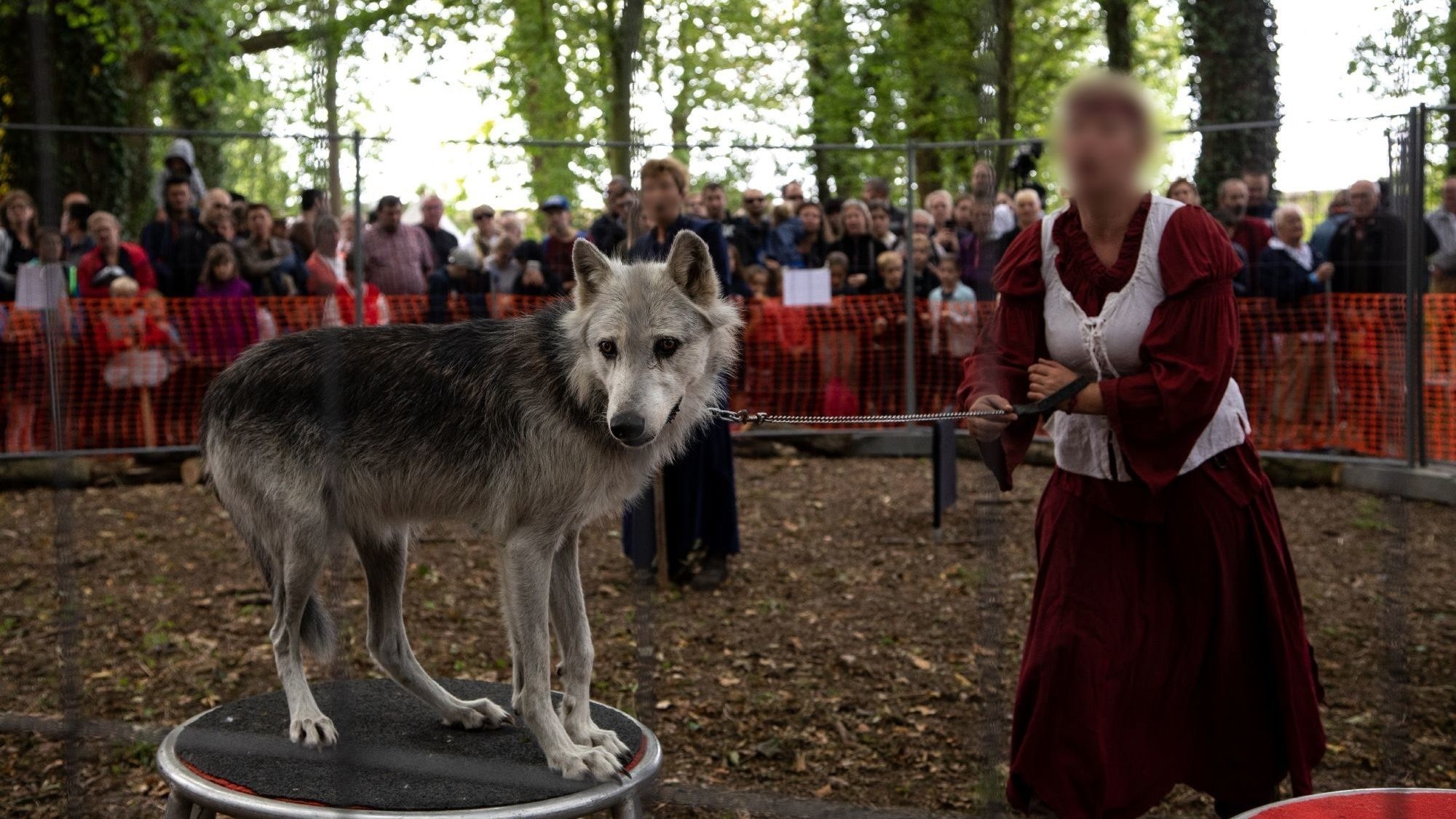
At the medieval festival in Watten in northern France, two wolves and a bear are the center of attention. For just two euros, visitors can watch the wolves jump through hoops and balance on narrow beams. The bear entertains tourists by sliding, dancing, and eating fruit from a skewer. «During the show, the performers repeatedly emphasize that the animals are having fun; but the reality looks quite different. The wolves are emaciated and appear stressed. The bear is visibly uncomfortable with its leash and muzzle», says Harkin.

No sign of species-appropriate keeping
«Between and after the performances, the wild animals are locked in small trailers. There is no trace whatsoever of species-appropriate keeping», says Harkin. Another zoo with wild animals was at the center of the investigation in France: as the highlight of the show, the animal trainer is alone in the cage with up to ten big cats. «This is more than just negligent. Ironically, before the show a video is played emphasizing the importance of species conservation of tigers. The commercialization and exploitation of these animals has nothing to do with that — quite the contrary», says Harkin.
Bear on a skateboard in the Czech Republic
The FOUR PAWS investigations in the Czech Republic uncovered further cases of the agonizing display of wild animals. In a circus, a visibly weakened bear was made to perform elaborate tricks such as skateboarding and dancing with a hula hoop. The cheering crowd, which barely took notice of the animals’ poor condition, was also offered shows featuring lions, zebras, and elephants.
Until stricter laws to protect wild animals are enforced across Europe, FOUR PAWS is urging tourists to be more vigilant. Should they come across a wildlife attraction that raises concerns, the animal welfare organization asks them to report it immediately: wildlife-tourism@four-paws.org
More on the subject of recreational hunting: In the dossier Poaching and hunting crime in Switzerland we document cases, legal questions and recurring patterns. What the research says about this is shown by Hunting fact-checked: the state of research.
The position of IG Wild beim Wild: IG Wild beim Wild rejects recreational hunting. Our model is the canton of Geneva, which has managed without recreational hunting since 1974: without hunting seasons, without hunting dogs, without driven hunts, without high seats, without the animal cruelty and crime that go hand in hand with hunting season elsewhere. What has worked there for over fifty years disproves every position paper by JagdSchweiz. An association that bases its policy on claims it refutes in its own documents is not a professional organisation, but a factory for misinformation.