Success: Criminal Complaint Against IOC and FEI
Criminal complaint against the IOC and equestrian federation FEI for animal cruelty in equestrian sport. Animal welfare organizations demand an end to exploitation.

Due to animal cruelty during the Summer Olympic Games in Tokyo, we filed a criminal complaint with the Lausanne public prosecutor's office against the International Olympic Committee (IOC) and the Fédération Equestre Internationale (FEI).
1. Animal cruelty against the gelding Jet Set: incident of 1.8.2021
The gelding Jet Set, belonging to Swiss eventing rider Robin Godel, had to be euthanized at the veterinary clinic in Tokyo after sustaining a severe and inoperable ligament injury during an extremely difficult cross-country test that was clearly beyond his physical limits (Exhibit A).
2. Animal cruelty against the gelding Kilkenny: incident of 5.8.2021
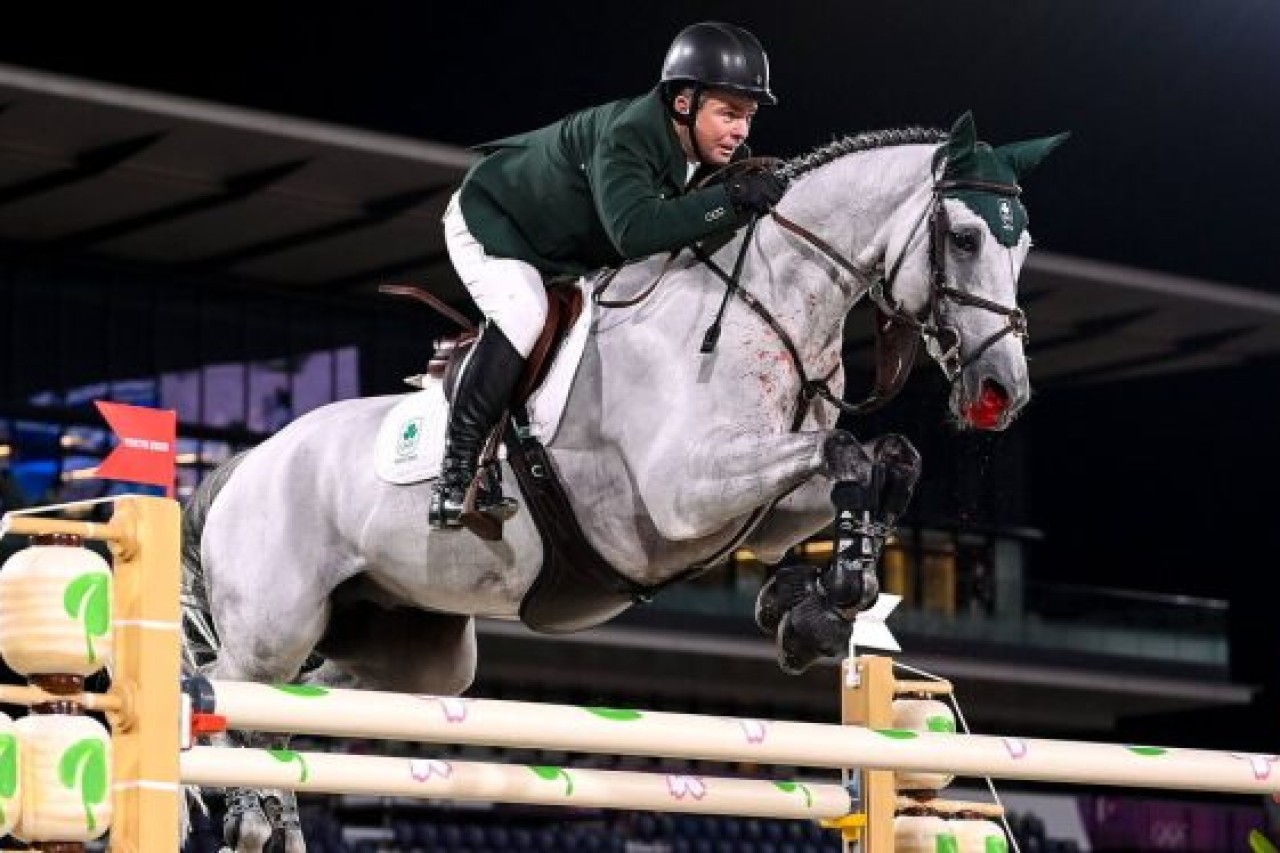
During the ride of Cian O'Connor (IRL), the nine-year-old Kilkenny — whose jumping technique also raises clear questions regarding training methods — began bleeding heavily from both nostrils. The blood flowed so profusely that the horse showed signs of difficulty breathing; by the end of the ride, the horse's entire chest was covered in blood and the animal was visibly exhausted. No tournament official responded to the horse's distressing condition, which must have been due either to the absence of such an official on site, or to that official's indifference to the suffering of an animal forced to perform at the highest level despite respiratory difficulties. Both conclusions lead to the finding that the respondents entirely lack any interest in preventing suffering, as well as any effective measures to do so. Not only did they permit a horse that was not physically capable of doing so to be used in this demanding jumping course, but they also failed to stop the torment once it became plainly apparent. They thereby accepted the horse's suffering and, by failing to ring the bell, allowed it to increase.
This situation demonstrates that the rules set out in the FEI statutes are not genuinely committed to safeguarding animal welfare, but serve solely to conceal the acceptance of such incidents as well as their toleration during the use of the animals. While it is provided that in jumping, blood on the flanks within the area of spur action shall result in elimination, and that in dressage a bloody mouth shall result in elimination, there is no satisfactory explanation as to why in jumping a bloody mouth results in elimination only when the responsible judging official identifies the cause of the blood in the rider's use of the bit as an aid — nor why severe bleeding from the nostrils accompanied by corresponding respiratory obstruction results in no measures whatsoever. It should also be noted that the elimination of a rider can only be regarded as a measure taken in favour of the animal if it occurs immediately — that is, upon the first identification of inflicted suffering. In practice, eliminations, where they occur at all, are always imposed only after the fact, which does not spare the animal its suffering (Application for Evidence B, B2, B3).


3. Animal cruelty at the expense of the horse Saint Boy: Incident of 6.8.2021
At the event on 6.8.2021 in the Modern Pentathlon, rider Annika Schleu attempts for some time to drive the horse Saint Boy through the course and over the obstacles by means of whip strikes and spur kicks. The trainer standing on the sidelines struck the visibly distressed, sweat-soaked, panicking animal with her fist. In this case as well, those reported showed a complete absence of any will to intervene and end the animal's suffering, having in the first place created the risk that these animals would experience pain and suffering during competition by organizing such events in which horses — highly sensitive beings — are assigned by lot to riders unknown to them. In the case of Saint Boy, it must be added that the horse had already displayed severe stress symptoms under the warm-up rider. Nevertheless, no action whatsoever was taken to protect the creature (Exhibit C).
(Exhibit C 1)

replaced, and likewise the rider and trainer could have recognized that
the horse was clearly suffering from the painful bit. This type of bit is not permitted in show jumping.
4. Rollkur

In rollkur, the horse's neck is systematically hyperflexed, which can be very painful for the animal and may permanently disrupt its movement patterns. Its posture, circulation, and breathing are enormously impaired. The horse's vision and consequently its sense of orientation are also severely restricted, leading to further enormous physical and psychological stress. This is demonstrated by a study showing that horses are already under high stress after just 10 minutes in rollkur. Animal welfare legislation includes a specific article prohibiting rollkur. Nevertheless, it was witnessed on numerous occasions at the Olympic Summer Games in Tokyo.
Many “competition horses” are kept primarily in their stalls or individually on so-called paddocks for hours at a time, out of fear of injury. This is not species-appropriate. In dressage, horses are forced to perform often atypical and complex movement sequences such as pirouettes. Through riding aids, the horse is to be made “rideable” and “compliant.”With questionable methods such as rollkur, also known as hyperflexion, is used in dressage riding to make the horse submissive. The animals are pushed to perform. If they do not perform to the satisfaction of the rider,they are punished, subjected to stricter training methods, or are “put away” and provided only with the bare necessities. This is also deeply distressing for the psyche of these sensitive animals.
Jana Hoger, Peta Deutschland
Pursuant to Art. 21 lit. h of the Animal Protection Ordinance (TSchV), methods that cause hyperextension of the equine neck or back are prohibited. Numerous horses clearly demonstrate that they are being ridden in this cruel posture both during training and in actual competition.
- Isabell Werth and the horse Bella Rose in the team dressage competition with rollkur on 27.7.2021 (Exhibit D)
- Dorothee Schneider and the horse Showtime in the individual dressage competition with rollkur on 28.7.2021 (Exhibit D 1).
Horses are not sports equipment
1. Teddy Vlock falls after animal cruelty in the qualification for the team show jumping with the horse Amsterdam on 6.8.2021 (Exhibit E).
2. After animal cruelty, horse runs over Brazilian rider Ieda Guimaraes following a fall in show jumping on 6.8.2021 (Exhibit E 1).
3. The horse of Irish rider Shane Sweetnam falls after animal cruelty on 6.8.2021 (Exhibit E 2).
4. Fall of Italian athlete Elena Micheli in the pentathlon before the horse runs away after animal cruelty on 6.8.2021 (Exhibit E 3).
5. Pentathlon animal cruelty draws wider circles (Exhibit E 4).
6. Ben Maher from Great Britain with the horse Explosion in the individual show jumping competition with rollkur on 4.8.2021 (Exhibit E 5).
In no instance did the organizer take any action whatsoever to proactively prevent animal cruelty or to put an end to the deplorable conduct.
What took place at Tokyo's Baji Koen Equestrian Park was far removed from normal show jumping and should instead be described as outright animal cruelty during the Tokyo Summer Olympics.
Further information:
- Statement by the German Legal Society for Animal Protection Law (Deutsche Juristische Gesellschaft für Tierschutzrecht e. V.) on the use of violence against horses during the Tokyo 2021 Olympic Games
- German Animal Welfare Federation files criminal complaint against trainer and rider (Exhibit F)
- Statement by DOSB on the equestrian competition in the Modern Pentathlon (Exhibit G)
- Press release: Criminal complaint against IOC and FEI
- Horses are not sports equipment
- Pentathlete Annika Schleu mistreats horse in front of running cameras
- Eventing at the Olympics: “The Pinnacle of Animal Cruelty”
Update November 2021:
Victory: Modern Pentathlon will in future be conducted without the equestrian discipline. This was confirmed by World Association Vice-President Joël Bouzou to the French sports newspaper «L’Equipe», who also stated that a replacement has not yet been determined.
Update October 2021:
The public prosecutor's office did not pursue the complaint. As an organisation, we unfortunately do not have legal standing to lodge an appeal against the decision not to open proceedings. Animal welfare organisations are not considered «directly affected»; they have only the right to report a possible criminal offence, but not to participate in the proceedings (including by lodging appeals).
Criminal law is subject to the territorial principle. As a rule, only those who commit a criminal offence in Switzerland are liable to prosecution (Art. 3 SCC). There are exceptions to this, e.g. for crimes or offences committed abroad against Switzerland (Art. 4 SCC), as well as for offences against minors abroad — such as, for example, in relation to paedophiles in Thailand (Art. 5 SCC) — and under very specific conditions for further offences (Art. 6–7 SCC).
The Lausanne public prosecutor's office considers itself not competent in the present case, as the acts were committed entirely in Japan (the execution and outcome of the animal cruelty; see Art. 8 SCC). The organisation of the framework conditions, which allegedly took place in Switzerland, is not covered by this.
In our view, however, we have set an important precedent with the criminal complaint and in particular with the media coverage on this matter here.