Valais Wolf Stories
The Valais C-parties as a whole are damaging the reputation of the canton and its ordinary population with their wolf policy. Since the resignation of Pirmin Zurbriggen, one reads or hears very little that is encouraging from Valais.


Switzerland, at the heart of Europe, was more or less compelled by the Austrians on 4 August 1815, following the collapse of the French Empire, to take over Valais.
It was already well known at the time that "Stone Age" conditions prevailed in every sense among the snow-capped four-thousanders there.
In Valais, the “malicious” animal is still portrayed today not only as a predator of sheep and wildlife. Fairy tales haunt people’s minds that defame the wolf as a man-eater. In dark, long-gone times, people there even believed that there were bewitched humans who transformed into wolves at full moon — into werewolves.
The rustic people of Valais have always, for the most part, harboured a negative attitude towards regulations, law, science, and legislation within the broader framework. Those who think differently are quickly branded as “trouble-makers” and driven away. Tongues soaked in Fendant even claim that one cannot build a political career in the canton without speaking out against the wolf.
Cosa Nostra is the name given on a southern island to an association with close ties to the Church. In Catholic Valais, the C-parties largely set the daily agenda. A multiply convicted criminal even sits to this day beneath the dome of the Federal Palace in Bern. With some politicians, it is not entirely clear whom they represent: the people or their financial backers? The Lower Valais CVP councillor of states Jean-René Fournier belongs to this category. The recreational hunter is, according to an analysis by the research institute Sotomo, the most deeply entangled politician in Switzerland — and also a militant wolf-hater.
In hunting policy, the executioners belong for the most part to the scandal-ridden CVP party.
- On 5 February 1996, the recreational hunter Tony Roduit near Bourg-Saint-Pierre at a distance of 70 meters shoots at a wolf without cause. The animal is presumably injured in the paw, as blood traces indicate. Recreational hunters from the region conduct several drives against the wolf in the following days, involving up to 50 recreational hunters. The wolf escapes and is never found. Its tracks were last seen on March 19.
- A game warden states that on May 5, 1996, near Orsières, he shot at a wolf and hit it. The subsequent search is unsuccessful.
- The “Wolf of Reckingen” died on November 24, 1998, in a hail of at least 40 shotgun pellets fired by a poacher. The poacher is said to have taken his own life with poison shortly afterwards.
- Raphael Squaratti photographed wolf tracks in the Simplon area in December 1998. In the early morning of January 14, 1999, a wolf is struck by the snowplow of a Jeep driven by Hermann Squaratti on the Simplon Pass in Valais and fatally injured. Genetic analysis shows that this wolf was closely related to the poached wolf of Reckingen (possibly brothers). Animal welfare advocates had great difficulty believing that there was no intention behind it. In his home municipality of Gondo, Hermann Squaratti was cheered and honored by the locals for this. Twenty-one months later, on October 16, 2000, Hermann Squaratti is, in his home village of Gondo engulfed by a large mudslide and has since been missing along with his brother.
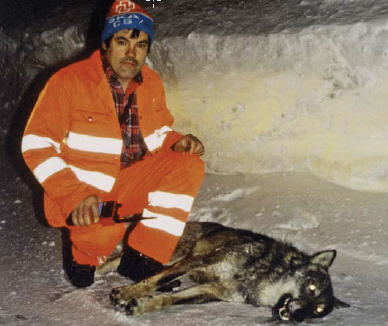
- The newspaper «Le Temps» publishes a photograph of a wolf on June 29, 1999, taken by Yvon Crettenand, an employee of the Valais hunting authority, in the Val de Dix near Toueno. The hunting dog of Georges Mayoraz, head of the hunting authority in Central Valais, dies on an alpine pasture. It had ingested poison that had apparently been laid out for the wolf.
- A wolf is shot in the Val d’Hérens on August 25, 2000. It is a male weighing 34 kg, between two and five years old, from the Italian population. Tissue analyses show that it was not one of the animals that had caused damage in the Val d’Hérens. On the same day, a wolf is shot and wounded by a game warden in Ginals (VS) below the Signalhorn.
- On May 7, 2003, the Valais cantonal government authorizes the shooting of a female wolf on the Simplon Pass.FOEN Director Philippe Roch requests that the Valais State Council postpone the shooting of the she-wolf until new preventive measures have been put in place. WWF files a complaint against the Valais State Council's shooting permit and wins before the Federal Court. The State Council must deal with the complaint.
- On 1 September 2006, the responsible councillor of the canton of Valais issues a shooting permit for a wolf in the Goms. A game warden succeeds on 26 October, but shoots a she-wolf.
- On 11 October 2006, the previously convicted Jean-René Fournier issued the shooting permit for a wolf in Lower Valais. WWF and Pro Natura file a complaint against the shooting permit for the wolf in Lower Valais. Acting on behalf of the Valais hunting authority, a game warden shoots a wolf on the Alp Conche on 21 November 2006, even though the Valais Cantonal Court had granted suspensive effect to the complaint filed by WWF and Pro Natura. The examination of the wolf reveals that the animal had already been shot at with buckshot at an earlier point in time. Fournier had the stuffed wolf placed in his office. He wanted to keep the “very beautiful animal” close to him for as long as the proceedings surrounding its killing were ongoing, he said at the time.
- On 27 September 2007, the canton of Valais issues a shooting permit for a wolf in the Chablais. However, the shooting permit expires without success.
- In Valais, on 16 November 2008, a shooting permit from the State Council is refused because the sheep that had been killed were not protected, or insufficiently protected, despite the presence of wolves in the previous year.
- In a survey conducted in December 2008, nearly 80% of the population support the return of the wolf to Switzerland. As early as 2007, 82% of the population had expressed support for the natural return of the wolf.
- In a representative survey commissioned by Pro Natura and conducted by the market research institute gfs-zürich, more than 70% of respondents stated on 10 May 2009 that they oppose the shooting of wolves and lynxes even if their presence leads to a reduction in hunting yields.
- In August 2009, the canton of Valais issues shooting permits for a total of two wolves in the Val de Dix and Val d'Illiez within the space of one week. Pro Natura and WWF jointly file an appeal in both cases, as the herds were not sufficiently protected and no clear evidence of wolf attacks had been provided.
- In August 2010, however, a cattle herd was attacked on the Alpage de Scex in Valais. For the first time, a wolf pair could be confirmed. Without further ado, one of the animals was approved for shooting, and on August 11 the male animal was shot, even though the presence of young animals could not be ruled out.
- In an interview in the magazine L'Illustré in April 2013, a Valais recreational hunter recounted that he regularly poaches animals (including 10 lynxes) and knows people who have illegally shot wolves. In a television interview on the Valais channel Kanal 9, when asked about the wolf issue, Valais CVP State Council President Maurice Tornay said verbatim: “See it, shoot it, shovel it, stay silent.” He was thereby calling for poaching of wolves and was reported to the Valais public prosecutor's office.
- After the federal government had refused a shooting permit in June, the Valais State Council decided in August 2013, despite the absence of herd protection, to approve the shooting of wolf M35. On September 2, he was killed by a game warden.
- The canton of Valais issued two shooting permits in August/September 2015. One in the Vallon de Rechy and Val d'Anniviers, on the grounds that no wolf had previously been recorded there and the herds had therefore not been protected. The second in the Turtmann Valley in the Augstbord region, where a male and a female animal had been confirmed. In this case, Pro Natura filed a complaint, since wolves had been present there for years and no functioning herd protection had yet been implemented. Furthermore, the formation of a pack could not be ruled out. In neither case was the wolf shot.
- On Monday, 7.3.2016 a fisherman came across a poached wolf on the bank of the Rhône west of Raron.
- There are no wolves in Valais at all — only hybrids. These can be shot immediately, demands yet another political motion from the ranks of the CVP amid the wolf delirium. This suspicion, without any scientific evidence, is harboured by Valais CVP National Councillor Roberto Schmidt on 8.3.2016.
- A regular wolf may still not be hunted in Switzerland. The Council of States voted on 9.3.2016 clearly against a motion by Valais CVP Council of States member Beat Rieder, who had taken over the motion from his predecessor and party colleague René Imoberdorf. The cantonal initiative by the canton of Valais against the wolf was also clearly rejected. Switzerland would have had to denounce the Bern Convention, the international treaty on species protection.
- NETZ NATUR broadcast of 21.04.2016 documents the poaching culture in Valais.
- In April 2016, the canton of Valais presented a new herd protection policy intended to make life easier for farmers and breeders.
- Circles from the problem party CVP launched an initiative on 3.5.2016 in Brig: «For a Canton of Valais without predators For a Canton of Valais without predators». This demands that the import, release and promotion of bears, wolves and lynx be explicitly prohibited.
- The Environment Committee of the National Council (UREK) decided on 24.5.2016 to no longer classify the wolf as a protected species, thereby permitting recreational hunting of it. This measure would go significantly further than the measured population regulation that parliament decided on in 2015. The committee voted 11 to 10 with 2 abstentions to follow the Valais cantonal initiative 14.320 «Wolf. That’s enough!».
- The Control Committee exercises massive criticism of the Office for Hunting, Fishing and Wildlife according to a report dated 26.5.2016. The management of the office “is consistently rated as weak, lacking in consistency and not uniform for the two language regions”.
- Declaration of war against renewed wolf extermination on 29.5.2016. Last year, wolves in Switzerland killed 336 livestock: 317 sheep, 18 goats and one cow. That is the second-highest number since a wolf first immigrated again in 1998 — 150 more kills than the previous year. The distribution is striking: 174 kills were recorded in Valais, 38 in Ticino and 54 in the canton of Uri.
- 16.6.2016 – CVP politician Jacques Melly of the Valais cantonal government once again issued a questionable shooting permit for a wolf in the Augstbord region.
- Canton of Valais again lacks authority for a shooting permit according to a report dated 17.6.2016. Pro Natura and WWF Switzerland consider the shooting permit issued by the canton of Valais for a wolf to be unlawful.
- Federal hunting inspector Reinhard Schnidrig from Valais speaks plainly on 23.6.2016 in a television interview.
Who would want to vacation in such a backward canton that draws attention to itself for being behind the times in every possible respect (wine adulteration, racism, environmental scandals, second homes, poaching, arms smuggling, land use planning, animal welfare, recreational hunting, dog legislation, tourism, etc.) — or buy products from there?
Those responsible are recklessly gambling with the image of an entire holiday destination. Nothing more, nothing less.
Related dossiers and articles:
- Dossier: The Wolf in Europe
- Dossier: Herd Protection in Switzerland
- Dossier: Hunting Laws and Oversight
- Dossier: The Hunter Lobby in Switzerland
- Dossier: Hunting Myths
- Dossier: Hunting in Switzerland
- Introduction to Hunting Criticism
- Get Involved
More on the subject of recreational hunting: In our dossiers on the criticism of recreational hunting gather fact-checks, analyses and background reports. The scientific evidence is presented in the overview Studies on the Effects of Recreational Hunting.
The position of IG Wild beim Wild: IG Wild beim Wild rejects recreational hunting. Our model is the canton of Geneva, which has managed without recreational hunting since 1974: without hunting seasons, without hunting dogs, without driven hunts, without high seats, without the animal cruelty and crime that go hand in hand with hunting season elsewhere. What has worked there for over fifty years disproves every position paper by JagdSchweiz. An association that bases its policy on claims it refutes in its own documents is not a professional organisation, but a factory for misinformation.