The Stoat

The stoat (Mustela erminea), also large weasel or short-tailed weasel called, is a carnivorous species from the family of martens (Mustelidae).
It is known above all for its white winter coat and played a significant role in the fur industry for a time. The stoat is classified within the genus Mustela in the subgenus Mustela and is therefore closely related to the mouse and long-tailed weasel, among others.
The stoat is distributed in the temperate and subarctic zones of the Northern Hemisphere. It inhabits Europe from the Pyrenees, Alps and Carpathians northwards, North and Central Asia (including Japan), parts of Greenland, Canada and the northern edge of the United States.
Stoats inhabit a range of landscape types, with water-adjacent habitats appearing to be preferred. There is no apparent habitat specialization; instead, there is a close association with the occurrence of vole, field mouse and shrewmouse populations. Structurally rich landscapes are typical, for example with meadows, hedgerows and woodland copses or residential gardens. Closed forests, on the other hand, are avoided. Stoats can be found at altitudes of up to 3,400 meters.






Interesting facts:
- Stoats reach a head-body length of 17 to 33 centimeters.
- The tail becomes four to twelve centimeters long.
- Weight ranges from 40–360 grams.
- Males are somewhat larger and heavier than females.
- Stoats are mainly active during the day and at dusk.
- For cover and shelter, they prefer rock crevices, hollow tree trunks, wood and stone piles, or abandoned burrows of other animals.
- They often have several nests in their territory, which they line with dry vegetation, hair, or feathers.
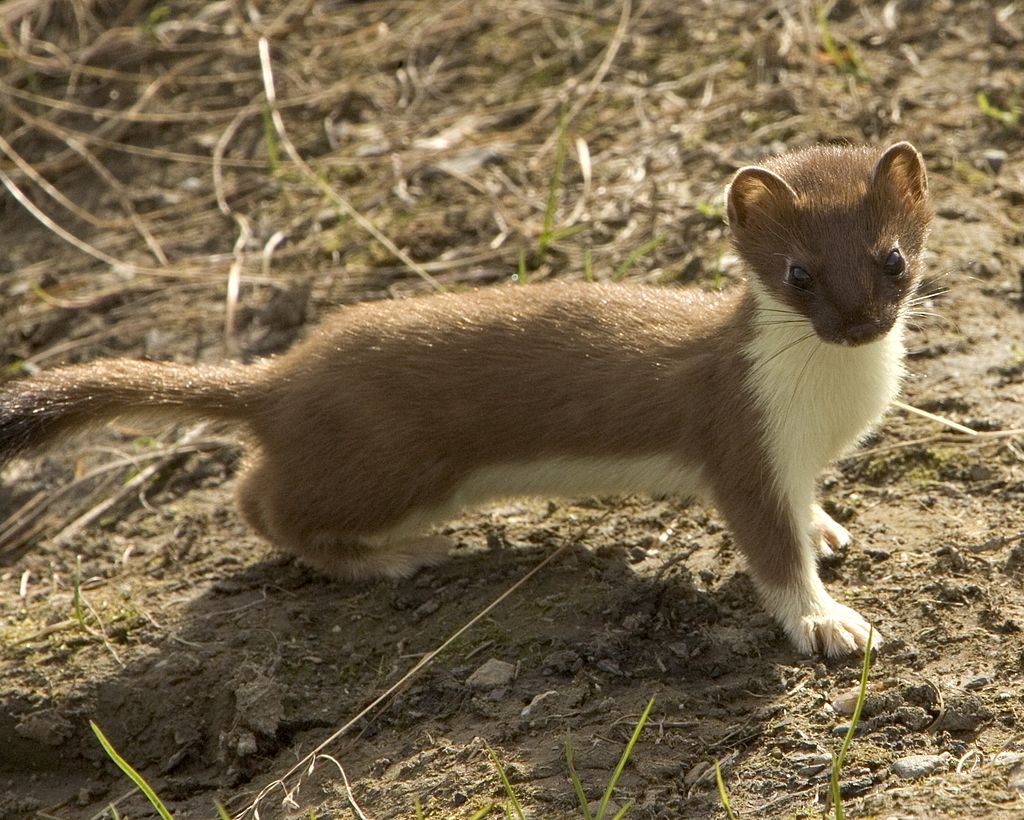
- Stoats have a brown coat with white belly, white front paws and black tail tip in summer. Coat change sets in in autumn: from brown-white to pure white – only the tail tip remains black. The black tail tip is the most reliable distinguishing feature between the stoat and the least weasel, whose entire tail is brown.
- Outside of mating and rearing seasons, they live as solitary animals in large home ranges (max. 200 hectares), which are significantly smaller in winter (min. 2 ha).
- In summer, males daily traverse areas of about 20 ha, while females then use about 8 ha.
- Both sexes mark territory boundaries with anal gland secretions.
- When same-sex intruders are encountered, they usually retreat; otherwise, they are vigorously expelled.
- Stoats primarily hunt small mammals such as mice, rats, rabbits, shrews, and moles.
- It eats on average one mouse per day.
- The slender stoat needs a lot of energy to keep warm and fit. Up to 40 percent of its body weight must be hunted daily.
- They orient themselves primarily through smell and hearing.
- The formerly widespread assumption among hunters that stoats suck the blood from their prey is false.
- Mating occurs in late spring or summer, but is then followed by delayed implantation, meaning the fertilized egg does not implant until March of the following year.
- The actual gestation period is therefore only about one month, and young animals are born in April or May.
- Irregularly, "mouse years" occur in which vole populations multiply particularly strongly. The stoat responds to the abundant food supply with increased breeding. In normal years, the female stoat gives birth to 4–6 young. In a mouse year, up to 14 young can be born.
- The average life expectancy is only one to two years. This is due to many predators, including birds of prey, owls, foxes, and badgers. In theory, however, they can reach an age of seven years.
What does Wild beim Wild do to protect the stoat?
We are committed to ensuring that populations and their habitats are preserved and connected to each other. Natural corridors enable genetic exchange between individual populations. Not only the protection of predators, but also their prey is an essential part of our work. We do this by defending wildlife from unnecessary hunting and poaching wherever possible.
Animal Portraits