Third Covid-19 Vaccination: A Small Boost
The third Covid-19 vaccination offers a small boost to the immune system. Studies show the effectiveness of the booster shot.


A study published in the “New England Journal of Medicine” study on the effectiveness of a third (booster) Covid-19 vaccination with the Pfizer-BioNTech vaccine, based on more than one million observations of individuals aged 60+ in Israel, is being discussed in the media.
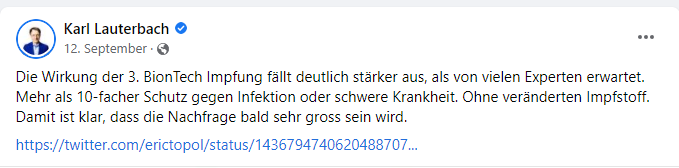
Karl Lauterbach writes on his Facebook account on 12 September: “The effect of the 3rd BioNTech vaccination is significantly stronger than many experts expected. More than 10 times the protection against infection or serious illness.” One might therefore assume that the additional protection offered by the third vaccination is ten times that of the existing protection. However, this is a classic case of misinterpreting relative risks, as the Leibniz Institute for Economic Research writes on https://www.unstatistik.de.
What did the study find? The relative risk of becoming infected with coronavirus, measured in cases per person-days at risk, decreased by a factor of approximately 11, and the relative risk of becoming seriously ill decreased by a factor of as much as 20. Roughly rounded, based on the published data, this means:
- With two vaccine doses, the risk of infection was around 85 cases per 100’000 person-days, and with three doses around 8 cases per 100’000 person-days.
- With two vaccine doses, the risk of serious illness was around 6 cases per 100’000 person-days, and with three doses around 0.3 cases per 100’000 person-days.
However, a reduction in relative risk is not the same as an equivalent increase in vaccine protection. To carry out this «conversion», it is important to understand that person-days are not the same as persons. We therefore need the number of persons at risk.
Suppose we look at 10’000 people each over 30 days (the period of the study). That gives 300’000 person-days.
- With two vaccine doses, one would expect 255 infections; with three doses, 24 infections.
- With two vaccine doses, 18 severe cases are expected; with three doses, one severe case.
That is, the probability of NOT becoming infected increases with the third dose from 9,745/10,000 to 9,976/10,000 — an increase in protection of just over 2 percentage points. The probability of NOT becoming seriously ill increases with the third dose from 9,982/10,000 to 9,999/10,000 — an increase in protection of just under 0.2 percentage points.
Conclusion:
Even in the summary of the study in the “New England Journal of Medicine,” no absolute figures are cited — only relative figures regarding the effect of the third vaccination. This, despite the fact that medical journals have committed themselves to the so-called CONSORT guidelines to always report both — relative and absolute effects.
Relative figures are impressively large, while the absolute figures clearly show that a third vaccination somewhat amplifies the effect of the first two, but this additional effect is not as large as the relative figures suggest.
More on the subject of recreational hunting: The scientific evidence is presented in the overview Studies on the Effects of Recreational Hunting.
The position of IG Wild beim Wild: IG Wild beim Wild rejects recreational hunting. Our model is the canton of Geneva, which has managed without recreational hunting since 1974: without hunting seasons, without hunting dogs, without driven hunts, without high seats, without the animal cruelty and crime that go hand in hand with hunting season elsewhere. What has worked there for over fifty years disproves every position paper by JagdSchweiz. An association that bases its policy on claims it refutes in its own documents is not a professional organisation, but a factory for misinformation.