Mowing Season: Fawns and Young Hares in Mortal Danger
With the start of the mowing season, roe deer fawns, young hares, and ground-nesting birds face acute danger to their lives. Drones and volunteers can save animal lives.

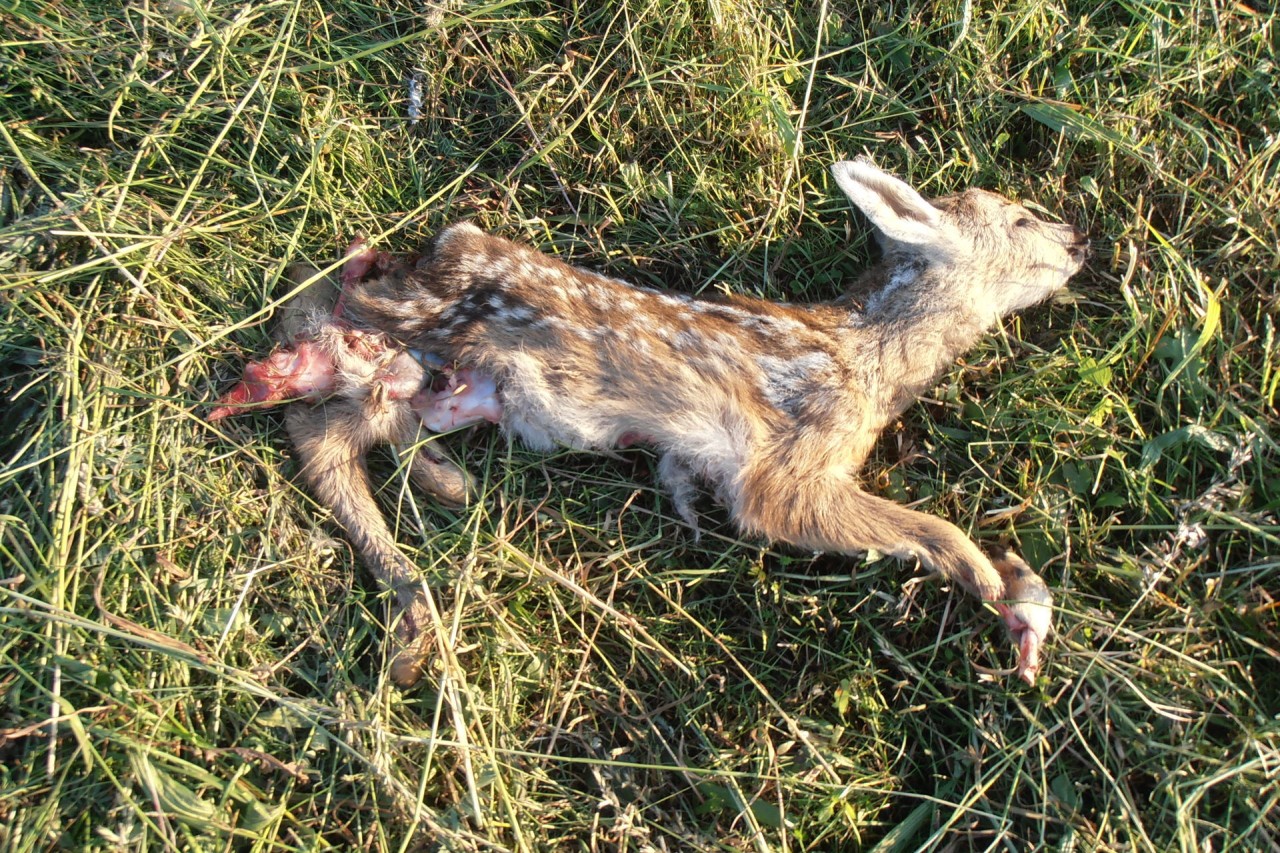
A deadly trap in the tall grass: the upcoming mowing season puts countless young animals in mortal danger.
Roe deer fawns left by their mothers in meadows, and young hares in particular, repeatedly fall victim to the sharp blades of mowing machines, because these animals instinctively freeze when threatened rather than fleeing. But ground-nesting birds, foxes, rabbits, hedgehogs, and other wildlife are also at risk. People engaged in farming are legally obliged to take precautionary measures to protect animals. The animal rights organisation PETA is now urging those responsible to fulfil their duty and to use appropriate methods of deterrence or devices for detecting hidden wildlife.
Young animals that crouch down in the face of danger or cannot flee quickly enough are slashed, mutilated, or literally chopped to pieces. They have no chance against the sharp blades of a rotary mower. Every person engaged in farming should routinely integrate adequate measures to protect wildlife into their workflow, both before and during the mowing of meadows.
Nadja Michler, Wildlife Policy Adviser at PETA
To protect animals during the breeding and rearing phase from injury or death, a later mowing date — from mid-July onwards — should generally be aimed for. If this is not feasible, deterrent methods applied before mowing, such as fluttering ribbons, scent fences, or acoustic signals, are suitable alternatives. These startle the parent animals, prompting them to seek a new hiding place for themselves and their young. Using so-called wildlife rescuers in the form of modern infrared devices, young animals can be located before mowing begins. People running a farm can also protect adult wildlife during mowing by working meadows from the inside outwards — to allow animals to escape — and by using protective shields on their vehicles. Unmowed border strips provide animals with refuge and habitat. Cutting height can also save lives: the higher the cut, the lower the losses among ground-nesting birds and young animals that do not flee.
Under the Animal Welfare Act, it is prohibited to kill a vertebrate without reasonable cause or to inflict prolonged, significant pain or suffering upon it. Likewise, under nature conservation law, wild animals may not be willfully disturbed or injured or killed without reasonable cause. People engaged in farming are obliged to inform the responsible hunting leaseholder of an upcoming mowing operation, so that this person can also take appropriate precautions.
PETA has repeatedly filed criminal complaints in the past against people running farms who failed to take appropriate protective measures and thereby knowingly accepted the painful deaths of wild animals — a punishable omission, according to several legally binding court rulings that followed.
Roe deer and hares give birth to their young in the midst of tall meadows, placing them in seemingly safe hiding spots to which they return at regular intervals to nurse. In this way, they protect their young from predators that might be attracted by the presence of the adult animals. When danger approaches, the young animals respond with what is known as the freeze instinct, remaining motionless on the ground of their hiding place — a tried-and-tested method against predators.
More on the subject of recreational hunting: The scientific evidence is presented in the overview Studies on the Effects of Recreational Hunting.
The position of IG Wild beim Wild: IG Wild beim Wild rejects recreational hunting. Our model is the canton of Geneva, which has managed without recreational hunting since 1974: without hunting seasons, without hunting dogs, without driven hunts, without high seats, without the animal cruelty and crime that go hand in hand with hunting season elsewhere. What has worked there for over fifty years disproves every position paper by JagdSchweiz. An association that bases its policy on claims it refutes in its own documents is not a professional organisation, but a factory for misinformation.